
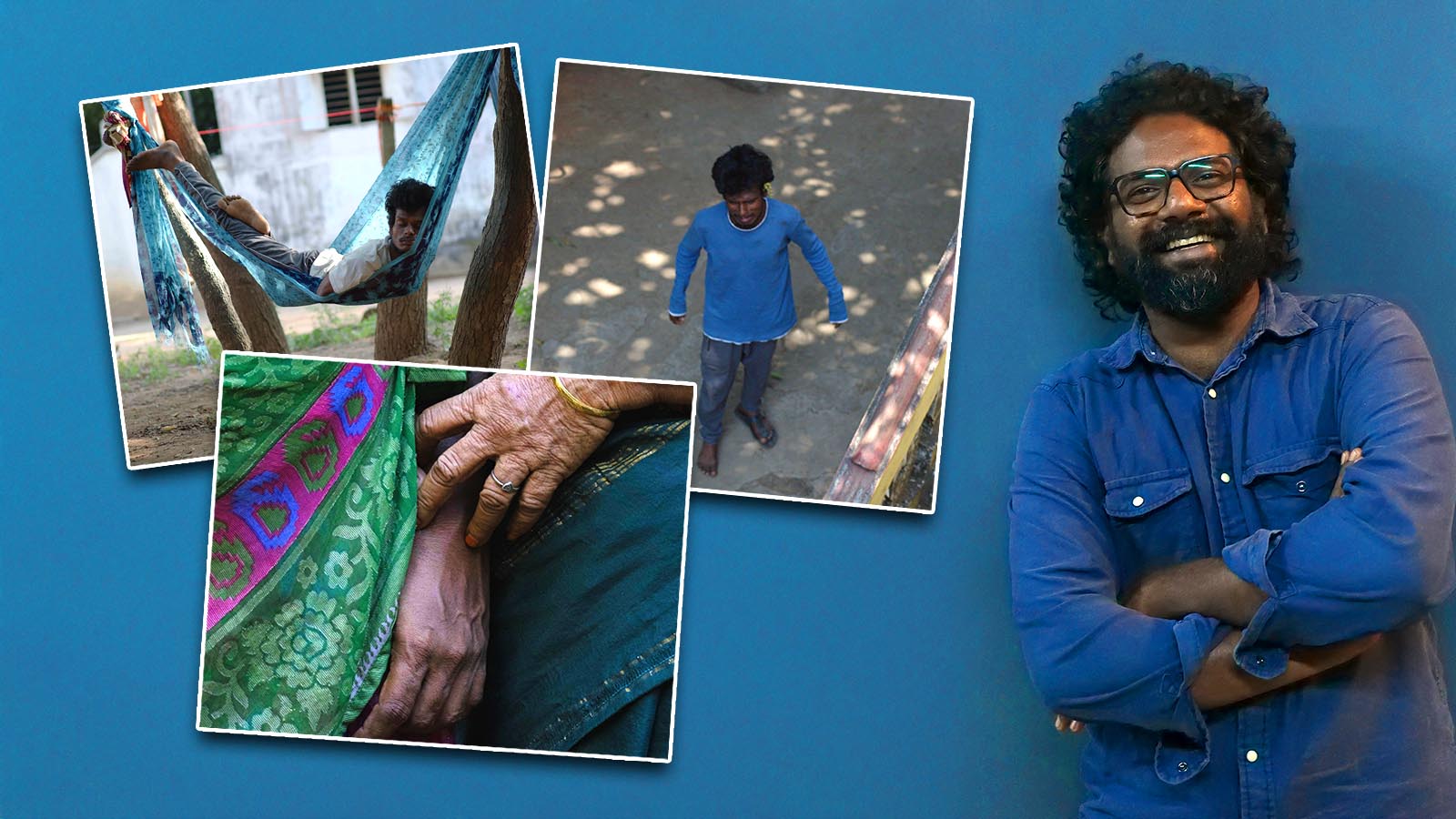
R. Gowtham on his Tamil film, Members of the Problematic Family, and why identity is art-based

R. Gowtham’s Members of the Problematic Family marks the first time that a debut feature by a director from Tamil Nadu has been selected for the Berlinale, and the fourth after Mani Ratnam’s Alaipayuthey (Ebbs and Flows of the Waves, 2001), Ameer Sultan’s Paruthiveeran (Hero of Paruthiyur, 2008), and PS Vinothraj’s Cabbage (The Adamant Girl, 2024). The film is about the death of a young alcoholic, the funeral rituals that follow, and the ripples they create in the extended dysfunctional family.
Members of the Problematic Family (Sikkalana Kudumbathin Uruppinargal) comes together through several scattered conversations and finds a unique voice and essence in its fragmented storytelling. The jump-cut guy, as Gowtham calls himself, is a self-taught filmmaker. He spoke to The Federal about all that went into the making of the film, his deep passion for cinema, his acknowledgment of filmmaking legends, and spotlighting traditional Tamil Islamic music. Excerpts:
Members of the Problematic Family is your debut feature film and it has made it straight to Berlinale, one of the five top festivals in the world. Tell us a bit about your journey into filmmaking.
I was into theatre, street plays, and mime during my college days. I had zero percent attendance in college. I never went to classes; I was immersed in these cultural activities. After college, I thought of preparing for competitive examinations. My ambition was to become a civil servant. I worked at an NGO managing rural programmes. Later, I joined the Asian College of Journalism (ACJ), doing research on media. I was never into films — my juniors were. I started by watching movies on a computer. It was at ACJ that I began dabbling in the short documentary format, which gave me confidence. Meanwhile, the appreciation for P.S. Vinothraj’s Koozhangal (Pebbles2021) made me realise that it was time for me to take up filmmaking.
How much have you drawn from your own life for your first film?
It bears a semblance to my life, but it is not my life. I try to detach a lot. I feel the film has to reflect me, but it shouldn’t replicate the incidents of my life. There has to be objectivity. I never succumbed to alcohol the way my protagonist does. I didn’t resort to the violence depicted in the film. I was lucky. I was pampered; I had friends.
So it’s the characters and situations around you rather than yourself?
I have been watching the world around me for a long time. I can’t say I was observing, because when you observe, you process. I wasn’t doing that. It was a kind of empty watching, what kids do. Not even kids; dogs do it too. They sit on a balcony and watch. That’s how I have been watching for a long time.
Also read: Semmalar Annam on how Mayilaa, her Tamil film, depicts the travails of a rural woman
So it was those moments that came back to me when I started writing. They surfaced, leapt up, and stood in front of me. I didn’t know I had them in my mind. I don’t keep a hard disk or memory cards. I don’t store anything — images, selfies. It can be very painful to lose them. So it surprises me when things return. I usually don’t forget those moments; I incorporated them into the scenes.
In the credits you have acknowledged a set of ace filmmakers from across the globe. How did world cinema come to you and how did these filmmakers influence you?
The Pirate Bay and Torrents were our go-to platforms. Back then, it would take two days to download a film. Even an 800 MB file — anything under 1 GB — would take a full day Tamil filmmakers Vetri Maaran, Mysskin, Ram, and Balu Mahindra were all into film appreciation. They were teaching people how to watch a film. I was with Mahindra for a long time before he passed away. I would go wherever he went. I followed him obsessively. Any name he mentioned, I would seek out that filmmaker’s work.
Tamil writer Charu Nivedita wrote an extensive book on Latin America, Towards a Third Cinema. That helped us a lot. Filmmaker-cinematographer Chezhiyan wrote about world cinema in the Tamil weekly Ananda Vikatan. So we would read, download, and watch. There was material available, and the environment was right. We would look up directors, study their profiles, and track down their films. Andrei Tarkovsky was the first. I also watched Federico Fellini and Charlie Chaplin. They were like a syllabus for us. But we would still watch the first-day, first-show of mainstream Tamil films. Diwali was movie day; I would watch three or four in a row.
How did you absorb them in your own filmmaking considering you are a self-taught filmmaker?
I don’t dissect movies, but I prepare a great deal before watching one. I set things up and switch off my phone. Once I watch a film, it stays with me for a long time. I don’t watch YouTube filmmaking tutorials. It was the masters who helped me most: Tarkovsky’s Andrei Rublev (1966), Fellini’s 8½ (1963), Vetri Maaran’s Aadukalam (2011), Anurag Kashyap’s Black Friday (2004), and Vishal Bhardwaj’s Shakespeare Trilogy.
I would watch films and discuss their commonalities, how characters move from frame to frame. That’s how I learned, not by analysing how a shot was taken or how a frame was constructed. Tarkovsky is God to me, and so is Yasujiro Ozu, whom I discovered very late. Everybody watches Akira Kurosawa, but Ozu had a profound impact on me, especially Floating Weeds (1959), which is my number one film.
The aftermath of the death of a young alcoholic, Prabha, forms the subject of the film. Then there is the offbeat, scattered structure, the unconventional storytelling and non-linear narrative.
When I was writing, I thought the script was very strong. But during the direction, I became very dismissive of it. By the time I reached the editing stage, I felt the shoot had not been up to the mark and that we would have to salvage things in the edit. Until the end of post-production, there is always a chance to improve and improvise.
Also read: Mahesh Narayanan on Patriot and how a filmmaker understands politics as human struggle
The element of the sketchy, the incomplete, the doubtful, that’s the key. I’m a very poor storyteller. My narration has to be jumpy, the way I speak. So there are only fragments. I discovered there is a term called anti-Aristotelian storytelling. I thought, let’s be anti. No neat action-reaction chain. No permutations and combinations, no mathematical formula. We never wanted that. I just wanted to show glimpses from the lives of a few people, without forcing them to signify anything.
Many people told me you shouldn’t start a film with a funeral; it’s inauspicious. Leo Tolstoy’s The Death of Ivan Ilyich (1886) begins with an elaborate funeral, but Kurosawa’s Ikiru (1952), which is based on it, does not. I wondered how Kurosawa reconceived it from the book. I watched Ikiru after I had written my script. I was certain my film had to be distinct; it shouldn’t carry traces of any other film.
Karuththadaiyaan, who played Ganapathy, the father, in Koozhangal, is your lead. Was the cast and crew largely drawn from your own circle of friends? Did you use non-professional actors too?
We have senior actors like Yuvasri, who was in R.K. Selvamani’s Captain Prabhakaran (1991). We tried to get a few names who backed out so I was forced to cast some local people. My own family members, actors and crew helped me a lot. The art director has done a cameo, my assistant director plays an important character, Mugil. Ara. Ajith Kumar is from Koothu-P-Pattarai theatre group. He plays Prabha, the young alcoholic who passes away. He is a trained, physical actor. We chose him because he can stay dead for two-three days.
There’s a universality to the dysfunctional family and a sense of injustice and anger that propels its members. But there is a specificity when it comes to the depiction of the place, community, culture, and its rituals, especially to do with death.
We have located the film in the OBC community. They are not socially marginalised. In fact, they carry a certain pride in seeing themselves as part of a ruling bloc. Economically and educationally, they are catching up.
The suburbs of Chennai are filled with people who migrated from the southern districts of Tamil Nadu and have been settled here for 30 or 40 years. Their children were born here, yet they don’t consider it home. They return to their villages at least once a year, carrying a fixed memory of that place in their minds. It’s similar to my own family history. My grandparents were from the deep South. They went to Myanmar, where my mother was born, and then returned to India. They were always straddling places, carrying memories and identity conflicts.
I relate more to Tarkovsky or Alejandro Jodorowsky. I often say I could cast Jodorowsky and David Lynch as my grandfathers in a film. For me, identity is art-based; there is nothing biological about it. Anurag Kashyap, Mysskin, Aki Kaurismäki, and Pa Ranjith are like maternal uncles. Vetri Maaran and Tarkovsky are father figures. Pa Ranjith is like an elder brother. That’s how I relate to people. Claire Denis and Chantal Akerman have been major influences. In the final DCP of the film, I included Denis’s Nice work (1999) in the acknowledgments. How could I have missed it!
For me, Karuththadaiyaan is like an Indian Denis Lavant. I would say he has the face of Toshiro Mifune, Mifune’s physicality, and shades of Klaus Kinski and Willem Dafoe. He is a composite of all of them. If he continues like this for the next 20 years, he could be in their league. There are no boundaries. It is completely boundaryless.
You have also paid tribute to Tamil poetry, spotlighted traditional Tamil Islamic music, and referenced the mosque and dargah at Chennai’s Stanley Hospital, as well as poet Sabarinathan and lyricist Isaimurasu Nagore Hanifa.
I was born in Mayiladuthurai, very close to Nagore, the coastal town known for the famous Nagore Dargah, a site associated with interfaith harmony, and Hanifa’s birthplace. The region has a rich musical tradition. My childhood was shaped by hearing those songs.
Also read: Mayasabha review: Tumbbad director Rahi Anil Barve’s new tale is beguiling and testing
Hanifa was also an important leader in the Dravida Munnetra Kazhagam (DMK). He sang for Kalaignar M. Karunanidhi and for the broader Dravidian movement. Last year marked his birth centenary. Those songs are woven into our lives. Many of the tunes have been remixed for mainstream films.
Recently, I met a 94-year-old man, Abu Bakr, who used to play the tabla for Hanifa. It was part of a musical collective that never received the spotlight of reality shows or commercial platforms. I felt compelled to introduce Hanifa to a global audience. You could call it Tamil qawwali or Sufi music. It is less religious and more spiritual, closer in ethos to Kabir.
What after this film? Are there ideas playing in your head already?
One of the articles mistakenly wrote the title of this film as Members of the Problematic Society. Coincidentally, that’s the title of the sequel I am planning for this film.
How would you assess the Tamil indie cinema right now?
We have always wanted to be famous filmmakers. When you do an indie film, you will not be known to people. So, how do you negate that and make a film? That’s a challenge for young filmmakers. There is a set of filmmakers who want to do indie movies, tell their own stories, and find their own voice. The seed was sown long ago but the journey has been long and tough. Things have been moving of late. There are a bunch of like-minded filmmakers. We have been talking to each other. Pa Ranjith’s Neelam Productions is supporting filmmakers. Vignesh Kumulai’s the tent premiered in Rotterdam. He is the cinematographer of Koozhangal. There’s Abdul Aziz, Aravind Siva’s The Tablet, Semmalar Annam’s Miles. But the distribution on OTT platforms is elusive. We don’t have a market and that makes it very difficult.

Comments are closed.