
Vijay’s loan waiver masterstroke successful! Which farmers will get its benefit? What will be the impact on the state treasury?

Tamil Nadu Elections Results 2026: The decades-old dominance of DMK and AIADMK in Tamil Nadu politics is now facing a new challenge. South Indian cinema superstar Vijay Thalapathy has made a political move through his new party, ‘Tamilaga Vetri Kazhagam’ (TVK), which has created a stir in the political scenario of the entire state. His 95-page manifesto has proved to be more than just an election document; In fact, it is a very carefully crafted ‘political script’.
The grand ‘climax’ of this entire story lies in two main promises: waiving off farmers’ loans and guaranteeing the Minimum Support Price (MSP). At the time of writing this article, Vijay’s party is leading on 109 seats in the 234-member assembly, contesting the elections independently. Given these circumstances, it seems almost certain that Vijay will become the Chief Minister. Let us try to understand how a single promise transformed Vijay from a ‘superstar’ to a ‘mass leader’ in rural Tamil Nadu; What problems are farmers actually facing; And what impact will this populist promise have on the state treasury?
Which farmers will get the benefit of loan waiver?
Vijay’s party has not promised loan waiver as ‘one-time waiver’ i.e. waiver for all without any conditions, but has targeted it in a very strategic manner. According to TVK’s manifesto, the benefit of loan waiver will be given especially to those small and marginal farmers who have land up to 5 acres. In Tamil Nadu, small and marginal farmers with less than 5 acres of land constitute about 92% of the total agricultural population. This simply means that Vijay has successfully won over that 92% ‘silent vote bank’.
This is a group that is actually most burdened with debt and plays a decisive role in deciding election outcomes. Apart from loan waiver, the manifesto also guarantees minimum support price (MSP) of ₹3,500 per quintal for paddy and ₹4,500 per quintal for sugarcane. These are such promises which are creating a deep resonance in the agricultural areas of the state.
Real issues facing farmers of Tamil Nadu and the vicious cycle of debt
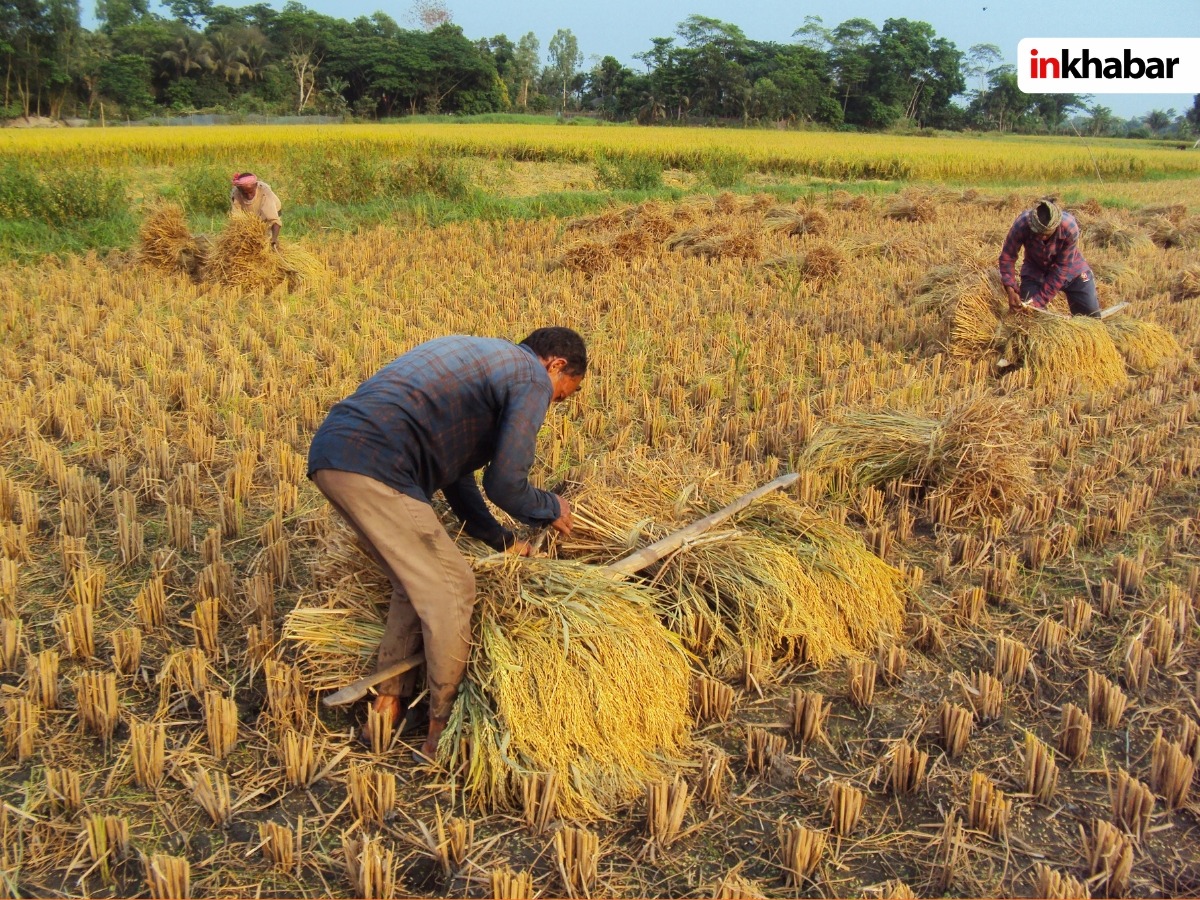
Farmers of Tamil Nadu are fighting battles on many fronts at the same time. Loan waiver alone is not a sure solution to this problem, because there are some deeper and fundamental reasons behind it.
Rising input costs- Ever since the government control on fertilizers has been removed, the cost of inputs used in farming has increased tremendously.
Disparity in MSP- While on one hand the prices of agricultural inputs are skyrocketing, the ‘Minimum Support Price’ (MSP) fixed for paddy and other crops has not increased accordingly; As a result, farmers’ profits are continuously decreasing.
Climate change and drought- Tamil Nadu often faces severe drought and unseasonal rains, resulting in crop failures and farmers being unable to repay their existing loans.
Social expenditure- In addition to agricultural losses, farmers also take loans for purposes that do not generate income, such as social functions (weddings), household expenses, health issues, and supporting large families, further entangling them in this debt trap.
heavy debt burden on farmers
- Many farmers in the delta districts of Tamil Nadu, the main rice producing region of the state, are forced to resort to private moneylenders and microfinance companies due to delays in distribution of crop loans by cooperative societies. These alternative lenders charge exorbitant interest rates ranging from 36 percent to 60 percent. Faced with frustration and distress, many farmers even lose their mortgaged properties.
- Farmers in various districts have expressed concern that cooperative societies demand a lot of documents before sanctioning loans, the most important of which is dues-free certificates from banks. This bureaucratic process often takes several weeks; And by the time this process is completed, farmers have already prepared their land for sowing.
- The data on farmers’ indebtedness is worrying, and Vijay has raised a very sensitive issue—and that too at the right time. According to some estimates, the total debt burden on farmers in Tamil Nadu has reached ₹5,06,290.45 crore—the highest figure among all South Indian states.
- According to Reserve Bank of India (RBI) data, outstanding loans to farmers in Tamil Nadu saw an alarming increase of 68% in just six years, from 2015-16 to 2020-21. These figures make it abundantly clear that farmers were desperately looking for a ‘Sanjeevani’, a life-saving solution, to get out of the vicious cycle of debt in which they had been stuck for generations.
What burden will this put on the state treasury?
Although this promise made by Vijay may prove to be a ‘masterstroke’ from a political point of view, but from an economic point of view, it is no less than a huge challenge. According to the budget estimates for the financial year 2025-26, the Gross State Domestic Product (GSDP) of Tamil Nadu is estimated to be ₹35,67,818 crore. The state is already under financial pressure, and the fiscal deficit target for 2025-26 has been set at ₹1,06,968 crore (3% of GSDP). The pressure on the state exchequer can be gauged from the fact that in 2025-26, the state government will have to pay ₹47,040 crore just to repay its outstanding debt.
Economists strongly believe that loan waiver may provide relief for some time, but it puts such a heavy burden on the government exchequer that the government is ultimately forced to cut budget allocations for other important development sectors like health and education.
The post Vijay’s masterstroke of loan waiver successful! Which farmers will get its benefit? What will be the impact on the state treasury appeared first on Latest.

Comments are closed.