
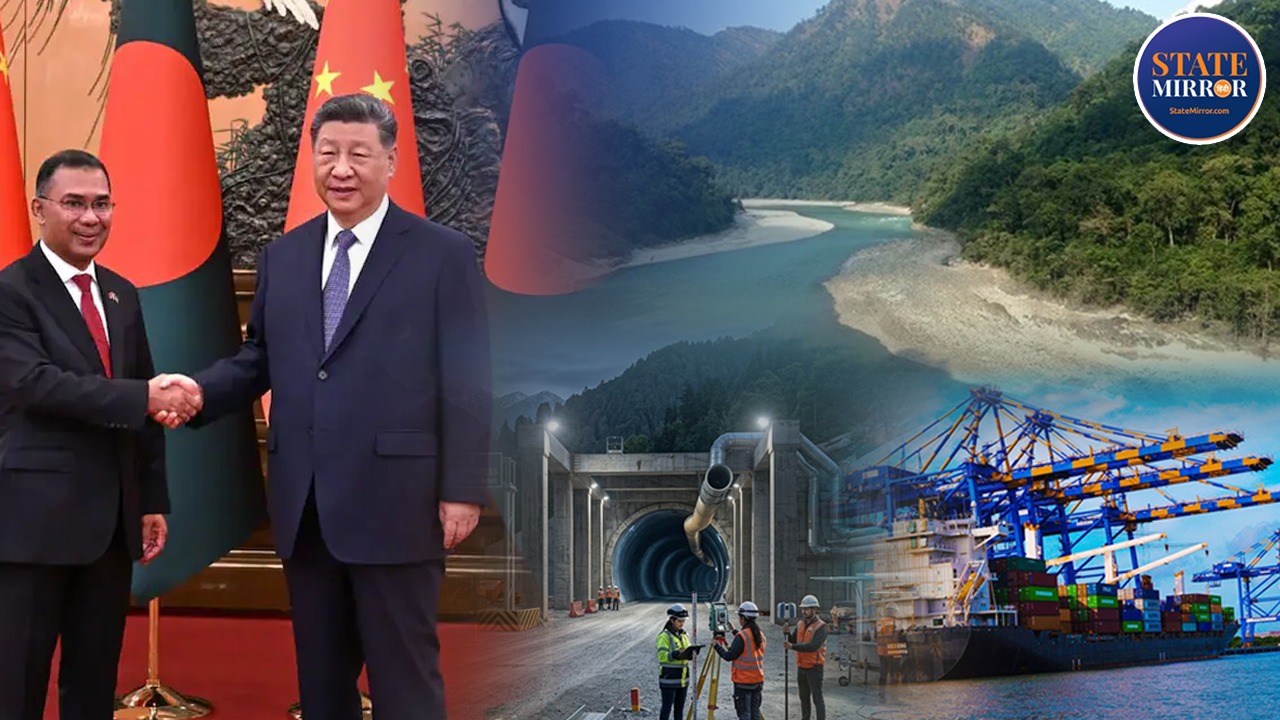
Tariq Rehman’s Beijing Diplomacy: From Teesta to Mongla Port, how big a challenge is the closeness of China-Bangladesh for India?

Bangladesh is once again at the center of South Asia’s geopolitics. The visit of PM Tariq Rehman to China on June 26, 2026 is being seen not just as a bilateral visit but as a sign of the changing regional balance of power. During this visit, both the countries agreed to enhance cooperation in many areas including Teesta river management, economic zone near Mongla Port, trade, artificial intelligence, green technology and infrastructure development. These agreements have also raised India’s strategic concerns, as the Teesta project is close to the Siliguri Corridor and the Mongla Port could strengthen China’s economic presence in the Bay of Bengal.
However, foreign affairs experts say that Dhaka is currently adopting a policy of balancing between India and China, but this visit definitely gives important signals for future regional diplomacy.
New sign of changing equations in South Asia
Bangladesh PM Tariq Rahman His visit to China in June 2026 is being considered very important in view of the changing geopolitics of South Asia. This was Sheikh Hasina’s first major foreign tour after becoming the PM there after her exile, in which she met Chinese President Xi Jinping, Prime Minister Li Qian and many senior officials. During the visit, many agreements were signed between the two countries in areas like trade, investment, port development, water resources, artificial intelligence (AI), green technology and industrial cooperation.
According to him, this visit is not limited to bilateral relations only, but also indicates the future strategic competition between India, China and Bangladesh.
Teesta project becomes the most sensitive issue
The most talked about topic of this visit was Teesta River Management Project. China reiterated its desire to increase technical and financial cooperation in this project. Teesta water sharing has been a pending issue between India and Bangladesh for many years. In such a situation, if China’s active participation in this area increases, then its impact will not be limited to water resources only.
The Teesta area is very close to India’s Siliguri Corridor, also known as ‘Chicken Neck’. This narrow land connects the north-eastern states of India with the rest of the country. Therefore, New Delhi is also looking seriously at China’s increasing presence in this project from a strategic point of view.
Mongla Port and China’s strategy in the Indian Ocean
China and Bangladesh also agreed to develop a special economic zone near Mongla port. This project is in discussion because earlier the possibility of India-backed investment in this area was raised. Now China’s investment can further strengthen its economic hold in the Bay of Bengal and Indian Ocean region. Although it is an economic project, experts believe that China also often exerts long-term strategic influence through ports and infrastructure projects. This is why India is keeping a close eye on this development.
Trade, Investment and New Economic Partnerships
Tariq Rahman has requested China to increase imports of Bangladeshi products – especially jute, leather, medicines, fisheries and agricultural products. So that the trade imbalance between the two countries can be reduced. Additionally, both countries agreed to enhance cooperation in areas such as industrial parks, green technology, health, education, AI and China–Myanmar–Bangladesh Economic Corridor (CMBC).
Bangladesh is becoming an important economic partner in South Asia for China, while Dhaka is looking for major foreign investment to boost its lagging economy.
Defense cooperation also discussed
The two countries did not formally announce any major defense agreement, but various media reports have mentioned the possibility of purchasing J-10CE fighter aircraft from China. If this defense cooperation progresses in the future, new dimensions can be added to the security strategy of India’s eastern border and the Bay of Bengal. At present, this is being seen as a possible cooperation, but it is definitely a sign that China and Bangladesh are also maintaining dialogue in the security sector.
What is the challenge before India?
The biggest concern for India is not just China’s investment, but the possibility that economic cooperation may gradually transform into strategic cooperation. China has already strengthened its regional presence through large infrastructure investments in Pakistan, Sri Lanka and Myanmar. If Bangladesh also becomes an important part of this strategic network, it could have an impact on India’s eastern borders and maritime security. Along with this, issues like Teesta Project and Mongla Port will remain important for both India’s security and foreign policy.
Is Dhaka going completely with Beijing?
At present, most strategic experts do not agree with the conclusion that Bangladesh is completely going into China’s camp. He believes that the Tariq Rehman government is adopting a “balancing policy”. On one hand, Dhaka wants investment, technology and infrastructure cooperation from China, while on the other hand it also wants to maintain trade, energy, connectivity and cultural relations with India. Therefore, it would be more appropriate to see this visit as a part of Bangladesh’s multipolar foreign policy rather than an anti-India move.
At present, Tariq Rehman’s visit to Beijing has made it clear that China’s influence in South Asia is no longer limited to infrastructure projects only. It is trying to strengthen its long-term strategic presence through water resources, ports, industrial investment, new technology and economic cooperation.
The challenge before India will not be one of confrontation, but of diplomatic and economic competition. If New Delhi further strengthens trade, energy, connectivity and trust-based partnership with Bangladesh, it will remain a more natural option for Dhaka to maintain the balance between India and China.

Comments are closed.