
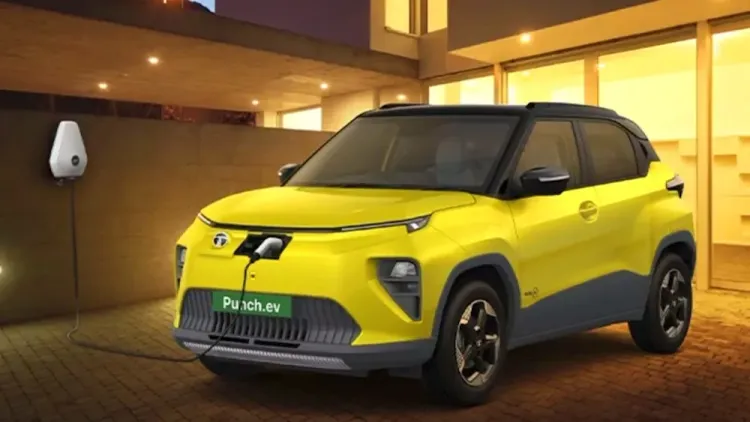
Tata Motors’ Chief Commercial Officer Vivek Srivatsa: New Punch.EV Can Be A Great First Car

In the run up to the facelifted Tata Punch.EV’s launch, CarToq’s Jayaprashanth Mohanram caught up with Tata Motors’ Chief Commercial Officer Vivek Srivatsa, to learn more about the new electric car. Here is that conversation in full, edited for grammar.
Jayaprashanth Mohanram: Good morning, sir. Good to talk to you again. We talked before the ICE Punch’s launch, and now we have the Punch EV Facelift. So I think the Punch is India’s fastest selling car, and Tata’s becoming the India’s fastest brand to launch cars.
Vivek Srivatsa: Yeah, you can imagine. We’re having a little busy time.
Jayaprashanth Mohanram: I’ve been noticing your teasers and the videos you put out about the new Punch EV. And I’m launching straight into the questions because I know you’re very tied up with time. . I saw that the Punch EV did nearly 594 kilometres on a single charge. Obviously, it was a record setting run. So you wanted to squeeze out the best that you could from the battery. But what in your estimate is a safe range to expect? What do you realistically expect that a common man would get from the Punch Long Range under normal driving conditions, considering that it’s now got a bigger battery?
Vivek Srivatsa: So yes, you’re right. C75 is something we had created thanks to the data we have of our own consumers. And yeah, this is something we’ll be announcing tomorrow. But I can share it with you. We all usually give a range, you know, because we can’t be very precise, because it is a estimate basis 70% of our customers, and how they drive. So, for normal driving behaviour, C75 for Punch will be between 335 and 350. So, that is actually a very good number. Because, again, you know, it almost makes the EV an everyday carr, and you can have a single car garage with the EV if you get 335, 350.
Jayaprashanth Mohanram: So, is that the entire point of the new Punch EV? So you kind of developed it to be the only car that you can have at home, you know? And one more thing, when I spoke to you about the Punch Facelift, you said that 70% of the punch buyers are like first time car buyers. Have you seen the similar numbers with the EV as well?
Vivek Srivatsa: First time EV for sure not first time car buyers. Punch EV, it has been first time EV owners. But with the Punch, this facelift, the current product, we hope to attract a lot more first time car buyers itself because the Punch EV can be a great first car, actually, because it provides absolute versatility that first time buyers look at, you know, first time buyers look at one car to do everything that they need, whether it is, you know, the school runs or the office run or intercity or entire family moving. And Punch EV now offers the versatility, as you said earlier, it offers range, it offers space, etc. Performance is already there.
Jayaprashanth Mohanram: All right. Now let’s move to charging infra. That is something that you’ve really been working on. What’s the big upgrade in the Punch EV in terms of charging speed? Because if you’re using a bigger battery with lifetime warranty, I think even charging speed will go up.
Vivek Srivatsa: Yes, definitely. So basically, we moved to prismatic cells. So it enables faster charging. I mean, we also have made it explicit that in 15 minutes, you can get about 135 kilometres of range. 10 to 80% also is possible in 26 minutes now. With one of the faster charging DC chargers.
Jayaprashanth Mohanram: So that is you’ll go up to 60 kilowatt in that case.
Vivek Srivatsa: Even beyond 100. And, you know, broadly, I mean, technically, it has gone to 1.5 C.
Jayaprashanth Mohanram: Great. That’s very good, because that’s a very solid number. And, you know, again, it will make it a much better electric car.
Vivek Srivatsa: And one more thing. What is fast charging today can become slow tomorrow. But 1.5 C means that it will be fairly contemporary for the next four or five years.
Jayaprashanth Mohanram: Yeah, that’s important. Because a lot of EV buyers also have that thing in mind. Because they say that, you know, if I buy a car today, tomorrow, the next year, it may become obsolete, because the technology is changing so quickly in terms of charging, etc.
Vivek Srivatsa: And 1.5 C for this level of battery pack is a wonderful balance, you know, because battery is 40 kilowatt. By the time you have a meal on the highway, you’re almost fully charged. So that balance is very important.
Jayaprashanth Mohanram: Now that your mega charger network is expanding steadily, what can we expect in the next one year, sir, in terms of charging infra expansion?
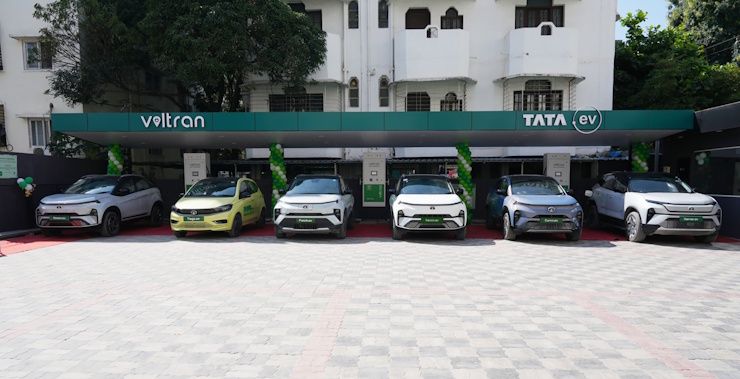
Vivek Srivatsa: See, currently, we have almost 450 charging points in our mega chargers and all of them are high speed chargers. Yeah. 130 different locations, but each location has up to three or four charging guns, you know. I think by end of next year, we’ll move to close to 800 charging points. So existing points also will be expanded, but new points also will be open. And that’s the way we’re looking at. So almost you’re doubling it up close to doubling it.
Jayaprashanth Mohanram: Also unified pay. We first saw this on the Harrier.EV. So where are we on that with respect to the Punch.EV?
Vivek Srivatsa: It’s the same app, you know, that app support will be enabled in Punch as well. So that is not car dependent. It is more app dependent.
Jayaprashanth Mohanram: About EVs, the main thing is the way you charge the EV and the way you drive an EV. Because driving is the main thing. A lot of people, if you drive an EV like an ice car, maybe you’ll end up getting a low range and then you’ll be disappointed So what is Tata really doing about education initiatives around EVs, both driving as well as charging? Because again, I have read in the Tata manuals that you, once you fast charge a car continuously, you have to slow charge it after a certain number of cycles so that the battery health is good.
Vivek Srivatsa: So it’s an interesting question. And also customer behaviour is very interesting here because, you know, initially you had a lot of new EV customers. We had to do a lot of education on how to drive EVs. Driving EV itself has to be different and not like an ICE where you, you know, especially people are used to manual transmissions really push the accelerator a lot and here the soft foot had to be taught to them. Regen breaking had to be taught to them. But then, you know, between 23, 24, the number of new customers getting into EV tapered down slightly. It was largely EV-to-EV changes or people who already knew. So we didn’t focus too much on education, but now again, we are seeing a resurgence. A lot of first time EV buyers are coming into the fold, whether it is for larger cars like the Harrier with more than 60, 75 kilowatt batteries. And now with the Punch EV also, we’ll start seeing first time adopters. So you’re right. We have to really accelerate our education programmes, both in terms of how to manage the battery and in terms of how to actually drive the EV differently.
To be honest, over a period of time, once people start using an EV, their driving behaviour does change after three, four months, they realise that I don’t need to press the accelerator as much as I need to do in an ICE car and also a light foot and a steady speed helps them. But at the same time, I think we have to get into more education. We have a driving behaviour monitor on our app. It has been there for last three, four years that rates you in terms of your driving behaviour, but probably we need to have more practical classes and all that on the ground. This is something we will think of. That is one of the reasons why we decided to do the hypermiling video. 593 kilometres with a Punch EV, because we showed a real human driving, it was not a, you know, stimulated condition. So there is a lot of curiosity on how it happened. Can I also do it and all that. So we will get into this now. We will get into education, we’ll start doing a lot on ground camps and all that. And now the need is more than ever because more and more first time car buyers are getting into first time EVs. So there’s a big overlap happening. And I think we’ll have to accelerate our education on this.
Jayaprashanth Mohanram: When I spoke to you in the run up to the Punch Turbo’s launch, you said that the decision to launch the Turbo Punch was in keeping the car’s use as a highway car for a lot of buyers. So what is the thinking behind putting a bigger battery in the Punch EV? Because there is already, you know, an overlap between the Punch long range and the Nexon Creative 45. The Punch long range is already 45,000 rupees pricier than the Nexon Creative 45 kilowatt. So, now you’re putting a bigger battery, I think a 40 kilowatt in the punch as well. So what is the thinking behind this?
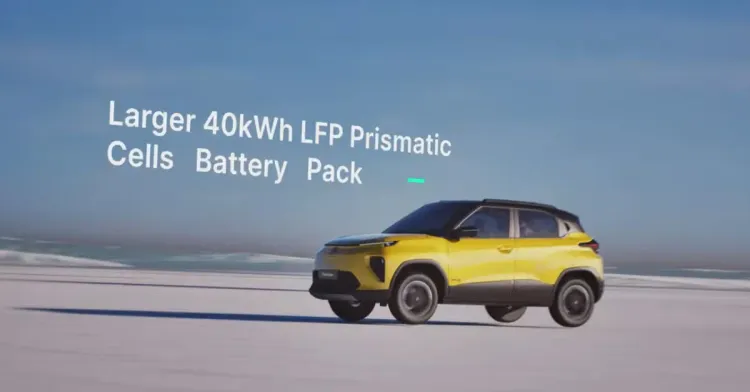
Vivek Srivatsa: See, between top end trims and entry trims of products, there’s always an overlap. It’s not just in this case. So that is not something we worry about, because at that point, people choose between features and body style or size. But the bigger reason for going 40 kilowatt in the Punch is to make it a far more versatile car. Like I said, first time EV buyers want their car to be everything, And if we want first time buyers to start considering an EV, we had to give them this breakthrough. Three large areas that we are looking at: one is longer range because of aided by a larger battery. When 345 to 350 is what we’re looking at a real world range, that itself unleashes a lot of confidence.
Of course, 40 kilowatt battery is what enables that but a larger battery means customers are a little bit more mentally comfortable that I can drive longer distances. Second, of course, is that we are going to implement lifetime unlimited lifetime warranty. So that is another big unpacking for customer. So there’s always been a misconception that battery life will 3-4 years or whatever. 8 year warranty was understood as 8 years of battery life. So unlimited warranty, again, may give a lot of comfort for first time car buyers. And of course, the price is something we’ll announce tomorrow.
But a combination of unlimited warranty, longer range, and fast charging has not been available below a certain price point so far. The three has been available above 15 lakhs closer to 20 lakhs. But you will see that with the new Punch, all three of these factors will be available at a very attractive price. And that is why we expect a lot of first time car buyers to look at the new Punch EV as their first car.
Jayaprashanth Mohanram: And you know, just having this particular thing is going to, I think, reduce the resistance towards buying EVs. Because lifetime warranty means you’re getting assurance that for 15 years, you’re sorted.
Vivek Srivatsa: Yeah. So the entire philosophy for our new Punch.EV is to attract first time car buyers directly into EV. And that is why we focused on these three pillars.
Jayaprashanth Mohanram: So in the teasers, what I also noticed is you’ve also said the punch is getting faster. So I assume that the motor’s output is also being uprated.
Vivek Srivatsa: What I meant by faster is overall journey. And faster charging. See, the biggest grouse with a lot of EV buyers was how long it takes to wait for your car to get charged. So with 1.5 C, you can actually by the time you have a coffee in a highway, you can charge it quite a lot, you know, you get 135 and 15 kilometres. Even if you spend half an hour, you can get close to 200 to 20 kilometres of charge. That’s more than sufficient. Yeah. So what happens is your travel between two cities, okay, actually, is the same time or quicker than a nice because why we say quicker because EVs are much more manoeuvrable, much easier to drive. Overall, the travel time comes down. That is what we meant by EVs are faster.
Jayaprashanth Mohanram: From the teaser, someone pointed out the rear disc brakes are no longer there. So what is been done in terms of EV safety?
Vivek Srivatsa Safety is something we will never compromise. In terms of spec, like disc brakes, we have kind of rearranged a little bit on the portfolio, depending on the battery size pack and packaging and real world performance. But no compromise on safety.
Jayaprashanth Mohanram: All right. Thank you very much.
Vivek Srivatsa: Thank you. Let’s meet at the drive.

Comments are closed.