
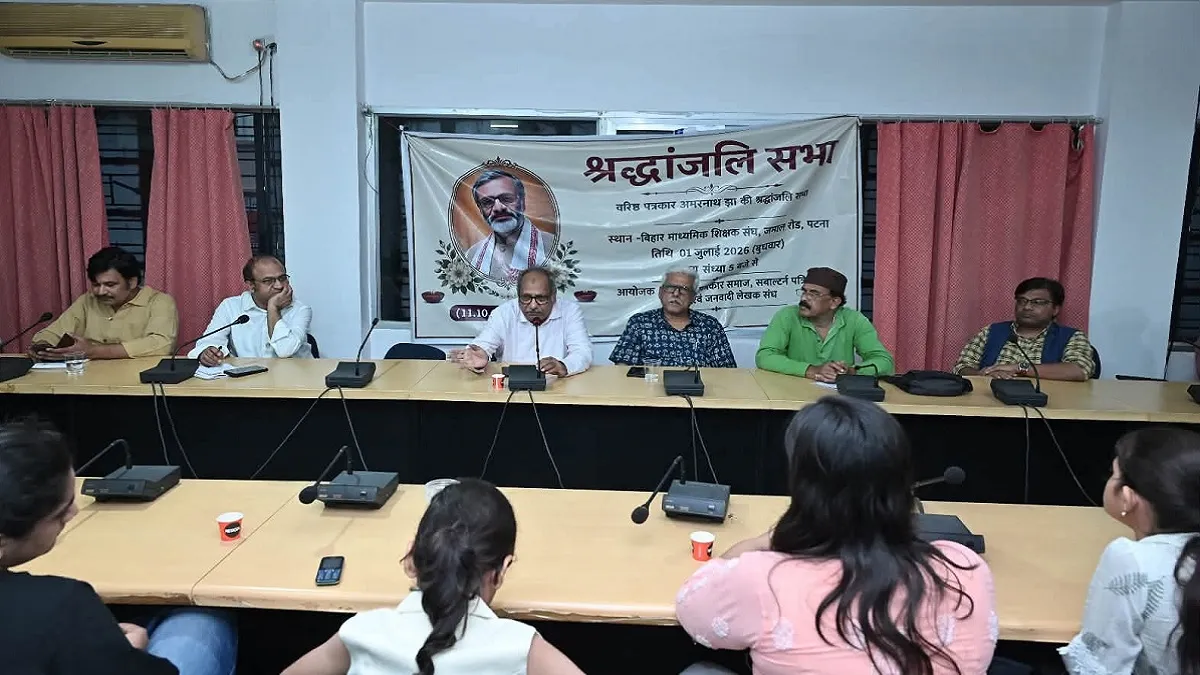

Patna. Journalist Amarnath Jha, who made a national mark through the journalism of North-East India, was remembered in a different way in the tribute meeting in Patna, the capital of his home state Bihar. Amarnath ji was remembered in the presence of journalists, litterateurs, professors, social workers and family members of his blood clan in a tribute meeting organized by the People’s Writers Association, Subaltern Patrika Pariwar and Patna’s Journalist Society in the auditorium of the Secondary Teachers Association of Patna on Wednesday, July 1.
After the condolence meeting of Amarnath ji at India International Centre, Delhi, many interesting incidents of his life emerged in the tribute meeting organized in Patna. Those close to the late journalist told such things about him which he never discussed with anyone. Trying to understand the structure and texture of the life struggle of a journalist who created a national identity by writing about rivers, floods, droughts, displacement and mass movements after his death establishes his popularity.
Amarnath ji’s father Narmadeshwar Jha, committed to Gandhian, socialist and Sarvodayi ideology, was the Additional Advocate General of Bihar Government and a big leader of Jan Sangh. After this new information, everyone kept wondering that with what effort and struggle Amarnath ji would have made himself progressive from the laboratory of Jan Sangh and RSS.
The ideals, values and journalistic determination of Amarnath ji, who always smiled innocently with khadi kurta, khadi gamchi and white beard, were remembered as the touchstone of journalism. The pain of Amarnath ji’s death at the young age of 63 continued to hurt everyone. On 17 June 2026, Amarnath ji died untimely due to brain hemorrhage.
Senior litterateur Ravindra Bharti said in the tribute meeting of public eminent journalist Amarnath ji that Amarnath was younger than me in age and I will have to come to pay his tribute. This was unimaginable. When he was in Guwahati, he had relations with the politicians there as well as Assamese theater and drama directors. Due to his interaction with Assamese language and culture, Amarnath ji understood the suffering there in a different way from the official standards of the Central Government. This was the reason why Hindi journalist Amarnath gained the trust and respect of the North-East while doing journalism in the non-Hindi region.
Sociologist Mahendra Suman told that his role was very important in the publication of the souvenir which was published on the 75th year of Goa Liberation Movement. He also went to Goa for that event.
Professor Safdar Imam Qadri narrated many memories of his association with Amarnath ji. Amarnath was one of our such friends, whom we used to call each other since our first meeting till now. We were classmates. In 1988 we had conceived an Urdu newspaper. Amarnath used to write reports in Hindi for that Urdu newspaper. Jabir Hussain was the editor of that newspaper. He started a new trend with his association with Sangharsh Vahini, Ganga Mukti Movement and journalism. In the beginning, English was also not good but by working hard I made myself proficient in English also.
Amarnath of Bhojpuri, while learning Bengali and Assamese, moved forward in the passion of study and research. Building oneself and thus earning such a name across the country is not within everyone’s power. Amarnath did not survive on the fungus. Their roots were buried deep beneath the earth. Ordinary Amarnath made himself extraordinary through his indomitable struggle. This was the charm of his existence. This was his own glow.
Storyteller Shivdayal said that I knew Amarnath ji very closely but the way I got acquainted with him after coming here. This makes me feel extremely proud. The reality is that he was so engrossed in the issues that he did not even remember to tell about himself. When I visited his house a decade and a half ago, I came to know for the first time that he was born in a rich family but he looked very simple in his attire and lifestyle.
Amarnath ji was included in the editorial board of Sahyatri magazine. In 2005, we had brought out an issue on governance on behalf of Sahyatri and for the first time a seminar on this subject was held in Bihar. Amarnath ji, who looked ordinary, was not ordinary. This was evident in his tribute.
Educationist Gyandev Mani Tripathi, while remembering Amarnath ji from his destiny, said that both of us started the career of newspaper writing together. It was his habit to write a lot, but it was also his nature to leave the previous work incomplete by getting entangled in some other issue while working.
We both started many works of writing and research together. His wish was that Gopal Singh Nepali’s birth anniversary should be celebrated in Guwahati and Prabhash ji should come. Prabhash ji could not come due to excessive rain and flood like situation due to water logging but he did not stop the program. He did not wave his flag but was completely determined to carry out his wish.
He had translated the report of the Common Schooling System very well. In the 21st century he developed a love for rivers. Loving rivers and talking about rivers, he became very restless. It is not within my power to write heavenly along with his name.
BBC journalist Situ Tiwari said that Amarnath ji was an expert in one stream. In the company of Ranjeev ji, Amarnath ji had studied the environment and river flow in depth. He had deep knowledge of his subject. His academic capital was very strong, hence he was exemplary for journalists like us. Amarnath ji, who was simple, ego-free, selfish-free and self-loving, was a different kind of journalist from the crowd.
India Today journalist Pushyamitra said that today people are anxious to tell about themselves. His best quality was that he did not tell anything about himself to anyone. I was introduced to Amarnath ji along with Ranjeev ji. I knew him as a water journalist. He kept reading me constantly and encouraging my writing. After Ranjeev ji’s death, both of us together searched for the necessary documents from the pile of Ranjeev ji’s documents.
Amarnath ji had continuously promoted women’s education in his family. As a result of this, 5 daughters of his family came out of the house and participated in his tribute meeting today. His daughter Riddhi, who is serving after getting education from IIM Indore, said – I used to call him Babuji. When I was born, Babuji was working in Jansatta Kolkata. He never stopped us brothers and sisters from doing anything. Born in the 60s, my father was the eldest son of his parents. Babuji used to continuously irrigate our family with his progressive thinking. Babuji was very kind and charitable. He taught us children to have compassion for the suffering.
NIT Patna topper Shraddha told that I am her niece. He was a special uncle of the world. He inspired the welfare of others. Utkarsh said – He was my father. I am Babuji’s son. I have done my master’s from ISM and am working. After his departure, we became acquainted with his extended family.
Arimardan ji told that he was my elder brother. I am 11 years younger than him. My father was a provincial leader of Jan Sangh. Father had contested elections from Chanpatia. In which the family suffered huge financial loss. We belonged to big Bhupati families of Bihar. In Bihar, the families whose land was mostly sealed. My family was one of them. Brother was brought up very luxuriously. Perhaps that is why brother’s attachment to wealth, happiness and opulence had broken long ago.
Many Gandhians in the country had turned their heads by calling the demolition of Babri Masjid a national mourning. Amar Bhaiya was also included among them. Our land was sealed and the landlord also took possession of it. In this way our family had to face huge financial ruin. After losing everything, we were left with no other option except education. Everyone in the family studied hard and today everyone is happy after studying.
Journalist Manish Shandilya said that Subaltern has some of his translations. Whatever will be published, but now his incomplete things will also be published. He was adept at compiling documents. Collecting their memoirs is an important task.
Social activist Udayan Roy, on behalf of the National Coordination of People’s Movements, Bihar, said that I can never forget his sympathy towards me when I went to jail. He listened to me patiently. He never got bored while listening to any social worker. He used to praise me a lot every time he saw me riding a bicycle.
He had said that I also want to ride a bicycle. The way they respected me because I rode a bicycle. That honor made me admire him and my love for cycling became stronger. If we had met him now, we would have asked him about the campaign going on against AC by holding it responsible for the rising temperature in Europe. Increase my knowledge about him. Bapu Tower has been built in a poor state at a cost of hundreds of crores by cutting thousands of trees. Thinking about its reality and uselessness would be a true tribute to Amarnath ji.
Engineer Santosh Yadav told that he was associated with the editorial group of Subaltern. His work in the fields of rivers, water, environmental justice and translation was particularly notable. He was a vigilant watchdog of pro-people journalism.
While discussing his love for caps, cultural activist Anish Ankur discussed the conversation with him regarding caps. Anil Anshuman, while paying tribute on behalf of Jan Sanskriti Manch, called him a true journalist for the rights of the people.
He was remembered by all as a studious, researcher, sensitive, ideologically honest and pro-people journalist. Amarnath ji, associated with Patliputra Times, Purvanchal Prahari, had gained a lot of respect as the North-East correspondent of Jansatta. Later, he kept writing on the issues of river, water, environment and displacement in Down to Earth, First Spokesman, Yathavat and Jan Chowk. Amarnath ji, who was associated with PTI as a translator, gained the reputation of an accomplished translator by translating from English to Hindi and from Assamese to Hindi.
Storyteller on North-East subjects Chittaranjan Bharti, Economics professor Dr. Manoj Prabhakar, English professor Dr. Ghanshyam, Journalist Rajesh Thakur, Journalist Sumita Jaiswal, Journalist Anant, Researcher Ashutosh, Social worker Chandrashekhar, Shyam Babu and many intellectuals participated in the meeting.
Journalist Kulbhushan expressed his gratitude to the guests while Pushparaj conducted the meeting. Arun Narayan played an important role in coordinating the program. The Secondary Teachers Association enhanced the value of journalism by providing an auditorium. The tribute meeting started with floral tributes and ended with two minutes of silence.
(Report by Pushpraj from Patna)

Comments are closed.