

If you walk through Ho Chi Minh City these days, you can feel it immediately.
Shops glow in red and gold. Flower markets are crowded. Beauty salons are fully booked. People rush home earlier than usual.
Beneath the decorations, something deeper is happening: Vietnam is preparing for Tet.
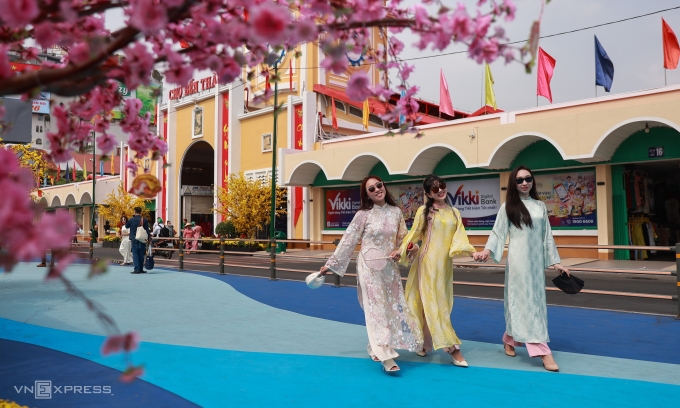
Young women pose for photos in traditional dress ao dai outside Ben Thanh Market, which has been refurbished for the Lunar New Year, February 2026. Photo by Read |
For many expats, Lunar New Year may look like a long holiday that slows business down.
In reality, it is one of the most important cultural windows into how trust is built in Vietnam.
What Tet really means
Tet is not just the start of a new calendar year. It is a time to: remember and worship ancestors; reunite with extended family; visit relatives, teachers, seniors, and friends; close the old year properly and begin the new one with intention.
Before TetVietnamese families clean their houses thoroughly – removing old, broken, or “unlucky” items and making space for renewal.
Homes are decorated in red, a color symbolizing luck and prosperity.
Compared to other East Asian and Southeast Asian countries such as China, South Korea, Malaysia, Singapore, Lunar New Year shares many similarities. But Vietnam’s Tet has its own unique characteristics.
In the south, families buy yellow May blossoms. In the north, pink dao cherry blossom flowers are traditional –though today you can find both across the country.
Food preparation reflects regional identity too: The North makes banh chung (square sticky rice cake), the south prepares banh tet (cylindrical sticky rice cake).
Pickled vegetables, sweet candied fruits made from coconut or ginger, and fruit offerings are carefully prepared.
On the altar, families offer five fruits symbolizing balance and harmony. Many people in the south specifically arrange “cau dua du xoai sung” (sugar apple, coconut, papaya, mango and fig) – a playful word combination roughly meaning, “May we have enough money to spend comfortably.”
On the first three days of Tetthere is a traditional visiting order: The first day is for visiting the father’s side, the second day the mother’s side, and the third day for teachers.
Children (and also adults) receive red envelopes with lucky money.
These are not just rituals. They reflect Vietnam’s core values: family, hierarchy, gratitude, and continuity.
What this means for you as an expat leader
Many foreign leaders ask: “How do I build trust with Vietnamese colleagues?”
Here is the uncomfortable truth: Trust in Vietnam is not built primarily through efficiency or authority, it is built through presence.
Presence means showing up consistently, participating when it matters, respecting what your team values, and emembering small details that matter.
Tet offers a natural moment to demonstrate this. You do not need to “become Vietnamese.” You do not need to master every ritual. But joining selectively, with sincerity, makes a difference.
Practical ways to build trust during Tet
Tet is a perfect time for nurturing the global-local relationship. As an expat leader in Vietnam, there are certain things you can do to boost the staff’s morale during the country’s biggest holiday.
One thing is to support their journey home. Many employees working in large cities travel back to their hometowns weeks in advance. Flights, buses, and trains are fully booked. They would appreaciate it if you can allow flexible leave timing and help with earlier holiday approval.
You can also personalize new year wishes. If you want a quick cultural bridge, learning a few New Year wishes in Vietnamese goes a long way. Even a simple sentence, spoken with sincerity, creates warmth, such as:
– Happy new year! (Happy New Year!)
– Chuc van su nhu y! (May everything go as you wish.)
– Chuc an khang thinh vuong! (Wishing you good health and prosperity.)
You don’t need perfect pronunciation. The effort itself signals respect – and that is what people remember.
Other small gestures that can make big impacts include wearing traditional aodai at the office celebration, talk to your employees about their hometowns, and giving lucky money while remembering their children’s names.
Tet is not just a holiday interruption. It is a cultural mirror.
It asks you: Do I know what matters to my team outside work? Do I acknowledge effort, not only results? Do I show respect in ways they value?
As the Lunar New Year approaches, perhaps the real leadership question is not: “How do I manage better?” But: “How present am I in the relationships I’m trying to lead?”
That question alone can change your success in Vietnam.
*The article is partly extracted from the book “When Global Meets Local – From the Culture Shock to Thriving in Vietnam, by Hana Bui.

Comments are closed.