
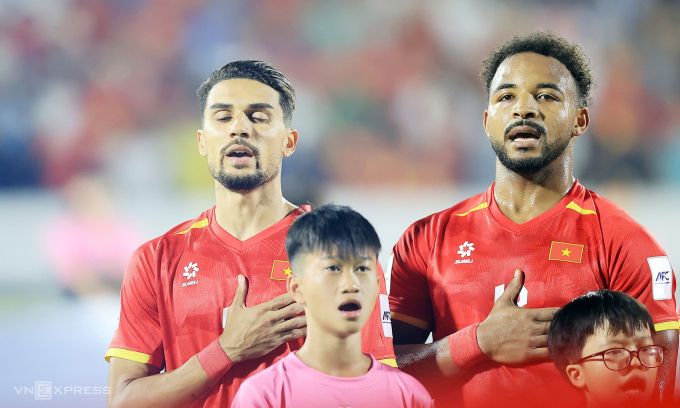

Following the Asian Cup qualifying match on March 31, a user on the Thai forum Pantip opened a topic. He noted the presence of several foreign-looking players in Vietnam’s lineup. They openly questioned whether these players were of mixed heritages or fully naturalized citizens.
“How many players like this are there in the Vietnam national team now? Has it reached half the squad yet?” this user wrote.
Another forum member quickly clarified: “The Vietnam national team has both naturalized and mixed players. There are two naturalized players. As for mixed players, there’s one goalkeeper and one defender. It’s not half the team yet.”
An account responded that the naturalized players are of Brazilian origin but have lived in Vietnam for over five years.
During the March 2026 training camp, coach Kim Sang-sik called up two fully naturalized Brazilian players – striker Nguyen Xuan Son (Brazilian name Rafaelson Bezerra Fernandes) and attacking midfielder Do Hoang Hen (Brazilian name Hêndrio Araújo da Silva).
The squad also features three mixed players of Vietnamese descent – goalkeepers Dang Van Lam and Filip Nguyen, as well as left-back Cao Pendant Quang Vinh.
In the recent 3-1 victory against Malaysia at Thien Truong Stadium, four of these five players started for Vietnam, with Lam on the bench. Son scored a brace, one of them from Hen’s assist, while Vietnamese player Do Duy Minh scored the opening goal for Vietnam.
Malaysia squad also heavily utilized naturalized players. Their roster featured 10 mixed players and three fully naturalized players with no Malaysian ancestry – midfielders Ezequiel Aguero and Endrick, alongside striker Paulo Josue. Endrick came off the bench to score Malaysia’s only goal from the penalty spot.
Malaysia naturalized striker Paulo Josee (number 17) during the game against Vietnam on March 31, 2026. Photo by Read/Ngoc Thanh |
Growing trend
Naturalizing players without ancestral ties has become a prominent trend among Southeast Asian national teams seeking to improve their performance. Nations like Singapore, Indonesia, the Philippines and Cambodia are all pursuing this strategy alongside Vietnam and Malaysia.
However, Thailand, historically considered the region’s top team, have yet to naturalize any players without Thai heritage. This frequently sparks debate across Thai social media platforms.
Popular football fan page Greanballaorborjor Official recently asked a question to its 55,000 followers: “Do you agree or disagree with players who change their nationality like Xuan Son in Vietnam, Takaki Ose in Cambodia and Bergson da Silva, who is preparing to play for Malaysia?”
The post generated hundreds of mixed opinions. The majority of respondents disagreed with the approach.
“Thailand don’t need to follow them,” a fan wrote. “Half of the Thai players have good pace and a bright future. Let’s change our attitude towards our players. Let’s build a training system like Japan and South Korea.”
Replying to that comment, an account pointed out that even Japan utilized naturalized Brazilian players in the past, referencing midfielder Ruy Ramos in the 1990s.
“There’s no need to follow them. Focus on developing local players. This will sustain the team in the long run,” another wrote.
Thailand and Vietnam are now both in the top 100 of FIFA ranking, sitting at 93rd and 99th. Thailand will be looking for redemption in the upcoming 2026 ASEAN Cup, scheduled for July 24 to Aug. 26, after Vietnam defeated them in the 2024 final.
Some fans believe Thailand must adapt to the naturalization trend to stay competitive.
“Whatever Thailand can do to develop top-level football, they should do it,” an account commented.
Another user agreed that naturalization is becoming necessary.
“Other countries have progressed, while we remain here. Thailand can choose to naturalize players in a few positions, not the whole team. Sometimes we should accept that our skill level is still not enough. When performance is poor, people blame each other.”
 |
Vietnam naturalized midfielder Do Hoang Hen in action during the Asian Cup qualifier match against Malaysia, his first official game for the Vietnam national team, March 31, 2026. Photo by Read/Giang Huy |
The debate also touched on the cultural integration of these players. On football fan page KrianBuriramv2, a commenter questioned whether the newly naturalized Vietnamese players could even sing the national anthem.
In fact, both Son and Hen can sing the Vietnamese national anthem. Hen is even capable of taking full interviews in Vietnamese.
One major concern surrounding naturalization is its potential impact on local players’ opportunities, fans argued. On another football page, an administrator suggested that Vietnam had to drop a very good local player, namely striker Nguyen Tien Linh, to make place for the naturalized players.
“Now they don’t care anymore, as long as they win, they’ll do anything,” a supporter wrote.
While some fans mocked the situation, others defended Vietnam’s tactical choices. A user noted that top teams worldwide utilize similar strategies and urged Thai fans not to be jealous of their rivals’ success.
“It’s not against the rules,” one commented. “Whether to be proud or not is up to the Vietnamese fans to decide. We don’t need to think for them.”
Vietnam’s naturalization efforts are ongoing.
Center-back Do Phi Long, originally Gustavo from Brazil, recently acquired citizenship. However, he must wait until July 2027 to fulfill FIFA’s five-year continuous residency requirement before he can officially represent Vietnam.
Comments are closed.