
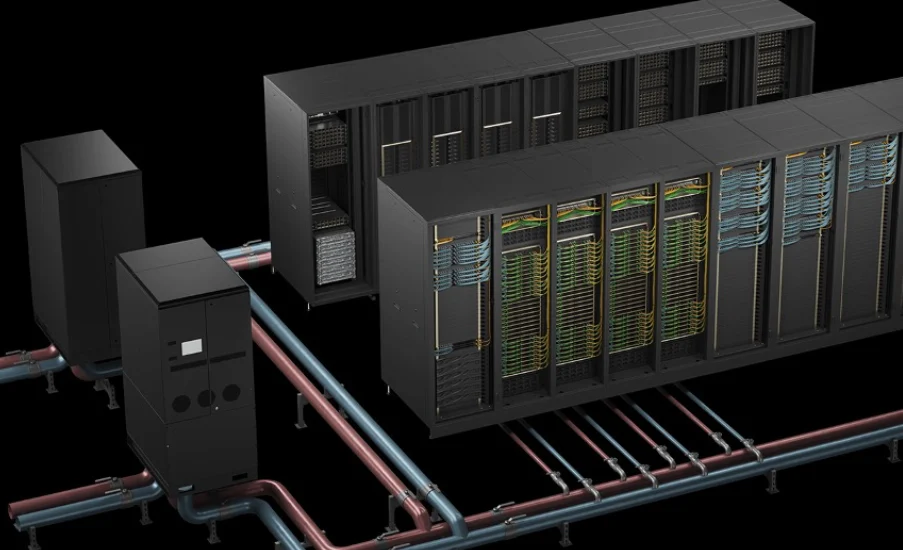

The rapid growth of artificial intelligence has moved from a software race to a massive hardware infrastructure challenge. As hyperscale operators deploy thousands of high-density accelerators to train next-generation models, legacy facility designs are hitting a strict physical wall. Air cooling can no longer keep pace with the thermal intensity of modern processors, forcing data centers to allocate up to 40% of their total power exclusively to cooling loops and evaporative water towers. To solve this crisis, tech giant NVIDIA has unveiled its NVIDIA liquid cooling design, a fully closed-loop architecture for its upcoming Rubin-generation infrastructure that operates at temperatures hotter than a residential hot tub to slash environmental overhead.
Presented at London Climate Week, the newly formalized DSX AI factory reference design marks a major shift in data center thermodynamics. By capturing heat directly at the chip and networking components through sealed cold plates, this system completely removes internal server fans and high-volume air handlers. Instead of relying on energy-intensive mechanical refrigeration, the architecture operates at a coolant input temperature of 45°C (113°F). This higher base temperature allows facilities to exhaust heat straight into the outside environment via dry coolers, driving on-site water consumption down to near-zero levels while providing millions of dollars in annual resource savings.
1. The Physics of 45°C: Why Running Hotter Saves Power
To understand the core innovation behind the NVIDIA liquid cooling designone must look at basic thermodynamic properties. Traditional data centers expend massive amounts of electricity running chillers to drop internal cooling fluid down to a crisp 21°C to 30°C. NVIDIA reverses this strategy by allowing its coolant a specialized mixture of 75% water and 25% propylene glycol to run safely at 45°C.
Because heat naturally flows “downhill” from a hotter source to a cooler environment, maintaining a high 45°C fluid baseline makes it incredibly easy to vent thermal energy outside. As long as the outdoor ambient air is below 45°C, the facility can use simple outdoor radiators (dry coolers) to expel the heat. By eliminating energy-guzzling HVAC compressors and air conditioners for up to 99% of the year, operators can dramatically boost their power usage effectiveness (PUE).
2. Eliminating the Evaporative Drain: Achieving Near-Zero Water Use
The environmental footprint of the AI boom has sparked intense public pushback, with recent disclosures revealing that hyperscale cloud operations draw billions of gallons of local water annually to maintain evaporative cooling towers. The Rubin DSX reference architecture directly addresses this ecological strain by operating as a sealed system.
Because the water-glycol mixture is filled once and continuously recirculated throughout the life of the facility, there is zero evaporative loss. In standard climates, the system cuts cooling water usage from 2.6 million gallons per megawatt a year down to near zero. According to engineering projections, making the switch to this fully liquid-cooled architecture allows a typical 50-megawatt hyperscale facility to save more than $4 million annually in combined water and electricity utility costs.
3. Tray-Level Engineering: Doubling Rack Density
Beyond its clear environmental benefits, this thermal overhaul completely alters physical server layouts. Air-cooled servers require massive, finned aluminum heat sinks and high-decibel fans to pull air across internal components, frequently generating noise pollution at or above 85 decibels.
Architectural Component and Deployment Shifts
| Engineering Layer Component | Legacy Air-Cooled Datahall | Liquid-Cooled Rubin DSX Standard |
| Acoustic Noise Footprint | ≥ 85 Decibels (Constant fan scream) | Near Silent (Fanless operation) |
| Compute Tray Form Factor | 6 Rack Units (6U) per node | 2 Rack Units (2U) (High-density design) |
| Coolant Plumbing Layout | Complex multi-point internal tubes | Single unified inlet/outlet front plate |
| Chiller Infrastructure Needs | Continuous mechanical refrigeration | Chillerless dry coolers in most climates |
By removing interior fans and shrinking components down into a unified, tray-level fluid framework, NVIDIA allows a compute module that previously required six rack units (6U) of vertical space to fit cleanly into a compact two-rack-unit (2U) slot. This space optimization lets operators triple the computational density of their existing data halls, allowing them to scale AI processing capabilities without needing to expand the physical square footage of their buildings.
The Path to Wide-Scale Adoption
As silicon power limits break past the cooling capacity of moving air, the industry is embracing liquid infrastructure as an absolute operational requirement. Supply chains are aligning rapidly, with major manufacturing partners like Supermicro and Motivair (a division of Schneider Electric) deploying fully integrated, liquid-ready racks.
While retrofitting legacy facilities involves clear upfront capital costs, the long-term economic benefits are undeniable. By decoupling server performance from ambient environmental temperatures and clearing the path for municipal waste heat recovery, the NVIDIA liquid cooling design offers a highly sustainable roadmap for the future of enterprise computation, proving that the industrial scaling of global intelligence does not have to come at the cost of the planet’s vital natural resources.

Comments are closed.