
The Biggest Takeaway From Putin’s India Visit – What The World Needs To Know | world news

New Delhi: When Russian President Vladimir Putin landed in New Delhi on Thursday, the mild December chill in the air did little to mask the warmth in India-Russia relations. The visit highlighted the depth of a friendship forged over decades and tested by history.
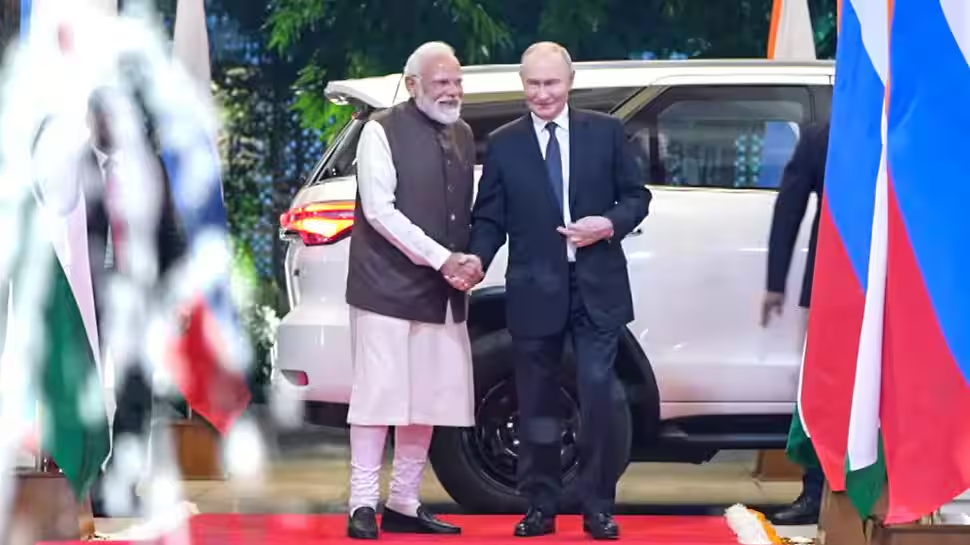
Prime Minister Narendra Modi personally welcomed Putin at Palam airport, accompanied by a full ceremonial guard of honor and a red-carpet reception. The following morning, a formal grand welcome at the Rashtrapati Bhavan further emphasized the special nature of the bond between New Delhi and Moscow.
The relationship between the two countries has grown a lot over time. Five years ago, trade between India and Russia stood at $8 billion, and today it has surged to $68 billion. India continues to import crude oil from Russia despite international sanctions, and its armed forces rely on Russian weaponry for operational readiness.
Add Zee News as a Preferred Source
Since Putin’s last visit to India nearly four years ago, the global geopolitical landscape has changed dramatically. Russia’s invasion of Ukraine altered its standing internationally, while the United States saw Donald Trump return to the presidency. India’s relations with the United States are going through a period of strategic tension, and Russia’s ties with China have strengthened greatly.
In this context, the visit highlighted India’s commitment to maintaining a close and independent partnership with Russia, even as Western countries attempt to isolate Moscow. The strategic implications of this visit extend far beyond ceremonial gestures.
The discussions during the visit demonstrated that Russia is keen to show it is not isolated, with nations across Asia, Africa and the Global South welcoming engagement. For India, maintaining a strong relationship with Russia ensures access to energy resources and defense capabilities, balancing its partnerships in a complex global environment.
Over the past four years, India has benefited from discounted Russian oil, strengthening its energy security and supporting GDP growth.
The visit reinforced that Moscow has not been sidelined on the global stage. Engagements with New Delhi and Beijing highlight Moscow’s strategic approach in Asia. While there was anticipation for major defense deals or announcements, much of the cooperation occurs silently behind the scenes, with past examples like the SU-30MKI deal demonstrating the scale and significance of such agreements.
The visit also signaled support for India’s strategic autonomy. Russia reassured that India remains a trusted partner, which is capable of maintaining independent policy decisions. This was reflected in the extended duration of the visit, signaling respect and recognition of India’s sovereign strategic choices.
At the same time, the visit took place against the backdrop of ongoing negotiations between India and the United States on trade and strategic issues. The United States has sought to pressure India regarding its relations with China and Russia, attempting to influence India’s stance on energy imports and agricultural trade.
India has maintained a measured approach, safeguarding its national interests while managing multiple strategic relationships.
Russia’s growing engagement with Asia, including partnerships with countries like Saudi Arabia and Turkey, shows its focus on strengthening influence in the region. Moscow is investing in infrastructure, energy and technological cooperation, pointing that the future of global strategic power is increasingly centered in Asia.
India’s balancing act between the United States, Russia and China remains delicate. Historical ties with Moscow, particularly in defense and energy, provide India with strategic leverage.
At the same time, India continues to assert itself as a sovereign actor, engaging with China and Russia independently while pursuing partnerships with the West.
The visit did not reset the India-Russia relationship, but it reinforced continuity and momentum. Over the past 25 years, the partnership has expanded, and it is expected to grow further in defence, small nuclear energy, labor mobility and trade agreements. Plans include deepening ties not only bilaterally but also with frameworks such as the Eurasian Economic Union, encompassing free trade, visa facilitation and labor movement.
In essence, Putin’s visit highlighted the enduring nature of India-Russia relations and their ability to experience a complex global landscape while pursuing shared strategic interests in Asia and beyond.

Comments are closed.