
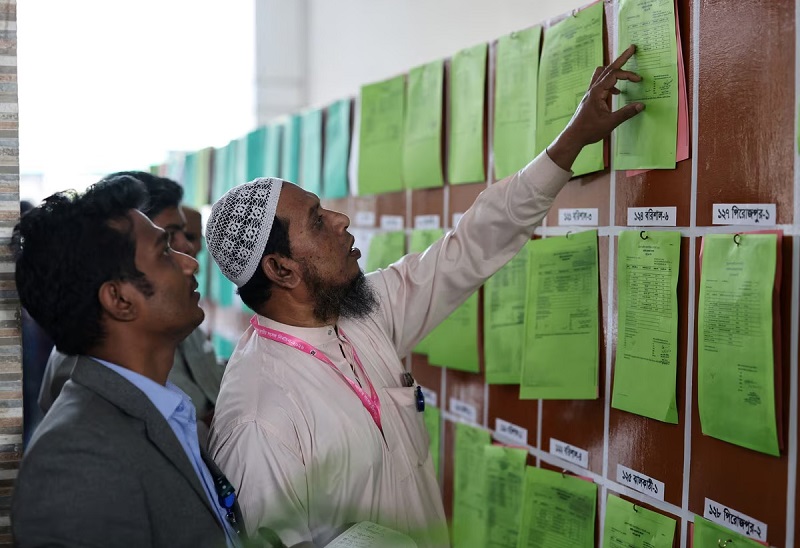
The BNP has scored a historic victory in Bangladesh… Jamaat’s victory in 77 seats has raised concerns in India, and border states are on alert.

Dhaka. Breaking the political deadlock of the last two decades in Bangladesh, the Bangladesh Nationalist Party (BNP) led by Tariq Rahman along with its allies has registered a historic victory in the general elections. By winning 212 out of 297 declared seats, the BNP has secured a two-thirds majority. With this victory, the BNP has returned to power in the country after 20 years. However, this election result has increased the concern of the security agencies and governments of India. The main reason for this is the landslide victory of Jamaat-e-Islami and its 11 allies in 77 seats.
The biggest concern for India is that a large portion of the seats Jamaat-e-Islami won are located in Bangladeshi districts bordering West Bengal and Assam. Analyzing the situation, Professor Maidul Islam of the Center for Studies in Social Sciences explained that after Sheikh Hasina’s Awami League withdrew from the election, the contest was essentially between Jamaat and the BNP.
Professor Islam said, “The BNP’s victory indicates that the issue of independent identity and nationalism remains important to the public in Bangladesh. Jamaat’s attempt to challenge the history of the 1971 Liberation War proved futile. However, the referendum also indicates that efforts will now be made to amend the 1972 Constitution.”
India’s border states on high alert
The Jamaat’s electoral strength can be gauged from the fact that it has re-established its dominance in the areas bordering six districts of West Bengal – Jalpaiguri, Malda, Murshidabad, Nadia, North 24 Parganas and South 24 Parganas – as well as Silchar in Assam. Security experts believe that this situation could pose a challenge for India’s Border Security Force (BSF) and intelligence agencies. The parts of the border where barbed wire is not installed have long been used for human trafficking and smuggling. Following this decision, India has been put on high alert.
Minority concerns
Political science professor Panchali Sen said that while Jamaat-e-Islami has softened its public stance toward India and shown openness to bilateral relations with neighboring countries, security and terrorism should remain a major concern for India. Professor Sen stressed, “The safety of minority Hindus in Bangladesh, who have already been attacked, should be on the Indian government’s priority list. While India has welcomed the decision, Delhi may adopt a cautious policy to maintain diplomatic relations with Dhaka and ensure a balance of power in the region.”
Terrorism Threat
An intelligence official, speaking on condition of anonymity, said it would be premature to make any predictions on the activities of terrorist organizations like Jamaat-ul-Mujahideen Bangladesh (JMB). The JMB has also established its network in India. “Of the six Bangladeshi organizations listed as terrorist groups in India, the JMB has shown the most growth in recent years. More than a dozen JMB operatives have been arrested in West Bengal and Kolkata between 2020 and 2025. These elements look towards organizations that support the Jamaat,” the official said.
In December 2025, a Kolkata court sentenced five JMB members, arrested from various parts of West Bengal and Assam in 2016, to life imprisonment. A large quantity of explosives and components of improvised explosive devices (IEDs) were seized from them.

Comments are closed.