
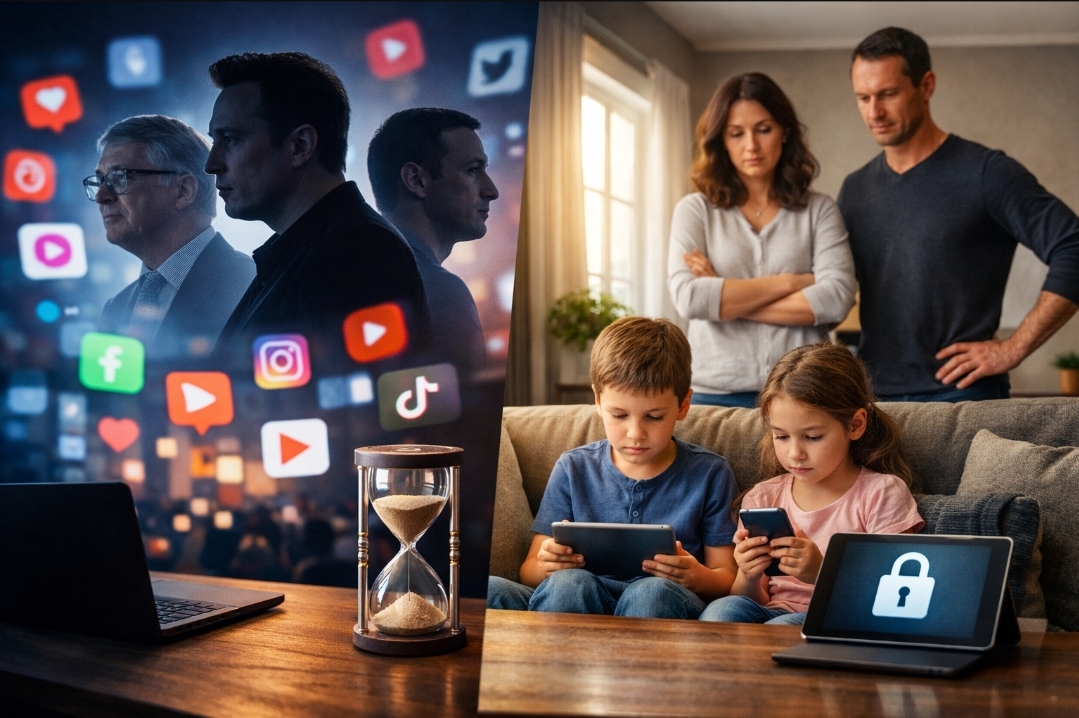

The people who helped design today’s always-online world are taking a surprisingly cautious approach inside their own homes. While their companies have built smartphones, social networks, and video platforms that dominate daily life, many of Silicon Valley’s most influential executives and investors are placing firm boundaries on how — and when — their children use those same tools.
This growing divide between public innovation and private parenting has drawn renewed attention as research mounts over the psychological effects of excessive screen time and governments consider new restrictions on youth access to social media.
More than a decade ago, Steve Jobs offered an early example of this restrained philosophy. In a 2010 interview with The New York Timesthe Apple cofounder said his children had never used the iPad, even as the device was becoming a global sensation. He also confirmed that technology use was limited in his household.
At the time, many found the revelation ironic. The man behind one of the most transformative consumer gadgets of the 21st century was deliberately keeping it away from his own family. In the years since, similar views have been echoed by other high-profile tech figures.
Childhood in the Era of Constant Connectivity
The broader cultural backdrop has shifted dramatically. Over the past decade, smartphones, tablets, and high-speed internet have become nearly universal. Social media platforms and short-form video apps now shape how young people socialize, learn, and entertain themselves.
The phenomenon has become so widespread that children deeply attached to their tablets are often referred to as “iPad kids.” According to the American Academy of Child and Adolescent Psychiatry, children in the United States between the ages of 8 and 18 spend an average of 7.5 hours per day interacting with screens — whether watching videos, scrolling social media, gaming, or texting.
For many parents juggling work and household responsibilities, digital devices can serve as an easy distraction tool. But among those who helped build the digital ecosystem, caution appears to be the prevailing instinct.
Concerns About Attention and Short-Form Media
Steve Chen, who co-founded YouTube, has publicly expressed reservations about the explosion of ultra-short video content. Speaking at the Stanford Graduate School of Business, Chen suggested he would prefer his children not grow up consuming only bite-sized clips.
His concerns center on attention spans. The dominance of rapid, algorithmically tailored videos has sparked debate among educators and psychologists who question whether constant exposure to fast-moving content may make sustained focus more difficult for young users. Chen has indicated that longer-form videos may encourage deeper engagement compared to the quick-scroll culture that now defines much of online media.
Tight Household Rules Among Tech’s Elite
Several other Silicon Valley leaders have spoken openly about strict digital rules at home.
At the 2024 Aspen Ideas Festival, investor Peter Thiel said his two young children are permitted just 90 minutes of screen time per week. Thiel, an early backer of Facebook, described firm limits as a deliberate parenting choice.
Bill Gates has long enforced similar boundaries. The Microsoft cofounder has said his children were not given smartphones until they turned 14 and that phones were not allowed at the family dinner table.
Evan Spiegel, who leads Snap, has also discussed restricting his child’s weekly screen exposure to roughly the same amount as Thiel’s limits. Meanwhile, Elon Musk has acknowledged that he may have been too relaxed about social media use in his own family and has reflected publicly on the importance of clearer boundaries.
Taken together, these examples reveal a pattern: many of the individuals who helped shape the attention-driven digital economy are deeply mindful of its potential downsides at home.
Platform Leaders Under Pressure
The conversation has intensified as technology companies face legal and political scrutiny over their impact on minors.
Shou Zi Chew has said his own children were too young to use TikTok. He later clarified that if they lived in the United States and accessed the platform’s version designed for users under 13 — which limits features such as posting and advertising — he would consider allowing it.
At the same time, executives have defended their companies against claims that social media platforms are intentionally engineered to be addictive for young people. Mark Zuckerberg recently testified in a case involving allegations that Meta’s products were designed to hook children. The company has highlighted safety tools it has introduced, including content filters and nighttime notification controls.
Adam Mosseri has also argued that labeling social media use as “clinical addiction” may overstate the issue, emphasizing the distinction between heavy usage and medical dependency.
Research and Regulation Gain Momentum
Scientific research has added urgency to the debate. A large 2025 study involving nearly 100,000 participants found consistent associations between frequent short-form video consumption and declines in cognitive performance, as well as worsening mental health indicators across age groups.
While researchers caution that such studies do not always establish direct causation, the findings have fueled growing concern among policymakers.
In response, some governments have begun taking action. Australia and Malaysia have introduced bans preventing adolescents under 16 from using social media platforms. Lawmakers in France, Denmark, and the United Kingdom are weighing similar measures, citing youth mental health and online safety concerns.
These public efforts mirror, on a national level, the cautious practices already adopted in many tech executives’ homes.

Comments are closed.