
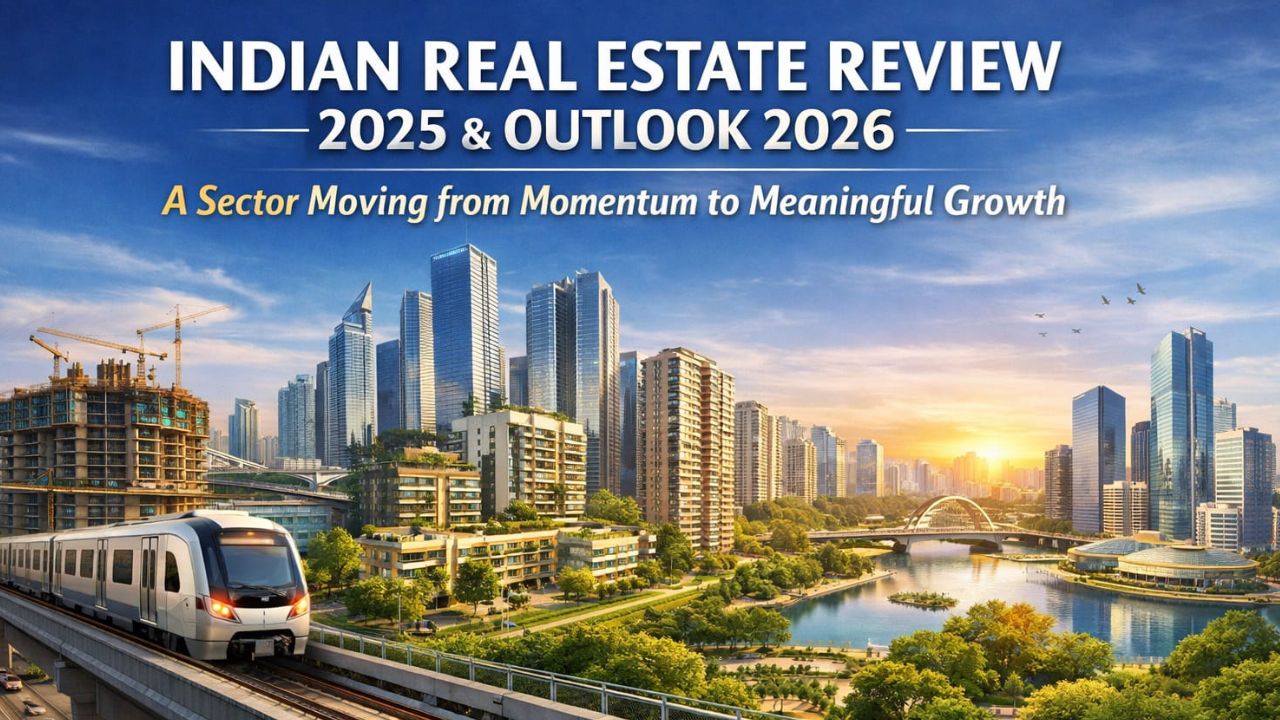
The ‘golden age’ of Indian real estate! Record growth in 2025; Now 2026 is the era of ‘smart’ and ‘sustainable’ homes

- The ‘golden age’ of Indian real estate!
- Record growth in 2025
- Now 2026 is the era of ‘smart’ and ‘sustainable’ homes
The Indian real estate sector ended the year 2025 with a strong and confident record. Consistent end-user demand, regulatory maturity and infrastructure transformation fueled the sector. 2025 saw a clear trend towards consolidation, experiential development and long-term value creation, creating a strong foundation for 2026.
While reviewing the previous year, Naredco Maharashtra Chairman Shri. Prashant Sharma said, “2025 has been a valuable year for India’s real estate sector. It has seen significant policy reforms, strong demand across asset classes and renewed emphasis on sustainable urbanization. The sector has not only shown resilience, but has also moved rapidly towards a more transparent, technology-enabled and customer-centric industry.”
Infrastructure and connectivity redefining urban growth
Infrastructure became the most influential growth factor in 2025, changing the pattern of value creation in cities, particularly in the Mumbai metropolitan region. Crest Ventures Limited Managing Director Shri. Vijay Choraria observes, “Connectivity is no longer just a complementary factor, but a key driver of real estate value. In the next five years, Mumbai will evolve into a multi-centric metropolitan region, supported by unprecedented infrastructure projects. This will bridge the gap and redefine urban values.” He further noted that newly developed areas with better connectivity will perform better than conventional pincodes as travel barriers are reduced.
Confirming the change, Srishti Group Co-Founder and Managing Director Shri. Kamlesh Thakur said, “There is a clear shift from connectivity to accessibility in 2025. Homebuyers are now not only considering locations based on distance, but are valuing ease of daily movement, saving time and easy access to workplaces, social infrastructure and lifestyle hubs.”
Also Read: Homelane’s Franchise Expansion Plan Accelerates! 756 crore performance with 22 percent revenue growth
Demand for home sales is stable, based on end users
End users continue to dominate residential real estate in 2025. The middle income group, premium and luxury segments witnessed consistent demand. Branded developers, planned projects and future-ready localities are favored by buyers.
Chairman of The Guardians Real Estate Advisory Shri. Kaushal Aggarwal said, “2025 proved once again that India’s real estate sector is now structurally sound rather than cyclical. Luxury and ultra-luxury homes saw record absorption, driven by HNI and NRI investors looking for stability and long-term value.”
In land-constrained markets, redevelopment was the hot topic of the year. The promoter of Ariha Group Shri. Dhrumaan Shah said, “Redevelopment is undoubtedly the dominant story of 2025. With land becoming increasingly scarce, co-operatives and tenants are looking to redevelopment as the best option for modern infrastructure and improved living standards.”
Design, well-being and intelligence: framing a new narrative
Not just limited to scale and infrastructure, 2025 saw a fundamental shift in how real estate is designed, valued and used.
Managing Director of Superb Realty Shri. Shilpin Tater explained, “Real estate is no longer just about building buildings; it’s about creating intelligent, human-centric ecosystems. Today’s buyers and users are opting for fewer but better-designed spaces that add real value to everyday life.” He further noted that design, technology and well-being have now become key drivers of long-term utility rather than optional factors.
Also Read: Baba Vanga predictions 2026: Big financial crisis in 2026? Baba Vanga’s prophecies created a sensation all over the world
Accelerate new segments
Commercial real estate remained stable in 2025. Grade-A offices, flexible workspaces and GCC demand supported the market. Warehousing, plotted developments and gated communities also witnessed increasing demand.
Ora Group Director Mr. Gaurav Verma said, “Plotted developments recorded demand growth of 25-30 per cent year-on-year in 2025. Land ownership, flexibility and long-term appreciation are driving the buyer trend. This trend is likely to strengthen in 2026.”
From an advisory and capital perspective, The Mandate House Pvt. Ltd. Founder Shri. Nihar Jayesh Thakkar said, “2025 marked a phase of stability and consolidation. Developers focused on faster implementation, less debt burden and stronger governance. Today the sector is more transparent, fiscally disciplined and aligned with long-term fundamentals.”
Vision to 2026: Structured Expansion, Smart Cities, Sustainable Value
Entering 2026, industry experts believe growth will be more balanced, infrastructurally aligned and quality driven. Sustainability, redevelopment and integrated planning will take center stage.
Naredco Maharashtra Chairman Shri. Prashant Sharma said, “Expectations are high for sustained growth, innovation and collaboration between industry, government and stakeholders as we enter 2026. Policy support, infrastructure acceleration and sustainability will be key drivers of growth in the next phase.”
Emphasizing the central role of connectivity, Mr. Vijay Choraria said, “In the next five years, Mumbai will not be seen as just an island city but as a multi-centric metropolitan region stretching to Panvel, Virar and Alibaug. The role of connectivity in determining demand will be more decisive than conventional pincodes.”
From a development point of view, Mr. Kamlesh Thakur added, “With many infrastructure projects nearing completion, many neglected corridors will be transformed into important residential and mixed-use destinations. Developers will focus on building landmark projects, in tune with changing mobility patterns and urban aspirations.”
Highlighting the importance of design intelligence and long-term utility, Mr. Shilpin Tater said, “Integrated, mixed-use projects based on walkability and proximity will gain more importance as we enter 2026. Buildings designed around people, intelligence and balance will remain useful for decades to come.”
Speaking on emerging investment topics, Mr. Kaushal Aggarwal said, “Plotted land investment will gain renewed importance as improved road, rail and metro connectivity opens up new development corridors. Long-term land ownership will increasingly be seen as a strategic asset.”
Taking a broad market view, Mr. Gaurav Verma said, “The picture is clearly optimistic as we enter 2026. With strategic stability, growing consumer confidence and expansion into new micro-markets, Indian real estate is poised for sustainable, scalable and smart growth.”
Summarizing the future direction of the sector, Director of Transcon Developers Ms. Shraddha Kedia-Agarwal said, “Infrastructure will continue to be the backbone of real estate growth in 2026, while sustainability, integrated lifestyle and responsible development will shape the next phase of urban evolution.”
As India enters 2026, the real estate sector is poised to move from momentum to maturity—creating connected, resilient and fundamentally human-centric cities.

Comments are closed.