
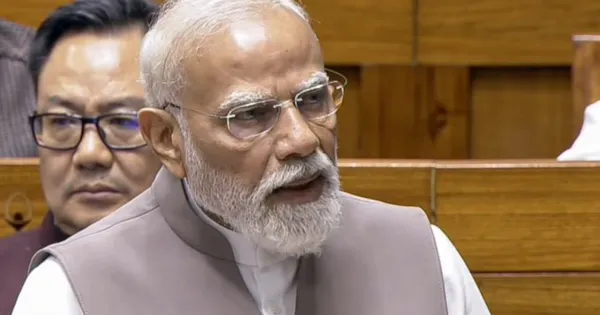
The government will continue to help the farmers… Amidst the West Asia crisis, PM Modi said in the Parliament – Adequate arrangement of fertilizers to deal with the emergency.

New Delhi. Amidst the deepening crisis in supply chains due to the war in West Asia, Prime Minister Narendra Modi on Monday assured the farmers of the country that the government will continue to help them in this crisis like during the Corona period. The Prime Minister has also assured the public that there is full stock of food grains in the country and there will be no shortage. He was giving a spontaneous statement in the Lok Sabha on the impact of the West Asia crisis due to the Iran war.
PM Modi said, “Through this House, I assure the farmers of the country that the government will continue to help the farmers in every possible way.” He called upon every section of the country to face the challenges together in this critical time. In his long statement, Modi mentioned in detail about farming, supply of fertilizers and the impact on farmers and said, ‘A big question is what will be the impact of the war on farming? The farmers of the country have filled our grain stores, so India has enough food grains. It is also our endeavor to ensure proper sowing of Kharif season. The government has also made adequate arrangements for fertilizers to deal with emergency situations over the years.”
Pointing to the Corona period and various geopolitical crises, the Prime Minister said that in the past also his government had not allowed the burden of world crises to fall on the farmers. During Corona and subsequent developments, global supply chains were disrupted and a bag of urea reached Rs 3000 in the world market.
He said that even at that time the same bag of urea was made available to the farmers in India at a price of less than Rs 300. The Prime Minister said that in the last decade, six urea plants have been started in the country, which has added the capacity to produce urea of more than 76 lakh tonnes annually. During the same period, domestic production of fertilizers like Di Ammonia Phosphate (DAP) and Potassium (NPKS) has also been increased by about 50 lakh tonnes.
He said, ‘Not only this, like oil and gas, the import of fertilizers has also been diversified. Similarly, for the import of DAP and NPKS, we have expanded our options.” He said that farmers have been given the option to use nano urea manufactured in the country and they are also being encouraged for natural farming. Under PM Kusum Yojana, more than 22 lakh solar pumps have been given to the farmers, this has also reduced their dependence on diesel.
The Prime Minister said, ‘A big challenge of the war is that the summer season is starting in India. In the coming time, with the increasing heat, the demand for electricity will also increase. At present, adequate coal stocks are available for all the power plants in the country.” He said that India has set a record of producing 100 crore tonnes of coal for the second consecutive year. All our systems from power generation to supply are also being continuously monitored, and the government’s preparedness has also been helped by renewable energy.
The country has taken big steps towards renewable energy in the last decade. All these efforts are of great use to the country today. He said, ‘Half of our total installed power generation capacity comes from renewable sources. Our total renewable capacity has today crossed the historic figure of 250 GW (2.5 lakh MW). In the last 11 years, the country has increased its solar energy capacity from about three giga watts to 140 giga watts (1.4 lakh MW).
In the last years, about 40 lakh rooftop solar have been installed in the country, in this the PM Suryaghar free electricity scheme has also helped a lot of people. Today, 200 compressed biogas plants have started functioning in the country under Gobardhan Yojana. The government has also encouraged nuclear energy production in the country through the Future Preparedness and Growing Peace Act. The Prime Minister said that just a few days ago the Small Hydropower Development Scheme has also been given the green signal, through which 1500 MW of new hydropower capacity will be added in the coming years.

Comments are closed.