

The habit of working through lunch has become a global phenomenon. According to Channel News Asiaa 2025 survey by Censuswide for corporate food delivery platform Deliveroo for Work revealed that only 32% of white-collar workers in Singapore take their full lunch breaks.
Priscilla Lee, a 32-year-old finance executive told the news outlet: “I can’t enjoy a meal when I know there’s something more important to finish.”
To avoid staying late, she eats a large breakfast at 9 a.m. and works straight through the afternoon.
The trend is equally prevalent in the U.S. A June 2025 report by ezCater showed that 51% of full-time American employees skip lunch at least once a week, while 33% skip it twice or more, as reported by Forbes.
Common cited drivers for this trend include mounting workload pressures, family responsibilities, the desire to leave the office earlier, and a fear of being perceived as incompetent at work.
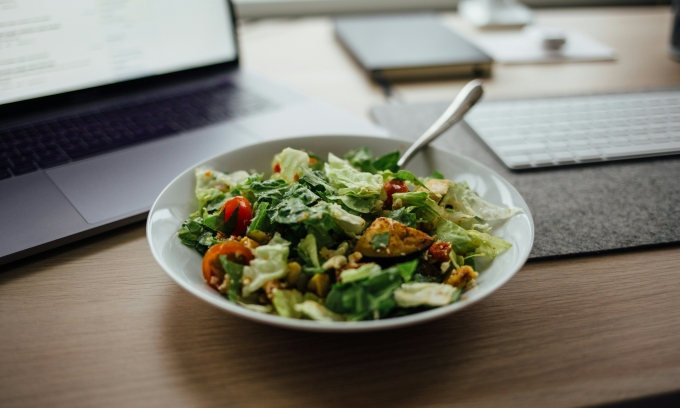
A salad bowl on top of a table near a laptop. Illustration photo by Unsplash |
However, experts argue that this approach backfires biologically. Attempting to multitask by eating while answering emails keeps the body in “work mode,” which slows the production of stomach acid and digestive enzymes, ultimately impairing nutrient absorption.
Soh Wan Keem, principal dietitian and founder of Nutrimaxx Consultancy, also noted that “desk-diners” are more likely to reach for fried or dry convenience foods that lack nutritional value. This leads to a domino effect: energy crashes during the day followed by overcompensation with a massive dinner at night, which unsettles blood sugar and disrupts hunger cues for the following morning.
The consequences go beyond physical health.
“In the long-term, not pausing to refuel leads to burnout, stress and less mental clarity,” said Diane Swint of ezCater, as quoted by the New York Post. “While workers might feel that skipping midday breaks saves time, the reality is that this habit decreases focus and lowers productivity.”
The data supports this: 82% of respondents in the Censuswide survey admitted that eating a proper meal actually boosts their output.
For Keiilynn Rainn Dean, a 22-year-old marketing executive in Singapore, a midday reset is essential for creative work.
“I don’t function well when I’m mentally drained. These resets often give me better ideas when I return to my desk,” she said.
Scientific evidence backs Dean’s experience. Pausing to eat activates the parasympathetic nervous system, often called the “rest and digest” mode, which stabilizes glucose levels and sharpens decision-making.
To avoid the negative effects, experts recommend maintaining a regular lunch break, ideally away from the workstation. For those on a tight schedule, Soh suggests keeping a “rescue pack” of oats, peanut butter, and berries to prevent the irritability and crashes caused by an empty stomach.
Sarah Heckler, a licensed dietitian in North Carolina, told the Fox News that the composition of the meal is just as important as the break itself.
“Choosing a well-balanced lunch that includes a mix of macronutrients (carbohydrates, proteins, and fats) helps maintain steady blood sugar levels,” Heckler said. “This, in turn, supports sustained energy throughout the afternoon, preventing the need for excessive caffeine consumption or unhealthy snacks to stay alert.”

Comments are closed.