

New Delhi: When Indian cinema was born in the early twentieth century, it faced a peculiar challenge—who would agree to act in films?
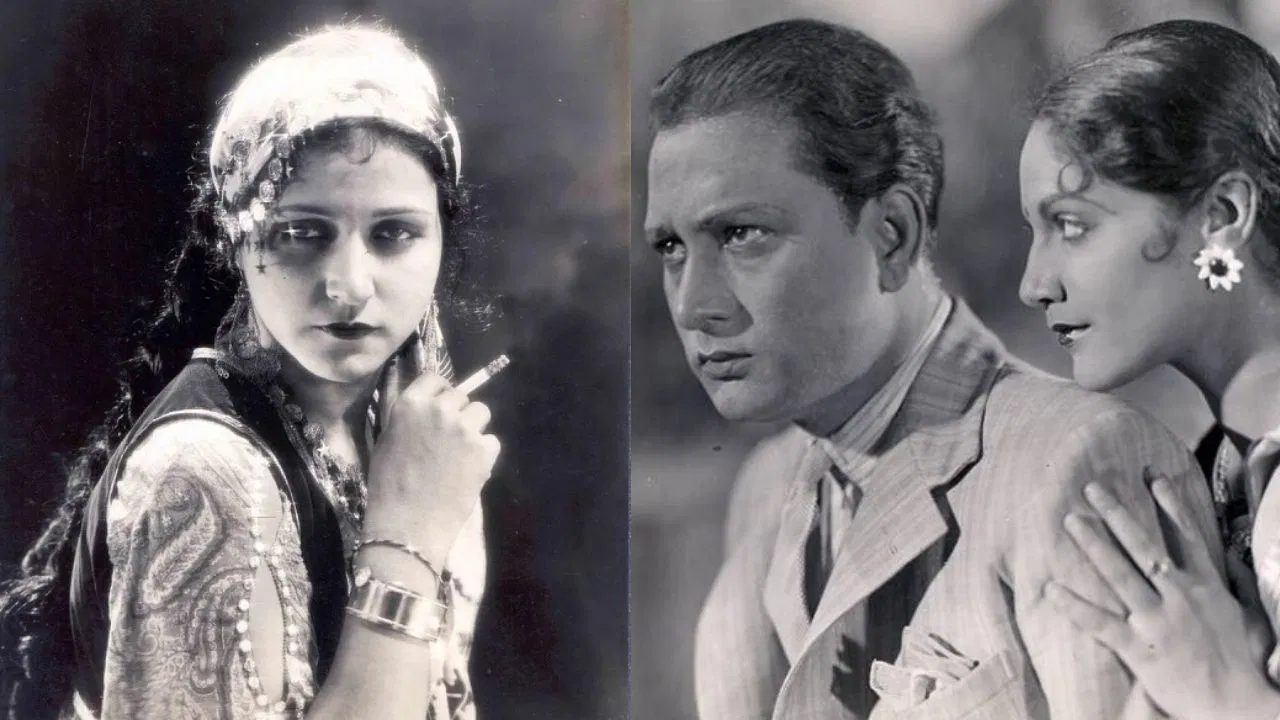
For many ‘respectable’ Hindu and Muslim families, appearing on screen carried social stigma. Acting was considered disreputable, and studios struggled to find women willing to perform. Into this vacuum stepped an unexpected community ‒ the Baghdadi and Bene Israel Jews of Bombay.
From a population that never seemed to exceed 6,000, it once numbered 30,000 in the 1940s. It was around that time that Jewish artists helped build the foundations of what would become Bollywood. They were silent-era superstars, early beauty queens, producers, directors, lyricists, and institutional pioneers. Their contribution was not marginal; it was foundational.
Women who became India’s first stars
At a time when few ‘respectable’ women would act, Jewish actresses filled a social gap. Many adopted Hindu screen names to connect with mainstream audiences. Reinvention became part of the job and part of survival.
Ruby Myers, known on screen as Sulochana (1907–1983), was the first true superstar of Indian silent cinema.
Born into a Baghdadi Jewish family in Pune in 1907, she rose to extraordinary fame in the 1920s, starring in over 70 films. In Wildcat of Bombay (1927), she famously played eight different roles, a feat that stunned audiences. At the height of her career, she was reportedly one of the highest-paid performers in the country. Her stardom demonstrated that cinema, still considered socially suspect, could nonetheless produce icons.
Another trailblazer was Esther Victoria Abraham, who performed under the name Pramila (1916–2006).
Crowned India’s first Miss India in 1947, she acted in around 30 films, which include hits like Mother India (1938) and Jungle King (1939), often performing her own stunts at a time when such roles were rare for women of any background. She later founded Silver Productions and produced 16 films, becoming one of Indian cinema’s earliest female producers. In pre-independence Bombay, she embodied a modern, boundary-crossing identity, professionally ambitious and socially unconventional.
Then came Florence Ezekiel, better known as Nadira (1932-2006), who defined the screen vamp of the 1950s and 1960s.
She appeared in landmark films such as Aan (1952), Shree 420 (1955), Dil Apna Aur Preet Parai (1960), Pakeezah (1972), and Julie (1975), winning a Filmfare Award for the latter. With her imperious poise and cosmopolitan aura, Nadira helped shape the image of urban sophistication and moral ambiguity on the Hindi screen.
Men who built the industry’s foundations
Jewish contributions extended far beyond acting and included prominent male achievers not only in front of the camera but also behind it.
Joseph David Penkar (1872-1949) helped shape a turning point in Indian cinema. He wrote the screenplay for Alam Ara (1931), India’s first talkie. In doing so, he contributed to the song-driven narrative structure that would become Bollywood’s defining feature. The transition from silent cinema to sound permanently altered the grammar of Indian films, and Jewish writers were present at that crucial shift.
David Abraham Cheulkar (1908-1981), affectionately known as Uncle David, became one of Hindi cinema’s most beloved character actors. Best known for his portrayal of John Chacha in the 1954 hit Boot Polish, he appeared in more than 110 films across decades, including cult films such as Chupke Chupke (1975), Baton Baton Mein (1979), and Gol Maal (1979). He worked with major filmmakers and represented India in cultural exchanges abroad. Known for hosting prominent shows, David once received one of the finest compliments of his life from former Prime Minister of India Jawaharlal Nehru, who remarked that no event felt complete without a speech from him. He also achieved a rare dual distinction when he was awarded the Padma Shri in 1969 for his contributions to the arts and sports promotion.
Ezra Mir, born Edwin Myers (1903-1993), directed numerous films and later became the founding Director General of the Films Division of India (FDI). Through documentaries and newsreels, he helped institutionalise filmmaking practices in post-independence India, shaping how the young nation saw itself on screen. He received the Padma Shri in 1970.
Bunny Reuben (1926–2007) of the Bene Israel community was among the country’s most respected cine-biographers and film historians. He served as Director of Publicity to leading filmmakers and was so highly regarded that when Steven Spielberg planned to shoot portions of Close Encounters of the Third Kind in India, Reuben was his chosen publicist. He also produced and wrote Aashiq (1962), a sensitive drama about a man torn between family and artistic passion, a subject ahead of its time. Reuben’s contribution to film journalism was recognised with the Twentieth Century Cine-goers Award (1990) and the Sahyog Foundation Award for Best Film Journalist (1994).
Herman Benjamin (1931-1968), also known as Harman, was among the early architects of Hindi film choreography, crafting some of the most energetic dance numbers of the 1950s and 60s. He worked on popular films such as Chalti Ka Naam Gaadi (1958) and choreographed several Shammi Kapoor hits, including Teesri Manzil (1966). One of his most enduring creations remains ‘Jaan Pehechan Ho’ from Gumnaam (1965), a song that found a new global audience decades later when it featured in the opening of Ghost World. In recognition of his contribution to film dance, his family was honoured posthumously by the Indian Film Dance Directors Association (IFDDA) in 2012.
From performance to policy, Jewish professionals were woven into the industry’s early fabric.
When silence turned to sound
The transition from silent films to talkies in the early 1930s changed the industry and altered trajectories.
In the silent era, expressiveness and screen presence mattered more than language. Once dialogue became central, fluency in Hindi grew important. Some Jewish actresses, whose mother tongues were Judeo-Arabic or English, found themselves manoeuvring a more linguistically demanding industry.
Film historians suggest this shift contributed, in part, to later Jewish actresses being cast more frequently as vamps or supporting characters rather than central heroines. As cinema became more dialogue-driven, its hierarchies subtly shifted.
Recovering the story
This largely forgotten chapter was revisited in the 2017 documentary, Shalom Bollywood: The Untold Story of Indian Cinema, directed by Danny Ben-Moshe.
The film explores how Baghdadi and Bene Israel Jews shaped Bollywood’s formative decades. Through archival footage, interviews, and historical reconstruction, it reclaims a narrative that had gradually faded from mainstream memory. The documentary underscores how deeply embedded Jewish artists were in the creation of Indian cinematic culture.
A community that slowly disappeared
The establishment of the State of Israel in 1948 set in motion a gradual emigration of Indian Jews to Israel, the United Kingdom (UK), and Australia. By the 1960s and 1970s, the community in India had significantly diminished.
As the population shrank, so did its presence in the film industry. The silent-era stars and early pioneers had no obvious successors from within their community. What remained were memories, credits in old film reels, and fading studio portraits.
The story of Jews in Indian cinema and beyond is ultimately a story about Bombay at its most cosmopolitan era ‒ a city where talent could, at least for a time, transcend religious boundaries, ethnicity, and gender. And before Hindi cinema found its voice, it found its faces, and many of them were Jewish.
From a tiny community of roughly below 5,000 people currently, these men and women advanced diversity, feminism and professional filmmaking in ways that shaped Indian cinema for generations. Their stories deserve to be remembered not as a footnote, but as a founding chapter.
Circa 2026
Though small in number, Jewish voices continue to shape Indian cinema and the arts in meaningful ways. Actor and screenwriter Haider Ali, son of the legendary Pramila (Esther Victoria Abraham), co-wrote the screenplay for Jodhaa Akbar and remains an active creative force. The Roy Kapur brothers, producer Siddharth Roy Kapur and actors Aditya Roy Kapur and Kunaal Roy Kapur, trace their Jewish lineage to their maternal grandfather.
Sam Aaron was a pioneer of jazz and ballroom dancing in India. Television actor Madhura Naik, of Bene Israel descent, remains a visible Jewish presence on the Indian small screen. Beyond cinema, Indian-Israeli chef Reena Pushkarna has become a cultural bridge between the two countries. On the global art stage, Mumbai-born sculptor Sir Anish Kapoor, of Iraqi-Jewish heritage, stands as one of the most celebrated contemporary artists, his monumental works and exploration of the ‘void’ earning him the prestigious Genesis Prize in 2017.

Comments are closed.