
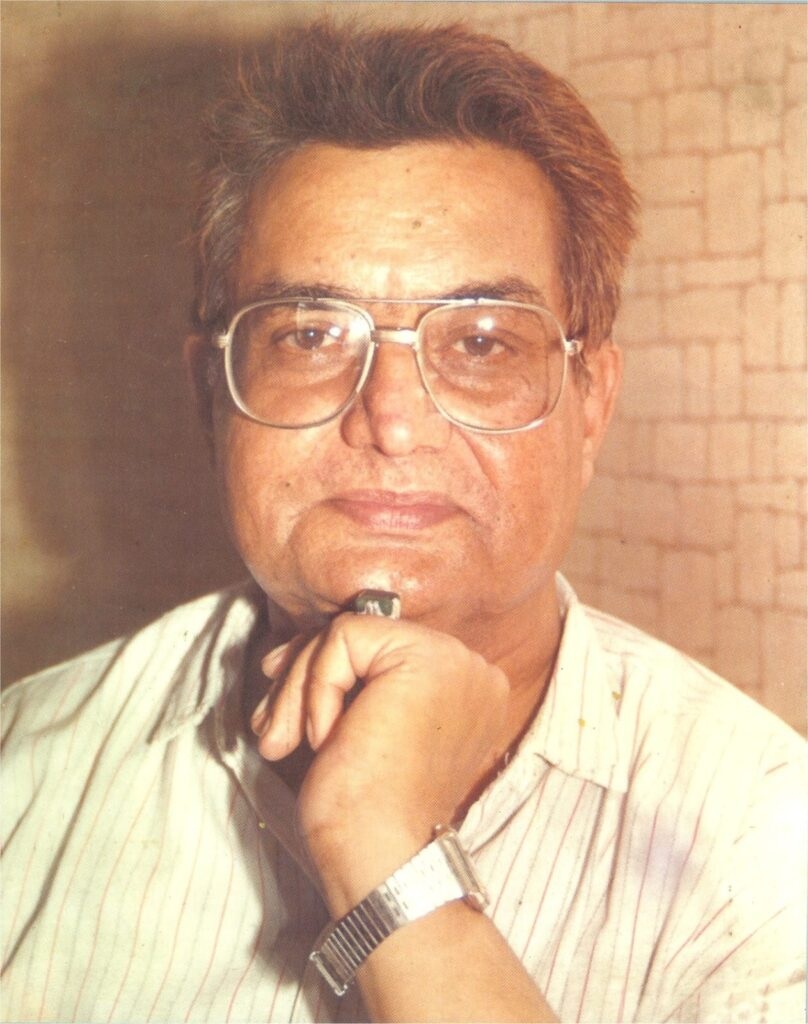

Born on 9 August 1933 in Ajmer, Joshi had his roots in a cultured Kumaoni Brahmin family of Almora district of Uttarakhand. Interestingly, this pioneer of Hindi literature started his career from science. Joshi, who did B.Sc. from Lucknow University, had the power of logic and analysis in his thinking which was later seen in his literature. His writings did not present a cry of emotions but a surgical analysis of the society.
In Lucknow, he met the legend of Hindi literature, Amritlal Nagar. Under Nagar’s guidance he learned that great literature is that which reaches straight to the heart of the common man. It was from here that the soul of ‘Kissago’ was born within Manohar Shyam Joshi.
Before becoming a writer, he was a journalist. He realized the power of voice while working at All India Radio and found cinematic vision while writing documentaries in the Films Division. Litterateur Agyeya made him assistant editor of ‘Dinmaan’ magazine. After this, when he became the editor of ‘Saptahik Hindustan’, the presence of his writings started being felt in every house of the Hindi belt.
‘Hum Log’, which ran for 154 episodes in 1984, made him the father of Indian soap opera. If ‘Hum Log’ was TV’s Ramayana, then 1986’s ‘Buniyaad’ was its Mahabharata. The intensity with which he presented the pain and displacement of India-Pakistan partition through the story of Master Haveliram and Lajo made the entire country cry. Director Ramesh Sippy also admitted that the real foundation of the success of ‘Buniyaad’ was the pen of Manohar Shyam Joshi.
After this he presented a unique blend of satire, humor and psychological depth on TV through ‘Kakkaji Kahin’, ‘Mungerilal Ke Haseen Sapne’ and many other programs. His style always challenged the boundaries of traditional grammar and words.
His first novel ‘Kuru Kuru Swaha’ (1980) created a stir in the literary world. Novels like ‘Kasap’ and ‘Kyaap’ won him the Sahitya Akademi Award. The influence of cinema is also clearly visible in his novels; With words like camera, silent shot and mute face, the readers feel as if they are watching a film. The Hindi dialogues of Kamal Haasan’s film ‘Hey Ram’ are also his contribution.
Manohar Shyam Joshi breathed his last on 30 March 2006 in New Delhi at the age of 72. But his contribution to literature and TV gave a new direction to Hindi cinema and television, and made him a master of ‘storytelling’.

Comments are closed.