
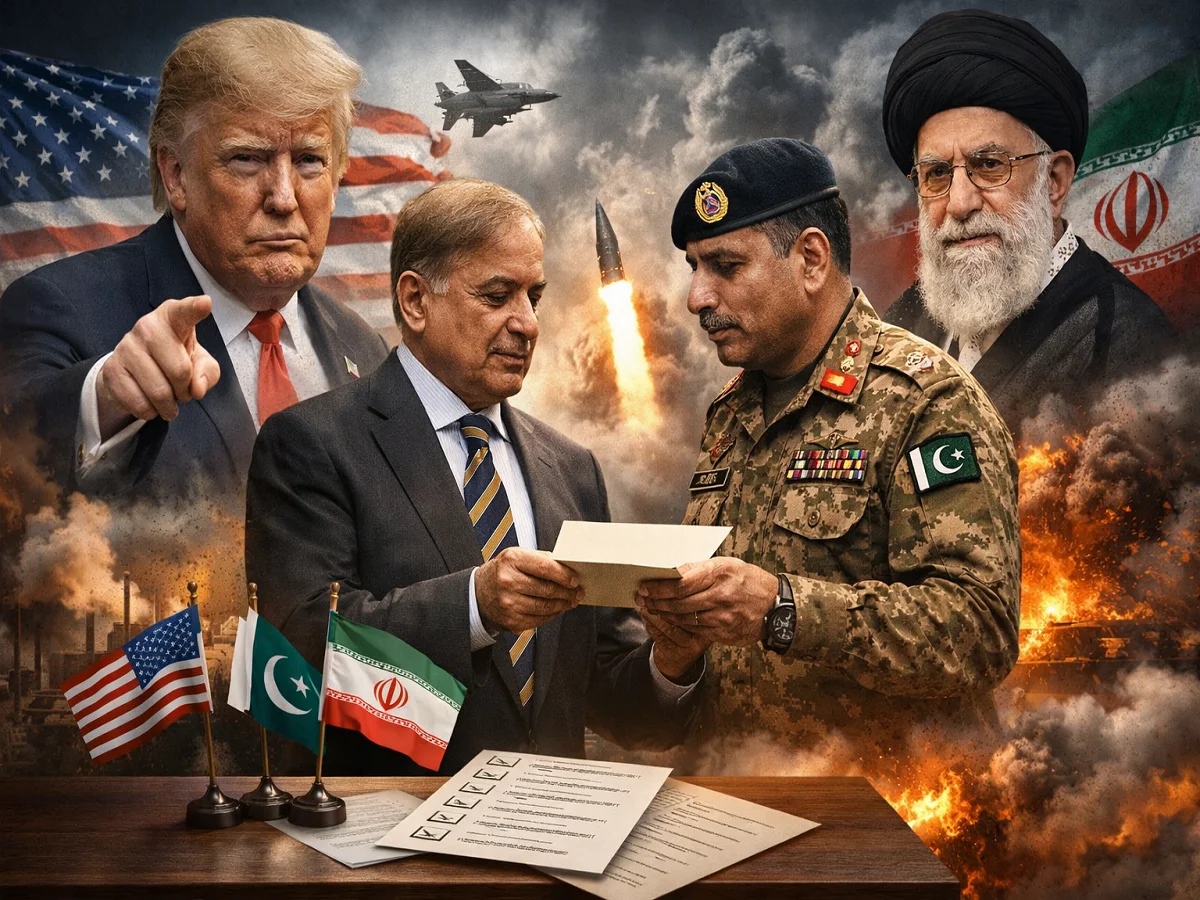
Big secret hidden behind Iran-America ceasefire! Pakistan becomes backchannel, shocking revelations in the report

A new report regarding the recent temporary ceasefire between America and Iran has exposed many hidden aspects of international politics. While Pakistan is trying to take credit on the global stage by portraying itself as an important mediator of this agreement, international media reports are presenting a different side of the story.
Prestigious London based newspaper Financial Times According to a report, Pakistan’s role in this entire diplomatic incident was not as independent as it is trying to show. In fact, America used Pakistan as a ‘backchannel messenger’ so that it could convey its conditions and proposals to Iran.
Pakistan’s role: mediator or messenger?
According to the report, America chose Pakistan as a medium instead of directly communicating with Iran. The strategic thinking behind this was that Iran could take the message sent through a Muslim majority country more seriously.
In this entire incident, Pakistan played an important role in the exchange of proposals between America and Iran. But this also raises the question whether Pakistan was actually an independent arbitrator or was merely acting on the instructions of the US.
Secret diplomatic game going on behind the scenes
Pakistan remained an important link in this secret diplomatic effort that lasted for several weeks. According to the report, America had handed over the responsibility of preparing Iran for a ceasefire to Pakistan.
Pakistan Army Chief Asim Munir played a central role in this process. He continued to maintain contact with the US leadership, including Donald Trump, JD Vance and Steve Witkoff.
During this period, Islamabad acted as a “silent channel” between Washington and Tehran, where proposals from both sides were exchanged.
15-point US proposal and Iran’s response
According to sources, America had prepared a detailed 15-point plan, which was delivered to Iran through Pakistan. In response, Iran also shared its proposals of 5 and 10 points.
After continued negotiations, there were indications that Iran had agreed to make limited concessions on some parts of its nuclear program. The result of this diplomatic process was a two-week temporary ceasefire, which was jointly announced by America, Iran and Israel.
However, during this period, Donald Trump’s public rhetoric remained quite strict. He clearly warned that Iran would have to face serious consequences if the conditions were not followed.
Social media post made with White House approval
Another important revelation was that the social media post made by Pakistan Prime Minister Shehbaz Sharif was also not completely independent.
According to the report, this post was shared only after the approval of the White House. This post appealed to extend Trump’s deadline, which came at a time when the US deadline was near.
This indicates that even though different statements were being made in public, behind the scenes there was a deep coordination between America and Pakistan.
What does this report say?
This entire incident makes it clear that diplomacy in global politics is often more complex than it appears on the surface. Pakistan may have presented itself as a ‘peacemaker’, but according to the report its role remained limited to that of a strategic messenger.
This case not only highlights the complexity of US-Iran relations, but also shows how big countries use third countries to further their interests.
This temporary ceasefire between Iran and America was not just a simple agreement, but diplomatic strategies hidden in many layers were working behind it. Pakistan’s role certainly remained important in this entire incident, but now questions are being raised about its independence and real influence.
It will be interesting to see in the times to come whether this temporary peace moves towards a permanent solution or leads to a new tension.

Comments are closed.