
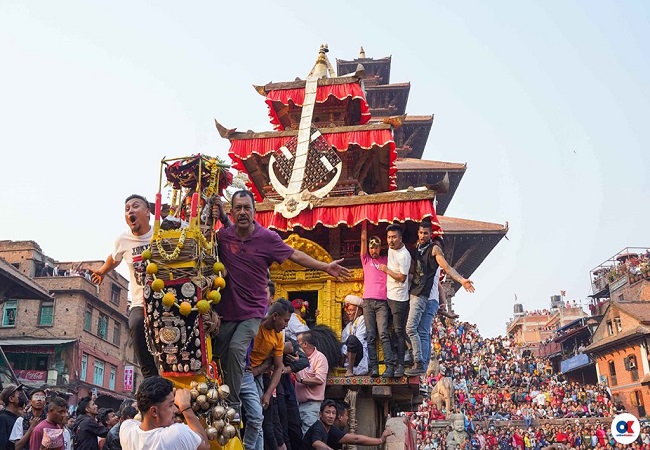
Nine-day Biska Jatra started to welcome Nepali New Year, cultural programs took place in the highest temple Nyatapol.

New Delhi. Early celebrations with music and festivities to welcome the Nepali New Year began in Nepal’s ancient city of Bhaktapur on Thursday. On the eve of the formal start of Bisca Jatra, the nine-day festival of the ancient city of Bhaktapur, dozens of teenagers and youth came together to give a rhythmic musical performance. Each beat of the Dhime, a traditional two-faced cylindrical drum, tells a different story and the dance also tells a story that has its own special significance. This cultural program was organized on the steps of Nyatyapol, the highest temple of Nepal.
Read :- Assam Election: BJP made 31 promises to the people of Assam in the manifesto, investment of Rs 5 lakh crore and guarantee of safety of indigenous people.
Manish Ghimire told that this presentation was given by the Neva community. It is done to welcome the Nepali New Year i.e. Vikram Samvat. It is performed by the Newar people in their traditional attire, commonly known as Newar costume (Haku Patasi). Located in the ancient Taumarhi Chowk of Bhaktapur, this temple is packed with celebrants and devotees during Bisca Jatra. According to folklore, this festival signals the arrival of the Nepali New Year. Ghimire said that it was really wonderful. Everyone was dancing in perfect sync and the artists did not make a single mistake, making it very enjoyable and beautiful to watch. Bisca Jatra, one of the popular religious festivals of Kathmandu Valley, begins with the enthronement of Lord Bhairava on a chariot built in front of Nyatyapol Temple, the tallest temple in Nepal. Two groups of local people display their physical strength and compete to pull this chariot in opposite directions, as per a centuries-old tradition. As a part of this festival, this three-storey chariot made of wood in pagoda style, which houses the idols of Bhairavnath and Betal, is taken around different settlements of the city. This festival of cultural and historical importance is celebrated for nine days and eight nights. Believed to have started during the reign of the Malla Dynasty, this Bisca Jatra festival formally begins just four days before the arrival of the Nepali New Year.
Comments are closed.