
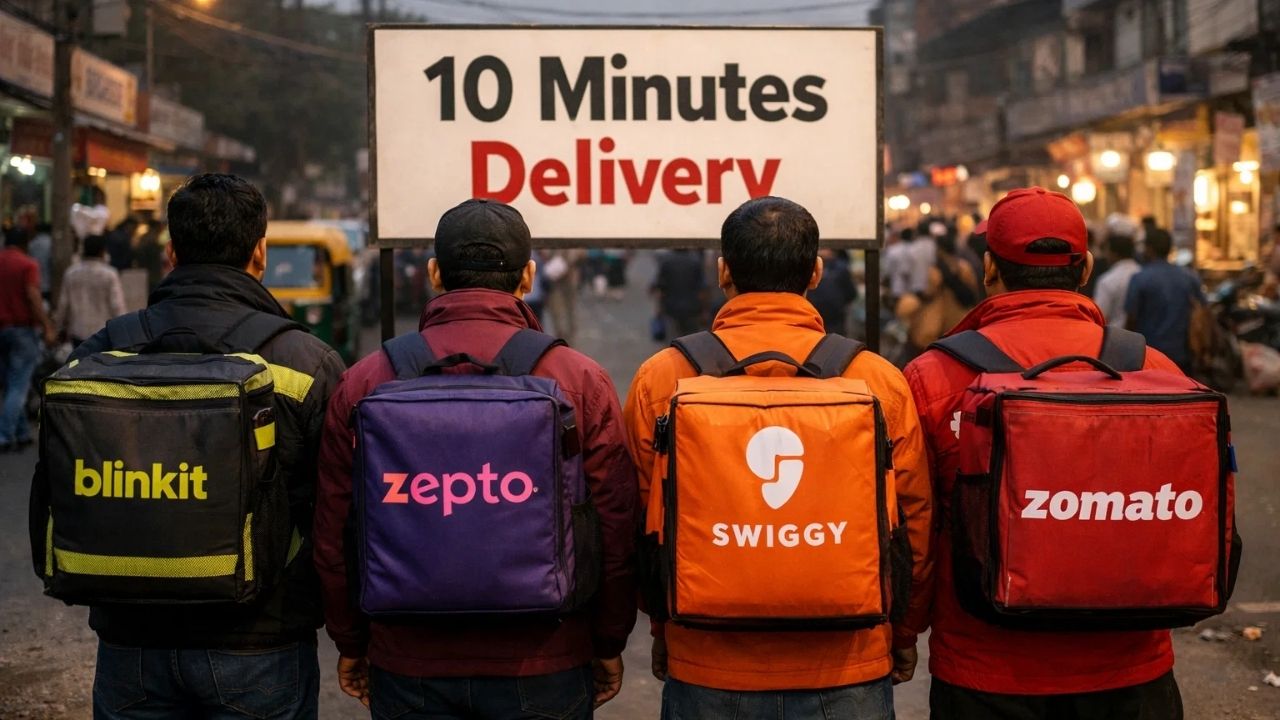
The order is yours, the risk is theirs… Why was it necessary to stop the 10 minute delivery model?

Ordering something from Blinkit and Zepto will no longer deliver the goods within 10 minutes. Companies have now ended the ’10 minute delivery model’. This means that now it is not necessary that the goods you have ordered should be delivered to you within 10 minutes. After the intervention of Union Labor Minister Mansukh Mandaviya, quick commerce companies like Blinkit have abolished the ‘delivery in 10 minutes’ system.
Last year, on December 25 and December 31, gig workers associated with companies like Blinkit, Zepto, Swiggy and Zomato went on strike. One of their major demands was to end the ’10 minute delivery model’.
Aam Aadmi Party MP Raghav Chadha had also raised the demand to abolish this model from Parliament to the streets. He also made the delivery with Blinkit’s delivery agent on Sunday. After the decision was taken to end this model, Raghav Chadha called it a big victory for gig workers.
Read this also– Your 100 rupees are worth 12 lakhs in Iran… How much has the currency of Khamenei’s country fallen?
What do gig workers have to say?
Gig workers have been demanding the abolition of the ’10 minute delivery system’ for a long time. Blinkit was the first to finish it on Tuesday. Blinkit also changed the brand messaging. Blinkit has changed it from ‘10,000+ products delivered in 10 minutes’ to ‘30,000+ products delivered to your doorstep’.
On this, Aam Aadmi Party MP Raghav Chadha said, ‘Today is a very important day for the gig workers of the country. This is good news for all of them. Quick commerce companies like Blinkit will now remove 10 minutes deliver branding. Your voice may not have reached the management of these companies or they may have ignored it. But the central government heard your voice and took action.‘
On this decision a gig worker said, ‘If we do not reach on time, customers abuse us. They get our ID blocked and impose fine. We also have to go to the wrong side. We have to break all the traffic rules for fast delivery.‘
Another gig worker said, ‘Whatever the government has done is good. it was very difficult. I have had two accidents. My leg was fractured twice. If we get more time, it will be more convenient for us. We had to deliver very quickly. If there was any delay, it would affect our rank. If there was a delay our rating would have fallen.‘
A gig worker associated with a quick commerce company in Ghaziabad said, ‘Now we can move at our own pace. Now there will be no pressure that we have to deliver within 10 minutes.‘
Read this also– What is ‘Orange Economy’? On which the government increased its focus
How big is the market of quick commerce??
- market leader: Blinkit is the largest player, with a market share of 45%.% Is. zepto’s 21% And 2 of Swiggy Instamart7% Is. all three together 93% Control the market. Apart from these three 7% Big Basket dominates the market.
- business revenue: According to Crisem’s report, sales in quick commerce industry increased by 280% in two years.% Has increased more than. Its value in 2021-22 was $500 million, which will increase to $3.34 billion by 2023-23. By 2029 it will reach approximately $10 billion.
- how many orders: Every day there are 30 to 50 lakh orders from Quick Commerce. According to the report of Economic Times, initially the average order on Quick Commerce was Rs 250. Now the average price of every order placed from them has reached Rs 500.
- delivery agent: It is estimated that 2.5 to 4 lakh people are associated with quick commerce companies in India. These include delivery agents, warehouse staff and people associated with companies.
- how does it work: In this, delivery is done within 10 to 30 minutes. of companies at various places ‘dark store‘ Are there. These dark stores remain closed to the general public. Delivery agents pick up the order from here and deliver it to the customer.
Read this also–Will consumption reduce by increasing taxes? Complete account of tax on cigarettes

why was it necessary ‘10 minute delivery model‘ finish?
On January 7, Zepto’s delivery agent K. Abhishek died in a road accident. 25 year old Abhishek was a resident of Hyderabad. Abhishek was going to deliver goods and hence was driving at high speed. Police said that due to high speed he lost control and the bike slipped.
’10 delivery within minutes‘ How great the pressure to perform can be understood from the example of Abhishek. If there was no pressure on him to deliver as soon as possible, he might have been alive today.
Al-Jazeera did a report in 2022, in which it was told how heavy the burden on delivery agents is to deliver in 10 minutes. A delivery agent told Al-Jazeera that deliveries had to be made 5 kilometers away within 10 minutes. This is impossible. Even if traffic rules are broken, goods cannot be delivered by covering 5 kilometers in such a short time.
A delivery agent had told that in order to deliver within 10 minutes, traffic rules have to be broken. Due to this, their challan is issued, the expenses of which they have to bear. This shows the mental pressure under which delivery agents work.

english newspaper ‘The Hindu‘ A report from November 2025 shows that in Bengaluru alone, 27 delivery agents have died in three years in the rush to make quick deliveries. Reports show that cases of delivery agents breaking traffic rules have doubled in three years. In 2023, 30,968 challans were issued to delivery agents for breaking traffic rules. 52,153 cases were reported in 2024. At the same time, 63,718 cases were reported from January to September in 2025. This data shows the kind of risks delivery agents have to take in order to make quick deliveries.
Not only this, Quick Commerce has also ruined the business of grocery stores. All India Consumer Products Distributors Federation (AICPDF) According to , more than 2 lakh grocery shops have been closed after the arrival of Quick Commerce.
However, Zomato founder Deepinder Goyal dismisses the concerns of delivery agents. He recently said that most dark stores are within a radius of 400 meters to 2 kilometers. Riders have to drive at an average speed of 16 kilometers per hour to deliver goods.

Comments are closed.