
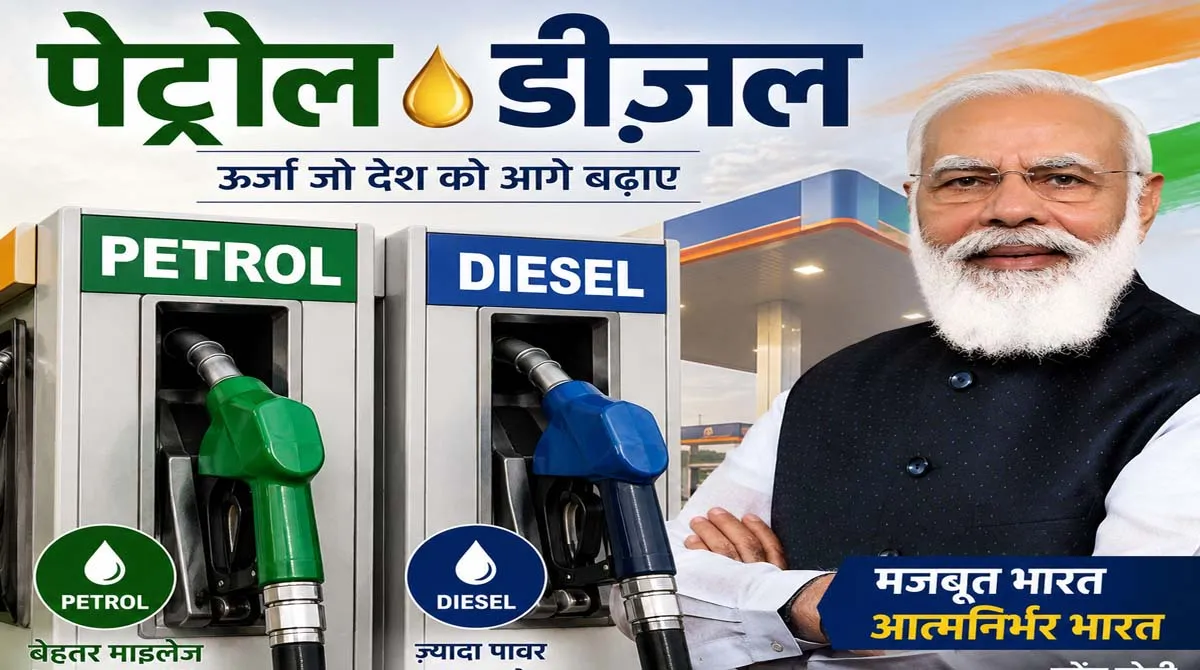
The tension of petrol-diesel-CNG is over forever! Cars will run on sugarcane juice, know the complete plan of the government

New Delhi. If you too are fed up with the skyrocketing prices of petrol, diesel and CNG and the daily fluctuations, then there is a very surprising and very good news for you. Very soon, vehicles will be seen running on the roads of the country running on the power of sugarcane juice and corn i.e. ‘Ethanol’. The central government has prepared a mega plan to rapidly introduce ‘Flex-Fuel’ vehicles on the roads to completely change the country’s transport system and make it pollution free. But just before the beginning of this revolutionary change, the big automobile companies of India have put such a condition before the government, due to which the whole matter may get stuck. Vehicle manufacturers clearly say that unless the prices of high-ethanol fuel are much lower than petrol, no customer will show interest in buying these new vehicles.
After all, what is this E85 and E100 fuel?
It is very important for the general public to understand what these E85 and E100 are. Actually, E85 simply means a fuel in which 85 percent ethanol and only 15 percent petrol is mixed. On the other hand, E100 means completely 100 percent pure ethanol fuel. Recently, a high-level meeting was held between the Petroleum Ministry, the country’s oil marketing companies and SIAM, the largest organization in the automobile sector. In this meeting, auto companies made it clear that merely changing the technology of vehicles will not bring crowd in the showrooms.
Actually, ethanol has slightly less energy density than petrol, which has a direct impact on the mileage of the vehicle. This means that the mileage of the vehicle may reduce slightly due to ethanol. To solve this problem, auto companies have directly presented the example of Brazil to the government. In Brazil, the price of ethanol is much lower than petrol, which is why people there buy flex-fuel vehicles indiscriminately. Indian companies also say that unless Indian customers see direct and significant savings in their fuel bills, they will continue to run with the existing fuel of E20 (20% ethanol) and will not spend money on new cars.
New technology may increase the price of vehicles, companies asked for tax exemption
High-Ethanol fuel i.e. 100% ethanol cannot be used in the engines of common petrol vehicles parked in our and your homes. For this, major technical changes will have to be made in the engines, fuel tanks and entire pipeline supply system of the vehicles, due to which the manufacturing cost for the companies will increase significantly. To save customers from this additional financial burden, the auto industry has requested the government to drastically reduce the GST imposed on these vehicles.
At present, like normal petrol and diesel vehicles, these flex-fuel vehicles also attract heavy taxes ranging from 18 to 40 percent. Leading two-wheeler companies like Hero MotoCorp believe that in a price-sensitive market like India, getting huge tax exemption in the initial days will be a lifesaver. However, the government is currently hesitant in reducing GST on cars, because doing so will directly compete with the electric vehicles (EVs) market, which attract only 5% GST. At present, it is believed that the two-wheeler i.e. bike and scooter segment is most expected to get policy relief from the government.
Why is the government dying so much on sugarcane juice and flex-fuel?
Now the question arises that why is the government giving so much emphasis on flex-fuel instead of petrol-diesel? Its direct and accurate answer is related to the country’s treasury and security. India imports about 90 percent of its crude oil needs from other countries, for which more than 120 billion dollars of foreign exchange has to be sent out every year. A large part of India’s oil comes from West Asia (Middle East), where there is often a danger of supply interruption due to war and mutual tension.
If we look at the government figures, about 95 to 98 percent of the total demand of petrol in the country and 65 to 70 percent of diesel is directly spent in our transport sector i.e. vehicles. In such a situation, if ethanol prepared from sugarcane and corn is used on a large scale within the country, then lakhs of crores of rupees will be saved for the country and India will not be dependent on any other country for crude oil.
The dream of 100% ethanol and the big challenge of the environment
The ground has been prepared for this big change in the country. The Bureau of Indian Standards (BIS) has also issued new stringent technical standards for high-ethanol petrol (E22 to E30). From the country’s largest car company Maruti Suzuki, Toyota and Tata Motors to big companies like Bajaj and Honda, they have presented their flex-fuel prototypes (models) to the world. The management of Maruti Suzuki has also clearly said that the country’s auto industry is fully ready to follow the new government rules.
On the other hand, ethanol production in the country has also increased at a record pace. Today, the total capacity to produce ethanol in India has increased to around 20 billion litres, whereas its current demand in the country is only around 11 billion litres. That means we have the capacity to produce more fuel than we need. But there is also a big environmental challenge in the way of this golden dream. The process of cultivating sugarcane and making ethanol from it consumes a lot of water. For this reason, former experts of NITI Aayog have given a big suggestion to the government that instead of relying only on sugarcane, we will have to increase the use of agricultural waste and stubble (second generation ethanol), so that the balance of water and environment in the country is completely maintained.

Comments are closed.