
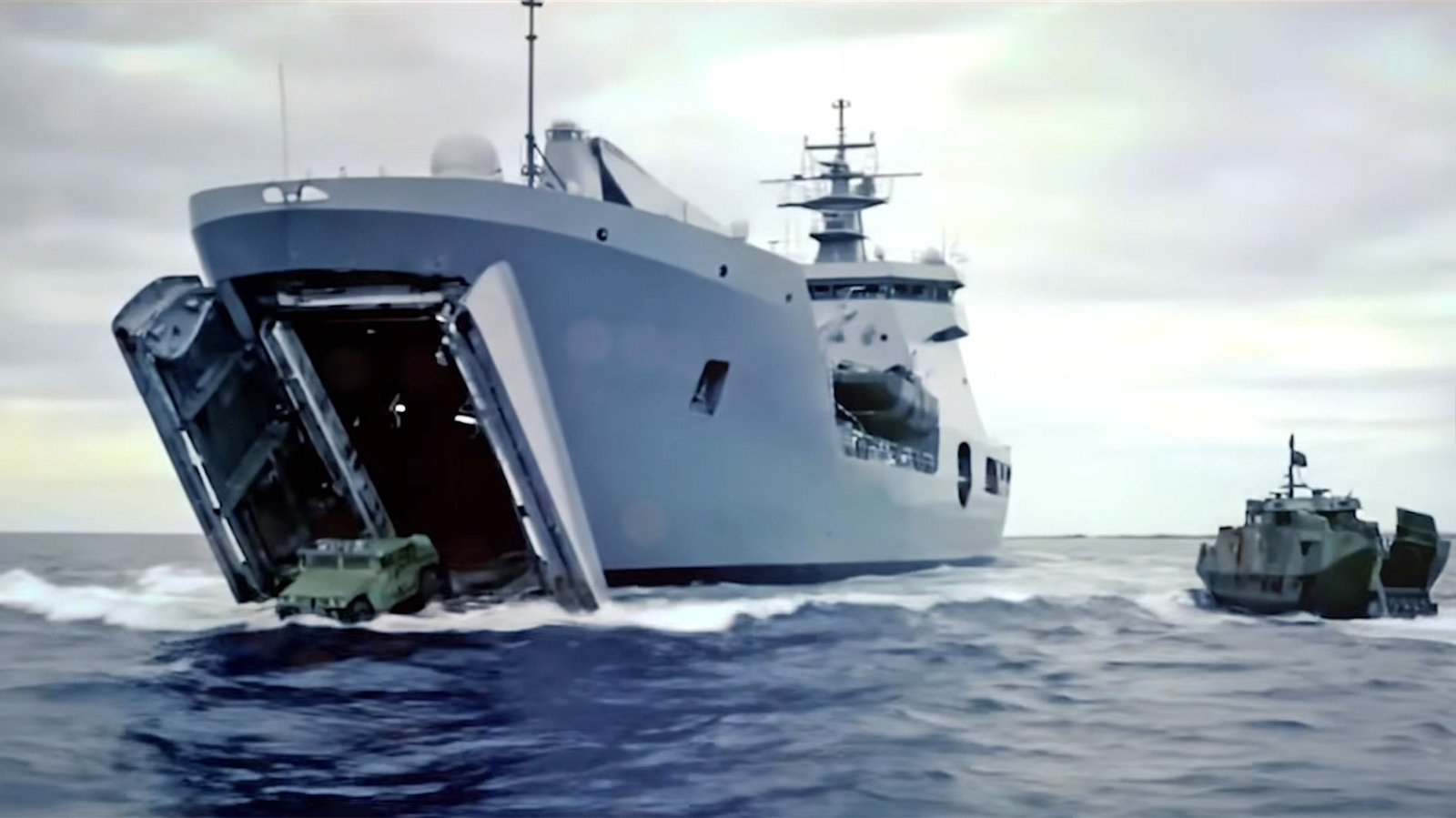

Even casual observers of the United States military and its associated defense industries likely know that America is currently in the midst of major changes and updates to its fleet of ships and fighting aircraft. On the U.S. Navy side of things, planned additions and upgrades to the fleet include everything from nuclear aircraft carriers to ballistic missile submarines.
For many of these upcoming vessels, it’s simply a matter of building additional ships of an existing class in a timely manner. For other ship types, the Navy has been busy working through the design selection process, weighing different options to pick something that’s not only highly capable, but also affordable. On top of that, it also needs to be a ship type that can be constructed quickly and easily. With all those requirements in mind, in December 2025 the Navy picked a design from the Dutch company Damen for its new medium landing ship.
Known as the LST-100, the Navy’s new ship won’t be a from-scratch prototype. Instead, it’s an existing ship model, which means that production and deployment should happen a lot faster than with a ground-up design. And while its blueprints originate from a foreign shipbuilder, the LST-100 will be constructed in America under what the Navy hopes will be a fairly streamlined process.
What is an LSM?
This class of ships, known to the Navy as a landing ship medium (LSM), is designed to quickly deploy expeditionary forces directly onto shore with no existing port or harbor needed. With a loading ramp in the rear and clamshell doors in the bow, the LST-100 is capable of unloading over 230 soldiers along with their vehicles. When completed, each ship will weigh about 4,000 tons and have a range of around 3,400 nautical miles. It will also be equipped with a helipad on its stern for chopper or drone use.
It should be pointed out that while the new ships will be owned and operated by the U.S. Navy, their primary mission is to land U.S. Marine Corps forces, as they don’t typically operate their own sea vessels. Naturally, the Marines were heavily involved in choosing the design along with their Navy partners.
The Navy is hoping the decision to go with the “ready to run” LST-100 design will help bring an end to a long series of delays and ballooning costs that have come with getting these new landing ships in the water. With ever-present tensions with China in the Indo-Pacific region, LST-100s would likely play a significant role in any potential Pacific combat scenario, so the sense of urgency is understood.
The U.S. Navy’s quest for a simpler, faster way to build ships
So much about the new LSM project isn’t just about the ship’s capabilities once they enter the fleet, but about how quickly and efficiently the LST-100s can actually be built and put into operation. This was one of the primary reasons why the Navy with Damen’s complete and proven design package. Construction has been a major problem for the U.S. Navy in recent years. Timelines for new Navy ships, including the upcoming aircraft carrier USS Enterprise, continue to be pushed back further and further because of supply chain issues and other delays in the construction process.
As for the actual construction of the LST-100s, that will be done by a soon-to-be-selected American-based shipbuilder, or a combination thereof. The Navy is hoping that construction on the first ship can begin in 2026, with the first delivery targeted for the year 2029. The Navy and Marines hope to have at least 35 of the new landing ships in the fleet when all is said and done. While there’s still a lot that needs to happen between now and when the first LST-100 hits the water, let alone dozens of them, this seems like a big step toward the modernization and expansion of the U.S. Navy’s fleet.

Comments are closed.