
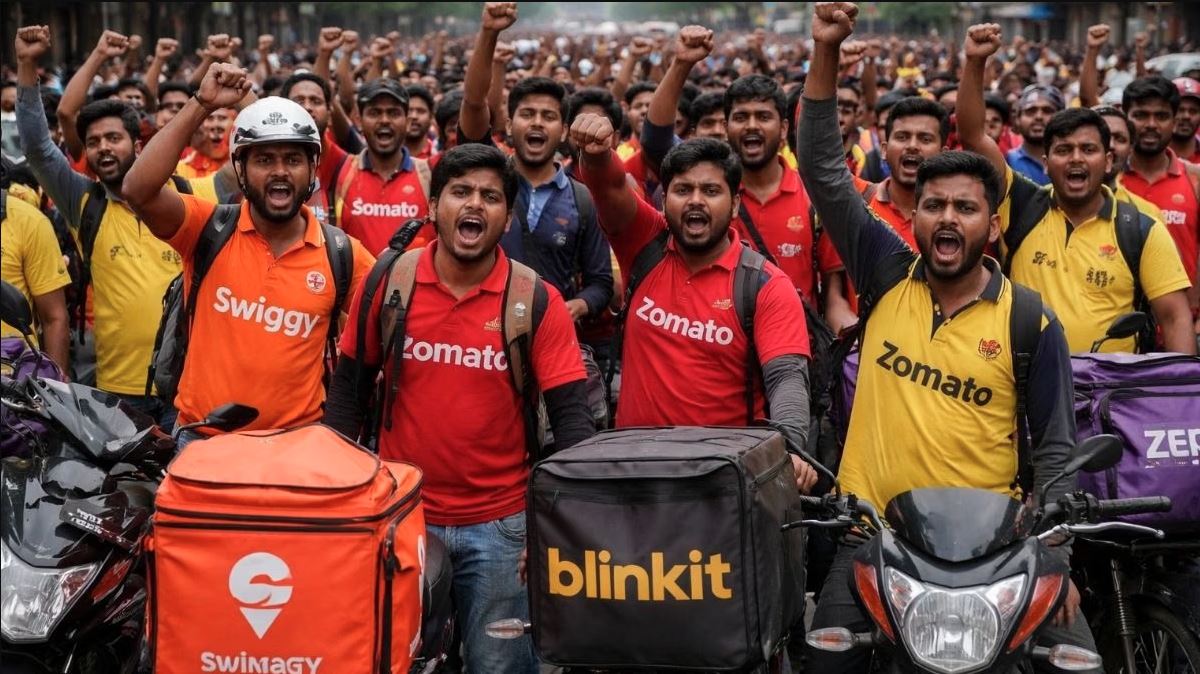
There is a fear of New Year celebrations being overshadowed, delivery stopped immediately, gig workers on strike for these demands

Tezzbuzz Desk- On one hand, the new year is ready to knock, while on the other hand, the strike of gig workers has put a brake on the speed of the online delivery system. This can have a direct impact on claims of delivering goods within 10 minutes. Gig workers associated with big digital platforms like Swiggy, Zomato, Blinkit, Zepto, Amazon and Flipkart have once again announced a strike from today.
The main reason for the strike is said to be reduction in delivery payment and increase in working hours. Gig workers say that due to changes in payment structure in the last few months, their income has decreased by 50 percent. Where earlier one could earn around Rs 1,000 by working for 7-8 hours, now one can earn only Rs 400 to 500 in the same time.
Talking to TV9 Bharatvarsha, gig workers said that companies are arbitrarily reducing delivery payments, incentives and bonuses. The situation is such that many workers are forced to work for 17–18 hours, yet the income is not satisfactory. On top of that, there is pressure to deliver more in less time. Customers have to face misbehavior in case of traffic jam or delay due to any reason. If an accident happens in a hurry, there is neither treatment facility nor insurance support.
Gig workers say that earlier this work was done by choice, but now it has become a compulsion. A strike was also called on 25th December, but instead of solving the problem, it increased further. The workers allege that when they raised their voice, the team leaders even threatened to block the ID and take police action. Orders have also reduced after the strike. Whereas earlier an average of 15 orders were received in 5 hours, now this number has come down to 7–8. Incentives are also not fixed.
The main demands of gig workers are that fair delivery payment should be fixed according to distance and time, fair incentives should be given and facilities of insurance and health benefits should be provided. He says that companies are taking advantage of the unorganized sector and lack of unity among all the workers. At the same time, some app companies argue that the new payment models are performance based and their aim is to make the delivery network more effective.
More than 80 lakh gig workers are working in the delivery, logistics and ride-sharing sectors in the country. This model of employment is definitely flexible, but there is still no clear legal framework regarding social security and minimum wage.
The impact of the gig workers’ strike is not limited to customers only, but shopkeepers are also in trouble. Food and grocery delivery services have been affected in many cities including Gurugram. Deepak, who runs a variety omelette shop in Gurugram, said that 70-80 percent of his sales were through online orders, but due to the strike, his sales have declined by about 80 percent. Many times the food remains ready, but the delivery boy does not arrive.
At the same time, customers say that they depend on online delivery during festivals and New Year. If the strike continues even on December 31, the problems may increase further. People’s question is that when apps charge full delivery fees from customers, then why gig workers do not get their rights.

Comments are closed.