
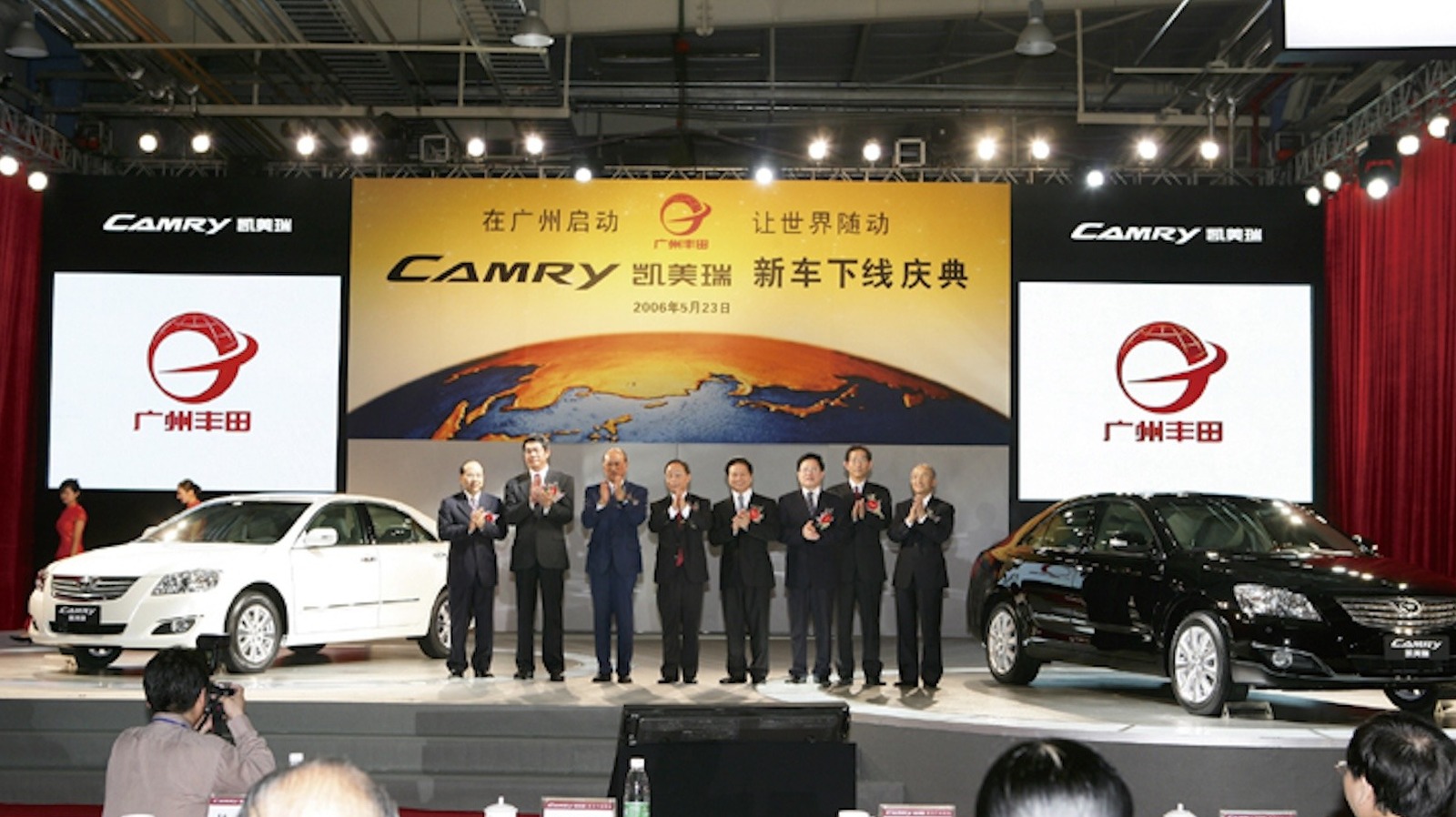

Back in 2004, Toyota entered into a joint venture in China with the Guangzhou Automobile Group Co., Ltd. (GAC), where two new entities were created. One was GAC Toyota Engine Co., Ltd. (GTE), and the other was Guangzhou Toyota Motor Co., Ltd., later renamed GAC Toyota Motor Co., Ltd. (GTMC). Toyota’s new joint venture with GAC was initially for the production of the GAC Toyota Camry in 2006. This was followed by the production of the GAC Toyota Yaris in 2008. While GTE produced the Camry engines, starting with those for export models in 2005 and later with engines for the Chinese market in 2006, GTMC took care of the production of these vehicles.
Further projects of GAC Toyota included the building of an additional production line, on which would be produced the GAC Toyota Highlander in 2009 and the GAC Toyota Camry Hybrid in 2010. Since then, GAC Toyota has shown steady growth in the Chinese market, even as other non-Chinese brands have faltered. These other brands have failed largely due to the rise of both home-grown Chinese vehicle brands and the increasing market share being taken by Chinese-made new energy vehicles of various types.
As a response to this phenomenon, Toyota has adopted an ‘if you can’t beat them, join them’ approach. The proof of this can be seen in its full self-driving EV, as well as two new vehicles that have been revealed by GAC Toyota at the Auto Guangzhou 2025 Show in November.
The GAC Toyota is a RAV4 — with a big difference
The first vehicle revealed by GAC Toyota at Auto Guangzhou 2025 was the Wildlander, which may look familiar, since it’s designated as the RAV4, the world’s best-selling car, in non-Chinese markets. The big difference between the Wildlander and the RAV4 is that the Wildlander’s intelligent cockpit was developed in China, the first time that Toyota has done this to a gasoline-powered vehicle. It uses a large language model with voice interaction that also incorporates more than 10 functions that are accessible through gesture controls. The intelligent cockpit features what GAC Toyota calls a “class-leading 15.6-inch ultra-narrow-bezel display.”
Another major difference between the Wildlander and the current RAV4 that’s available in the U.S. is that the Wildlander offers a non-hybridized powertrain. This is a 2.0-liter inline-four that is naturally aspirated and produces 169 horsepower that can be sent to either the front wheels or all four, if you specify all-wheel drive.
Two different conventional hybrid drivetrains are available as options. One uses a 2.0-liter four plus electric motors that produce 150 horsepower, with the other being a more powerful 2.5-liter four that works with additional electric motors generating a more generous 182 horsepower. The hybrid versions can also be had in front-wheel drive or all-wheel drive versions. There has not been a plug-in hybrid (PHEV) version of the Wildlander announced for the Chinese market as of this writing. The Wildlander is an attempt to make internal-combustion vehicles more acceptable to the Chinese buying public by adding tech features.
The GAC Toyota bZ7 is a look into Toyota’s Chinese EV future
The other vehicle Toyota unveiled at Auto Guangzhou 2025 is much more consequential for Toyota’s future fortunes in China. This is the bZ7, Toyota’s flagship Chinese EV with some pretty cool features. The bZ7 is a large sedan designed in China for the Chinese car-buying public. For comparison, the bZ7 is about five meters long, a little longer than a Tesla Model S. Its front-end ‘hammerhead’ styling places its looks right in line with its Camry and Prius siblings.
Inside, the bZ7 uses Huawei’s HarmonyCockpit, integrated with Xiaomi’s smart ecosystem called “Human x Car x Home.” This advanced system allows bZ7 owners to control their smart home appliances through either their smartphones or the bZ7’s infotainment system. The occupants are treated to an upscale interior treatment that combines ambient lighting and tasteful wood accents with a large center touchscreen, supplemented by an instrument panel directly in front of the driver. Additional controls reside in a small console built into the roof, right between the sun visors.
Another innovative feature on the bZ7 is its LiDAR (Light Detection and Ranging) roof-mounted sensor, which works with the Momenta 6.0 smart driving system that is standard equipment on the top trim levels of the bZ7. The styling of the bZ7 is both elegant and sporty, with an aerodynamic sloping roofline that culminates in a ducktail spoiler. Energy flows from a Calb-tech lithium iron phosphate battery, while power comes from a 278-horsepower Huawei motor driving the rear wheels.

Comments are closed.