
‘Today Shahbagh, Tomorrow Jamuna’: Hadi’s Inqilab Moncho Announces Blockades Across Bangladesh | world news

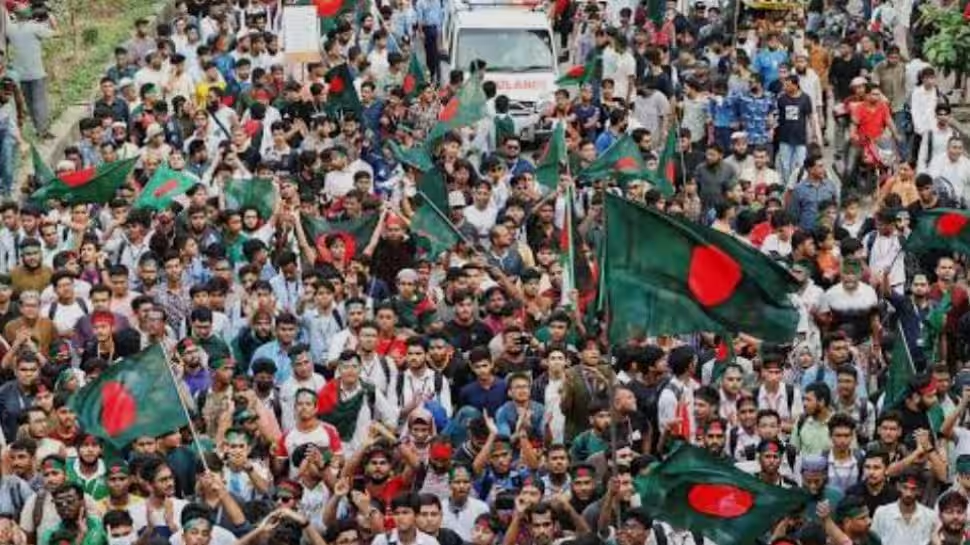
Bangladesh is set to witness widespread disruption on Sunday after Inqilab Moncho reportedly announced blockades in all divisional cities, escalating its agitation over the killing of its leader, Sharif Osman Hadi. The protest movement, which began in Dhaka, has now spread across multiple regions, raising concerns over law and order.
The organization said the blockades would begin at 11 am local time, according to a Facebook post cited by The Daily Star. The announcement was also made from Shahbagh in the capital, where Inqilab Moncho supporters have maintained a sit-in since Friday, Prothom Alo reported.
On Saturday, activists, primarily from Inqilab Moncho, blocked key roads and staged sit-ins in Dhaka, Sylhet, Chattogram and Kushtia, demanding justice for Hadi.
Add Zee News as a Preferred Source
In Dhaka, protesters occupied Shahbagh after Jummah prayers on Friday and remained there overnight. On Saturday, they briefly moved to the front of Aziz Supermarket to allow BNP acting chairman Tarique Rahman to visit Hadi’s grave near Dhaka University. The demonstrators returned to Shahbagh around 12:40 pm, bringing vehicular movement to a standstill, The Daily Star reported.
Threat Of Wider Action
Addressing the crowd at Shahbagh, Inqilab Moncho Member Secretary Abdullah Al Jaber warned that the protests would intensify if the government failed to respond.
“Today we are in Shahbagh; tomorrow we may occupy Jamuna, the parliament or even the cantonment,” he said.
He accused the government of indifference, noting that no adviser had visited the protest site despite the sit-in continuing since Friday. “People were shivering on the streets while the advisors were sleeping at home,” Jaber said, adding that public trust in the administration was diminishing.
“If you think you can control the country from inside the secretariat or the cantonment, you are wrong,” he warned. Emphasizing the group’s strength, he added, “On December 12, the day of Hadi’s namaz-e-janaza, if we wanted, we could have toppled the government. Your Jamuna or cantonment couldn’t have saved you.”
The protest at Shahbagh drew a wide cross-section of society, including women, children, cultural figures and professionals. Poems were recited, verses from the Holy Quran were read, and chants demanding justice ran out across the area.
Details Of Hadi’s Killing
According to Prothom Alo, Sharif Osman Hadiwidely regarded as a key figure of the July mass uprising, founded Inqilab Mancha in August last year. He was also seen as a potential candidate for the Dhaka-8 seat in the upcoming parliamentary election.
On December 12, shortly after Friday prayers, Hadi was shot while traveling in a rickshaw on Culvert Road in Old Paltan, Dhaka. He later died while undergoing treatment in Singapore. He was buried beside the grave of national poet Kazi Nazrul Islam near the Central Mosque of Dhaka University.
Earlier, Inqilab Moncho had declared it would remain on the streets until those responsible for the killing of “martyred Sharif Osman bin Hadi” were arrested. The group has also warned of laying siege to Jamuna, the residence of the interim government’s chief adviser, or the cantonment if the situation escalates further.
Spillover Unrest
Hadi’s death has triggered unrest across Bangladesh, with local media reporting incidents of vandalism and arson, including attacks on the Dhaka offices of The Daily Star and Prothom Alo.
Separately, protests were reported in parts of India, including Kolkata, following the alleged killing of Dipu Chandra Das, a Hindu garment factory worker accused of blasphemy. He was reportedly beaten to death on December 18, after which his body was hanged and set on fire.
In another incident, a Hindu youth, Amrit Mondal, was lynched in Hosendanga village in Rajbari’s Pangsha sub-district over an alleged extortion case. Local media said multiple cases, including one of murder, had earlier been registered against him.
As Inqilab Moncho presses ahead with its call for nationwide blockades, authorities face mounting pressure to contain the unrest and address the growing demands for accountability.
(With agency inputs)

Comments are closed.