
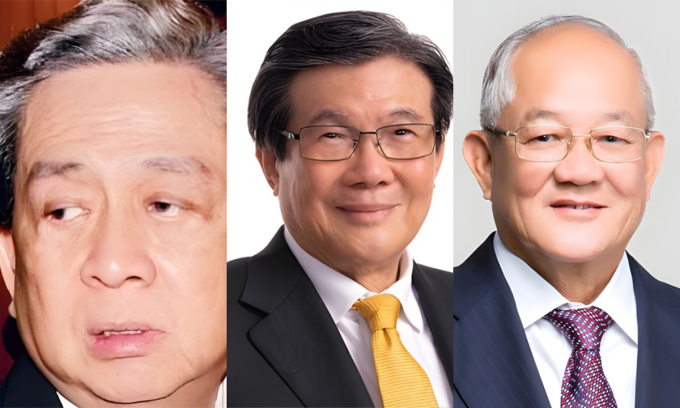

The richest man in the country, Robert Budi Hartono, 86, now has a net worth of $15.7 billion, down 66% from the end of last year.
Bank Central Asia, which he controls, has seen share prices tumbling 24%. Other companies which he has stake in, such as e-commerce and retail firm Blibli, and telecom firm Sarana Menara Nusantara, also experienced a decline of 31% and 24%, respectively.
Indonesia’s top billionaires. From L: Robert Budi Hartono, Prajogo Pangestu, and Low Tuck Kwong. Photos courtesy of Barito Renewables Energy, SEAX Global and tokoindonesia via Wikipedia |
Together with his brother Michael, Robert sits atop one of the country’s most diversified business empires spanning tobacco, banking, electronics, digital businesses and prime real estate.
In the second place, Low Tuck Kwong, 78, saw his wealth falling 34% to $14.7 billion. Share of his coal mining company Bayan Resource has slid 38%.
Kwong worked in his father’s construction business in Singapore before moving to Indonesia in 1972 in search of better opportunities. He first set up construction contractor Jaya Sumpiles Indonesia in 1973, then moved into coal by acquiring his first mining concession in Kalimantan in the 1990s.
Prajogo Pangestu, 84, who was the richest man in Indonesia last year, is now in the third place with a net worth of $13.2 billion, down 67%. His conglomerate Barito Pacific’s share has dropped 53%
The decline in wealth of these billionaires was mostly driven by Indonesia’s stock market plunge.
The sell-off began in late January after financial services firm Morgan Stanley Capital International (MSCI) raised concerns about Indonesian market transparency, free float data, opaque ownership structures and possible coordinated trading behavior.
MSCI even froze several Indonesian stock indices with immediate due to its consideration that the transparency level of Indonesian stock ownership was inadequate, according to The Jakarta Post.
Following MSCI’s actions, Indonesian stocks nosedived. The Jakarta Stock Exchange Composite Index has plunged 29% so far this year, making it one of the world’s worst-performing indices.
There is no guarantee of a quick market recovery, as both credit ratings firms Fitch and Moody’s have lowered the country’s outlook to negative. MSCI this month even removed more than a dozen Indonesian stocks from its global indices, including several major tycoon-controlled companies.
Goldman Sachs analysts estimate the MSCI changes will lead to US$1.6 billion in passive outflows from Indonesia’s stock market, the largest expected outflow for any Asian country under the latest MSCI adjustments, according to The Financial Times.
Indonesia’s wealthiest individuals dominate the stock market through dozens of companies spanning mining, energy, petrochemicals and banking. Their stocks rank among the country’s largest listed companies.
Of the six stocks being removed from the MSCI global index, three are controlled by Pangestu. His group said in response: “The decisions made by index providers are outside of our control. As a group, we remain focused on delivering both our organic and inorganic growth strategies.”
Stock investors are also concerned about President Prabowo Subianto’s economic agenda. Vows to make changes and the resignations of five top officials from the financial regulator and stock exchange have failed to stabilize the market, and a struggling currency points to a deeper problem, Reuters reported.
Investors have been avoiding Indonesia and worry Prabowo’s spending and cosy governance are slowly undoing hard-won progress made since the Asian Financial Crisis, when the rupiah collapsed and Prabowo’s former father-in-law, Suharto, was forced from office.

Comments are closed.