
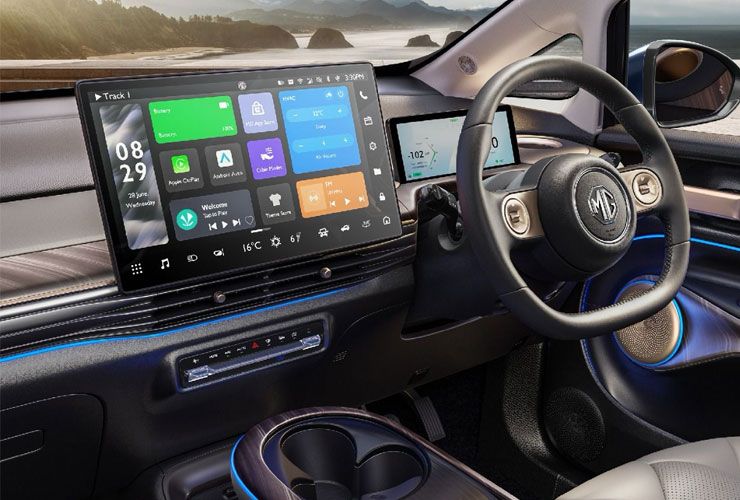

One of the popular trends in cars lately is the widespread use of touchscreens. In most cars recently launched in the market, you would have noticed that many features are now integrated into the touchscreen that were earlier controlled using physical buttons. We have objected to this in many of our reviews in the past.
Ferrari EV’s interior designer and the designer of the Apple iPhone and iPad, Jony Ive, recently stated that touchscreens are “the wrong technology to be the primary interface” in cars. He made this statement while talking about his contribution to the interior of the Ferrari Luce EV, the first EV from the supercar manufacturer.
Speaking to Autocar UK, Jony Ive said that the way touchscreens are currently being used in modern cars is wrong and even dangerous. According to him, it ignores the basic principles of safety and usability. He added that touchscreens were originally introduced to solve a specific problem. He said, “The big idea was to develop a general-purpose interface that could be a calculator, could be a typewriter, could be a camera, rather than having physical buttons.”
Touchscreens were never meant to be used in cars, as the same logic of having a general-purpose interface does not translate well to automotive applications.

The reason why using a touchscreen for main controls in cars is dangerous is because it forces the driver to take his or her eyes off the road to ensure they are touching the correct section of the screen. He said, “I never would have used touch in a car [for the main controls]. It is something I would never have dreamed of doing because it requires you to look [away from the road]. So that’s just the wrong technology to be the primary interface.”
Many car manufacturers in India and around the world are heavily pushing touchscreens. They are often marketed as premium features to customers. However, it is only after living with one of these cars that you realise how inconvenient these touchscreen controls can be.
MG cars like the Comet and Windsor EV, which are extremely popular in their segments, do not offer many physical buttons. Most functions, including ORVM adjustment, have to be done via the touchscreen.

This becomes a problem in real-world usage. Indian car manufacturer Mahindra is also moving in a similar direction. The recently launched Mahindra XUV 7XO features triple screens on the dashboard. Two of them are touchscreen infotainment systems, while one is a fully digital instrument cluster. With this update, Mahindra has removed physical buttons for AC and seat ventilation. Now, the driver has to navigate through the touchscreen to adjust the temperature, which can be frustrating and distracting while driving.
While many argue that these features can be controlled using voice commands, the reality is that voice systems often fail to work reliably. In addition to touchscreen controls, several brands like Tata are also promoting touch-sensitive buttons on the centre console that lack proper haptic feedback. This too can be dangerous, as the driver may not clearly know whether the input has been registered.
We really hope that brands take feedback from customers and reviewers seriously and bring back physical buttons in cars, as they are much easier and safer to operate.

Comments are closed.