
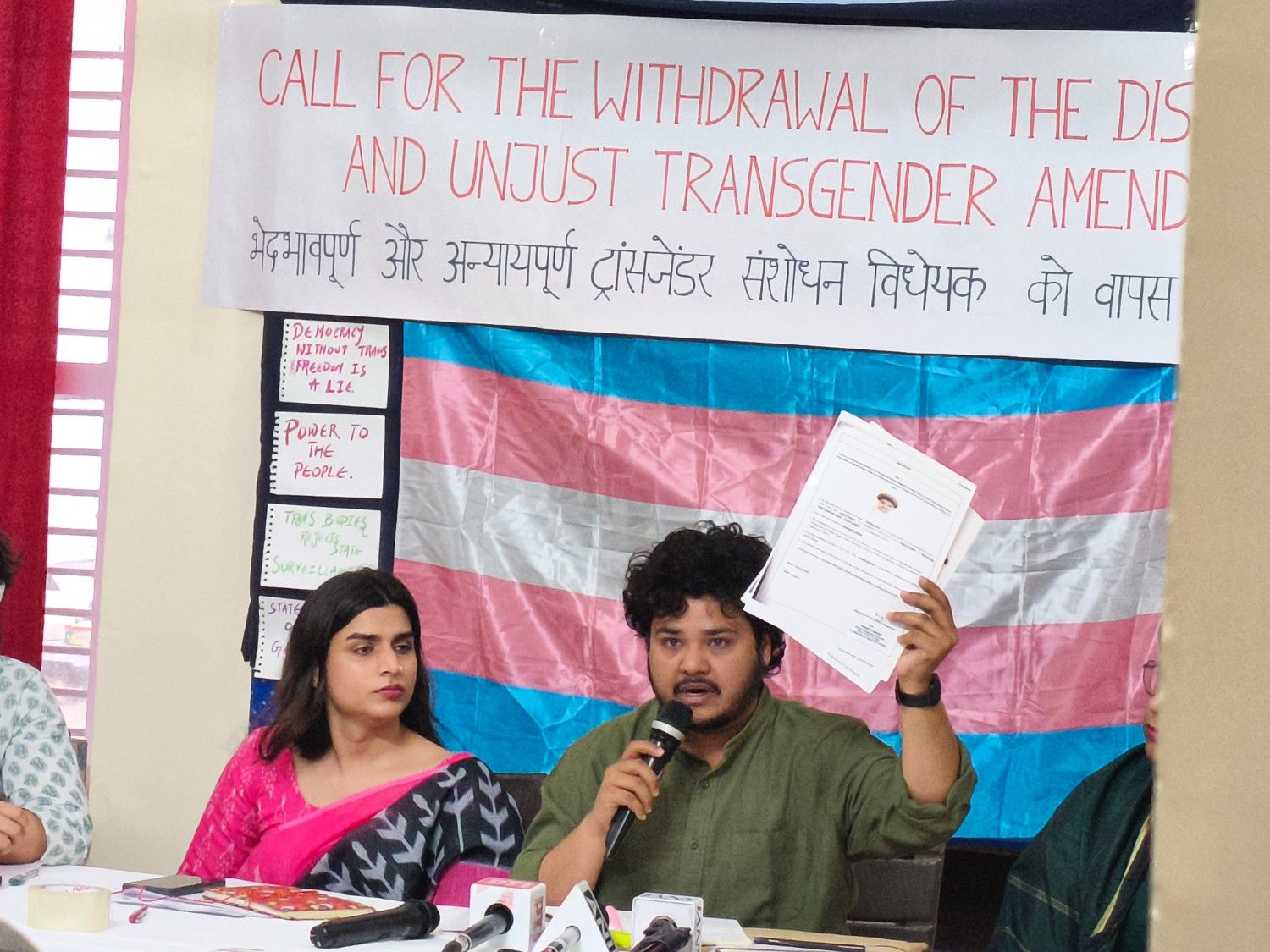

Within hours of the Union government introducing the Transgender Persons (Protection of Rights) Amendment Bill, 2026, in the Lok Sabha last week, transgender and queer collectives across the country came out strongly against it, unequivocally rejecting the proposed changes and demanding that the Bill be withdrawn in toto.
Union Minister for Social Justice and Empowerment Virendra Kumar tabled the Bill on the evening of March 13 to amend the Transgender Persons (Protection of Rights) Act, 2019. But community members say the proposed amendments fundamentally alter the meaning of who can be recognised as a transgender person and threaten rights that were hard won through years of legal and social struggle.
Intersex, transgender identities as single category?
At the centre of the criticism is the Bill’s proposed redefinition of “transgender persons”. According to transgender collectives, the amendment collapses intersex and transgender identities into a single category, even though the two are distinct: many transgender persons are not intersex, and most intersex persons do not identify as transgender.
Also read: Budget 2026-27 leaves transgender welfare largely untouched
More significantly, activists say the amendment removes the principle of self-determination by limiting legal recognition to people belonging to specific socio-cultural identities such as Hijra, Cheeks, The carriage or Jog. If enacted, they warn, it could exclude a large number of trans men, trans women, gender-queer and non-binary persons from legal recognition.
SC’s 2014 landmark judgment defied, says community
Community members say the move directly contradicts the landmark ruling in the National Legal Services Authority (NALSA) v. Union of India case, in which the Supreme Court affirmed that transgender persons have the right to self-identify their gender and recognised “transgender” as an umbrella term for those whose gender identity differs from the sex assigned at birth.
“The language of the amendment makes it very clear that the Act will protect only a certain class of transgender persons. It talks about protecting those who are considered the most disadvantaged or those in need of help. But there is no explanation of how the ministry decided which groups are the most marginalised,” said Krishanu, a trans woman, at a press conference organised at the Indian Women’s Press Corps in Delhi on Monday (March 16).
She pointed out that several members of the community had already accessed identity cards, healthcare and welfare schemes under the 2019 law, and that the proposed amendment now casts uncertainty over those systems.
“It raises questions about the validity of identity cards, medical benefits and procedures that people have already accessed, and leaves many young transgender persons wondering what will happen if the law changes,” she said, adding that legislators ought to have consulted the community before pushing ahead with the Bill.
Section 18 of 2019 Act
The proposed changes to Section 18 of the 2019 Act have also drawn concern. The Bill expands penalties for several offences and introduces prison terms of up to five years for “alluring” or “forcing” someone to become transgender. Activists say the language is vague and risks criminalising transgender persons, their families or allies while reinforcing harmful stereotypes about the community.
For many speakers, the issue also touches on bodily autonomy. “The State cannot decide what my relationship with my body will be. They cannot tell me whether I should undergo surgery to transition or not. That is my personal decision,” said Ritu.
Also read: Why has Transgender Persons Amendment Bill drawn widespread flak?
Others questioned provisions that could allow district magistrates and medical boards to scrutinise or determine gender identity. Holding up his transgender certificate in hand, Kabir, a trans man, asked what would come of them if the new definition were to be put in place. He said he had been working for years to get employed as a primary schoolteacher in central government schools, and now that his name was finally on the list, the future looked uncertain.
‘How can others decide my identity?’
“What am I supposed to do with these? How can a DM (district magistrate) and medical board decide my identity? Were community members part of the decision-making? I’m sorry to say this, but who will be responsible for the increase in suicidal rates once this definition comes into being?” he asked.
Aakash, a community member who does not wish to medically transition, said the framing reinforces stereotypes about what transgender identity should look like.
Also read: Why 3 recent judgments from southern High Courts give hope to queer people
“The assumption seems to be that everyone sitting here has transitioned, or wants to transition. I don’t… We don’t need to physically transition to know who we are. This kind of framing puts pressure on individuals, families and allies to fit into a narrow prototype of what a trans person should look like — wear a saree, put on lipstick and a bindiclap on the streets, fit into a stereotype,” they said.
“Many of us chose education and different paths precisely to escape the systematic injustice that pushed our communities into those roles for generations. You cannot reduce our identities to a prototype, and no one has the right to dictate how we should look, how much we should transition, or how we should feel,” they added.
‘Bill should be taken back’
Raghavi, a trans woman and lawyer, was blunt in her assessment. “There is nothing salvageable in the Bill. There is nothing good in it. It should be taken back as it is,” she said, warning that the changes could disrupt healthcare access and expose transgender persons to greater violence.
In a joint statement, the collectives said the language and framework of the amendment echo the stigma once codified under the colonial-era Criminal Tribes Act, 1871, which branded communities as “hereditary criminals”.
Also read: Why LGBTQIA+ community is battling India’s blanket ban on blood donation
They said the proposed amendment was an existential threat to their dignity and rights. “Since Parliament is on, we are lobbying with MPs in both the Lok Sabha and Rajya Sabha. Some political parties have also come out in our support. We want the Bill to be taken back. If not that, it should be sent to a Standing Committee, where it is reviewed from scratch. Naturally, community members will have to be part of that process,” said Krishanu.

Comments are closed.