
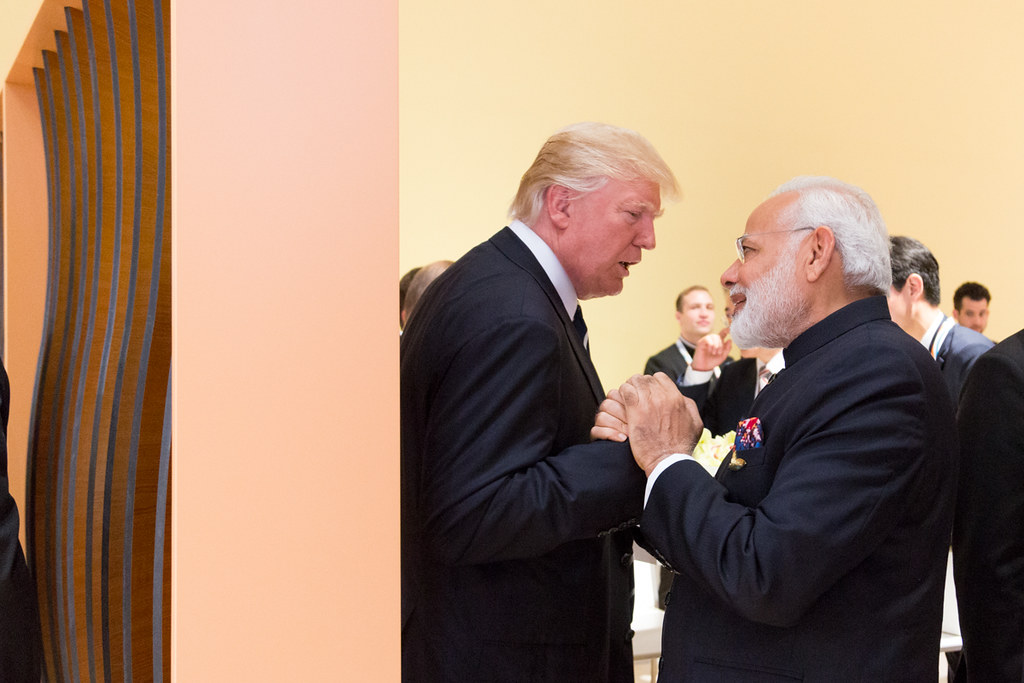

United States President Donald Trump and Indian Prime Minister Narendra Modi displayed their strong personal relationship during a bilateral meeting on the sidelines of the G7 summit, even as significant disagreements continue to complicate relations between Washington and New Delhi.
According to CNBC reporter Priyanka Salve, Trump offered strong praise for Modi and said the United States would support India if it faced an attack, although he linked that commitment directly to Modi remaining in power. Trump also described India as an important international player and highlighted his personal confidence in the Indian prime minister.
The meeting revived the public warmth that has often characterized the relationship between the two leaders. However, analysts warned that their personal chemistry has not resolved wider concerns involving trade, immigration, China, regional security and the deaths of Indian sailors during recent American military operations.
Ronak D. Desai, a visiting fellow at Stanford University’s Hoover Institution, told CNBC that the personal relationship between Trump and Modi remained genuine. However, he said it was not addressing the deeper tensions and declining trust within the broader India U.S. partnership.

One major concern emerged when the United States renamed its Indo Pacific Command as the U.S. Pacific Command. The removal of the word “Indo” was viewed by some analysts as a sign that India may no longer occupy the same central position in Washington’s strategy toward Asia.
For more than two decades, successive American administrations strengthened relations with India partly to counter China’s growing regional influence. The command’s previous name was widely viewed as recognition of India’s strategic importance and its role as a potential counterbalance to Beijing.
During the G7 meeting, Trump also discussed improving relations with China and revived the idea of a partnership between Washington and Beijing described as the G2. Analysts said that approach could reduce the influence of middle powers, including India, in American decision making.
Arpit Chaturvedi, South Asia adviser at Teneo, told CNBC that India remained important to the United States but may no longer be viewed as indispensable when Washington deals with China. He said the Trump administration appeared confident that it could address many China related issues directly with Beijing.
Another major source of tension involves American attacks in the Gulf of Oman that reportedly killed Indian sailors. India summoned U.S. Chargé d’Affaires Jason Meeks and formally expressed its strong protest over the incident.
Modi also raised the safety of Indian seafarers during his meeting with Trump. He asked the American president to give the issue the highest priority as the United States implemented its Middle East peace arrangements.
When Trump was asked whether he had a message for the families of the Indian sailors who were killed, he acknowledged the incident but did not offer a direct expression of condolence. His response attracted criticism from political opponents in India.
Indian opposition leader Rahul Gandhi has repeatedly accused Modi of taking an overly cautious approach toward the United States. Gandhi has criticized the government’s handling of trade disputes and the deaths of Indian seafarers, although Modi continues to maintain strong domestic political support.

Trade remains another important source of disagreement. India and the United States have been negotiating an agreement since Washington reduced tariffs on Indian goods from 50 per cent to 18 per cent in February, but a final deal has not yet been reached.
Trump again described Modi as a tough negotiator during their meeting. India is seeking improved access to the American market, but the Office of the U.S. Trade Representative has also proposed additional tariffs of as much as 12.5 per cent on imports from 60 economies, including India.
Immigration policy has also created uncertainty. The Trump administration is appealing a court decision that blocked its proposed $100,000 fee for H 1B visa applications. Indian workers would be affected more than any other group because they account for approximately 71 per cent of H 1B visa holders in the United States.
Asked whether highly skilled Indian workers would continue to receive opportunities in the United States, Trump praised their abilities and said the two countries had long maintained a strong employment relationship.
The meeting demonstrated that the personal connection between Trump and Modi remains politically valuable to both leaders. However, the future of the India U.S. partnership will likely depend on whether they can translate that relationship into progress on tariffs, immigration, regional security and India’s role in Washington’s evolving approach to China.

Comments are closed.