
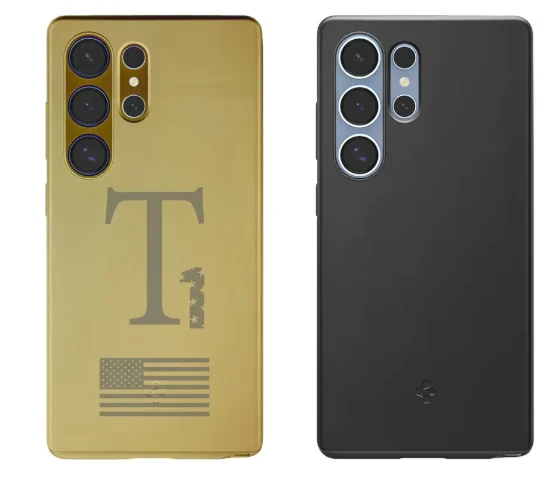

A major hardware controversy is hitting the consumer technology sector as Donald Trump’s highly anticipated smartphone finally reaches early consumers. According to an engineering teardown by repair authority iFixit, later amplified by NewsBytesthe newly launched flagship is far from an original piece of hardware. Specifically, technical diagnostic tests prove that the Trump Mobile T1 smartphone is essentially a rebranded HTC U24 Pro a mid-range device originally released by the Taiwanese manufacturer back in 2024.
Consequently, this physical revelation has triggered intense backlash from tech analysts and early backers alike. While marketing campaigns aggressively pitched the device as an independent milestone for western hardware autonomy, industrial X-ray CT scans reveal that the underlying electronics, internal chip configurations, and motherboard traces are virtually identical to the older HTC design. Instead of an original engineering breakthrough, the premium handset is a recycled mid-range option wrapped in a gold-colored aluminum shell.
The Industrial X-Ray: Proof of Rebranded Hardware
To determine the true architectural origins of the Trump Mobile T1 smartphone, hardware engineers subjected the device to a comprehensive multi-point disassembly alongside an industrial Lumafield CT scanner. The results left no room for ambiguity, showing that the internal components are a drop-in match for HTC’s two-year-old platform.
The core internal components remain completely unchanged across both devices:
- The Silicon Processor: Both phones run on the exact same mid-range Qualcomm Snapdragon 7 Gen 3 chipset framework.
- The Motherboard Blueprint: The main logic boards are so perfectly aligned that iFixit successfully swapped the T1’s chipboard straight into an HTC U24 Pro chassis, and the device booted and operated without a single error code.
- The Camera Sensors: The triple-lens rear arrangement consisting of a 50MP main sensor, a 50MP 2x telephoto lens, and an 8MP wide lens shares the same physical footprint and electronic ribbon cables.
Furthermore, the only real structural variations between the two phones are purely cosmetic skin adjustments. The Trump-branded device features a modified rear camera bump, an alternate drill pattern on the bottom speaker grille, and a flashy gold-colored finish.
Sourcing the Parts: The Broken “Made in USA” Slogan
The discovery of the underlying HTC architecture directly undercuts the core marketing message used to generate millions of dollars in consumer pre-orders. When Trump Mobile initially opened waitlists for the device, promotional copy claimed the project would deliver an American-made alternative to mainstream Big Tech platforms.
Hardware Component Sourcing and Operational Differences
| Hardware Component Layer | HTC U24 Pro Baseline (2024) | Trump Mobile T1 Layout (2026) |
| System Memory (RAM) | Sourced from SK Hynix | Swapped to Micron Technology |
| Battery Cell Origin | Manufactured in China | Manufactured in the Philippines |
| Total Charge Capacity | 4,600 mAh (Supports 60W charging) | 5,000 mAh (Limited to 30W charging) |
| Primary Assembly Origin | Contract Factories in China | Final 10-Part Assembly in Florida |
Over time, the corporate group quietly backtracked from explicit promises of domestic manufacturing. The website’s terms were softened to vaguer branding slogans, describing the device as an “American-Proud Design” built with “American values in mind.”
While the company claims a local team in Florida handles final assembly by combining ten pre-fabricated components, the physical reality remains unchanged. Because the display glass, aluminum frames, and core circuit boards are imported directly from contract manufacturing pipelines overseas, iFixit labeled the device as a product designed and manufactured predominantly in China.
Technical Performance and Market Comparisons
From a pure performance perspective, the hardware behaves like an adequate, albeit outdated, mid-range mobile platform. The 6.78-inch curved AMOLED display outputs a smooth 120Hz refresh rate, and the inclusion of a legacy 3.5mm headphone jack offers a welcome touch of utility that modern premium flagships have abandoned. The software layer comes pre-loaded with conservative ecosystem tools, including specialized widgets and a pre-installed native application for Truth Social. Ultimately, the commercial friction surrounding the release highlights a common trend in niche product marketing. Much like the controversial “Freedom Phone” of 2021 which was later exposed as a generic $119 Umidigi device sold to consumers at a massive premium the T1 leverages political identity to sell older consumer electronics.
By charging $499 for a two-year-old mid-range design, the venture proves that while engineering a brand-new smartphone from scratch is an incredibly difficult task, rebranding an existing foreign supply chain is a fast way to enter the market.

Comments are closed.