
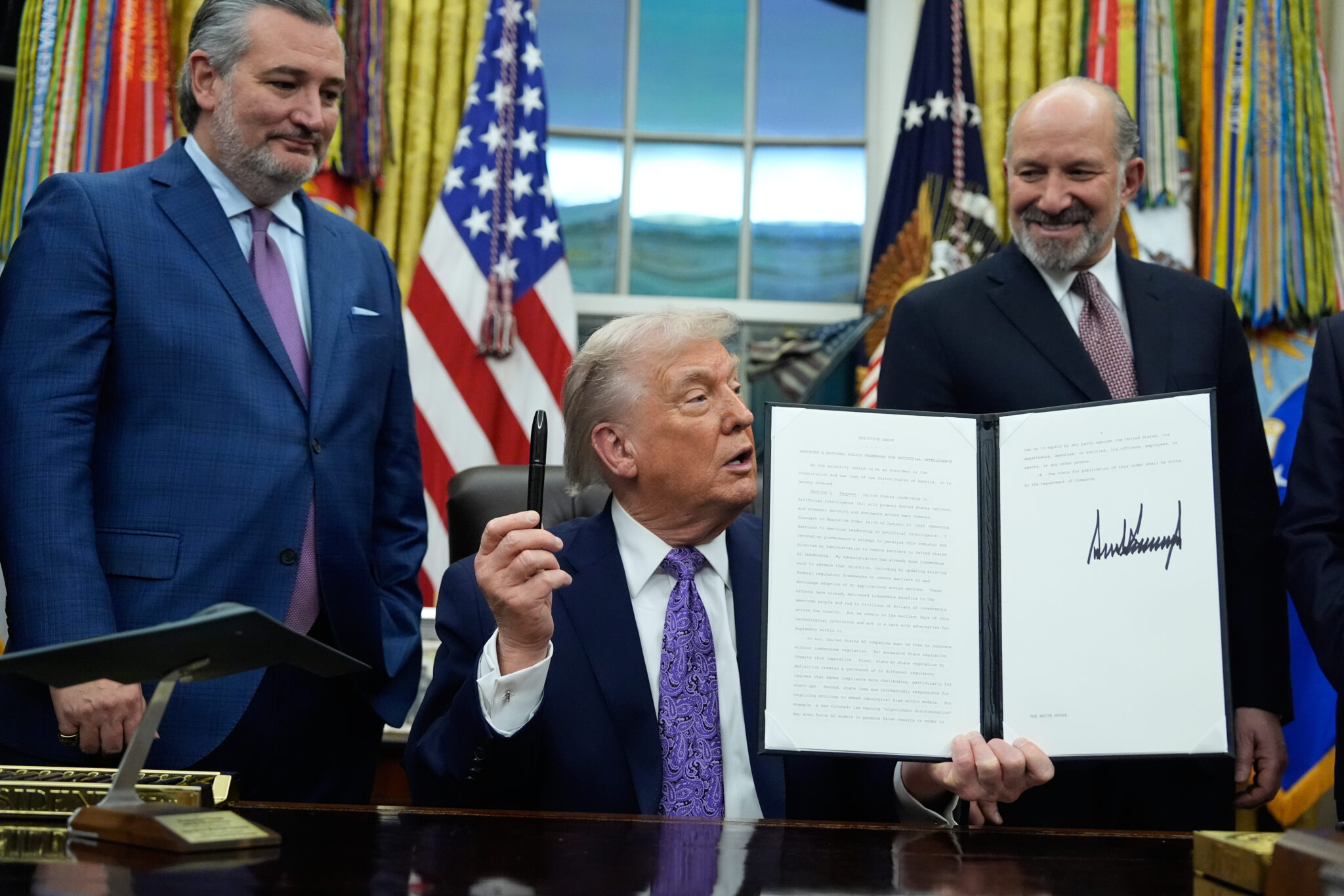

Trump Signs AI Order to Override State Regulations/ TezzBuzz/ WASHINGTON/ J. Mansour/ Morning Edition/ President Trump signed an executive order banning states from setting their own AI regulations. He argued that state-by-state rules would hinder U.S. competitiveness against China. The order creates a federal task force and threatens funding cuts for noncompliant states.
Trump AI Executive Order Quick Looks
- Trump signed executive order to override state AI regulations.
- Cites threat of inconsistent state laws stifling U.S. innovation.
- Federal agencies tasked with targeting and overturning state laws.
- Executive order could restrict funding for states with AI rules.
- Trump emphasized urgency in U.S.-China AI competition.
- Some states have already passed their own AI laws.
- Order faces criticism from privacy, civil liberties advocates.
- AI decisions impact housing, healthcare, hiring, and lending.
- States like California, Colorado, Utah, and Texas have passed AI laws.
- Trump’s AI advisor says safety rules like child protection are exceptions.
Trump Signs AI Order to Override State Regulations
Deep Look
President Donald Trump on Thursday signed a sweeping executive order aimed at preventing individual U.S. states from enforcing their own regulations on artificial intelligence, signaling a major shift in the federal government’s approach to AI oversight.
Framing the issue as a matter of national economic security, Trump warned that allowing a fragmented system of state-level regulations could severely hinder the nation’s ability to compete with China in the global race for AI dominance.
“There’s only going to be one winner,” Trump said from the Oval Office, flanked by Commerce Secretary Howard Lutnick and Sen. Ted Cruz of Texas. “If companies need to get 50 different approvals from 50 different states, you can forget it—it’s impossible to do.”
The executive order directs the U.S. Attorney General to form a new task force dedicated to challenging state AI laws that conflict with federal interests. Simultaneously, the Commerce Department has been instructed to compile a list of what the administration deems “problematic” regulations already enacted by state governments.
Perhaps most controversially, the order gives federal agencies the authority to withhold funding—including broadband and other technology grants—from states that refuse to comply with the national AI framework.
The move comes amid growing concern across the political spectrum over the potential harms of artificial intelligence, including bias, discrimination, and misuse of personal data. While lawmakers from both parties, along with civil liberties groups, have pushed for tighter oversight, Trump’s order appears to prioritize innovation and deregulation over state-led consumer protection.
Venture capitalist David Sacks, a prominent figure in the tech industry and Trump’s advisor on AI and cryptocurrency, said the federal government would only challenge “the most onerous examples of state regulation.” He noted that the administration would not seek to interfere with “common-sense” rules, such as those protecting children from harmful AI applications.
Still, the executive order represents a significant federal preemption of state authority, and it is likely to face legal challenges and political backlash.
What States Have Done So Far
According to the International Association of Privacy Professionals, four states—California, Colorado, Utah, and Texas—have already enacted laws regulating various aspects of AI in the private sector.
These state laws typically include provisions that limit the collection and use of personal data, enforce transparency requirements for companies using AI, and mandate that businesses assess the potential for discriminatory outcomes from automated systems.
Such regulations are seen as a response to the growing influence of AI in daily life. Algorithms are now routinely used in deciding everything from who gets called in for a job interview to whether someone qualifies for a mortgage or receives a medical diagnosis. Yet studies have shown that AI systems can reinforce existing social and economic biases, sometimes prioritizing applicants based on race or gender.
Some states have gone even further. California, for example, has proposed regulations requiring companies to assess and publicly disclose potential discriminatory impacts of their AI tools. In addition to broad laws, several states have enacted narrower rules targeting specific uses of AI—such as banning deepfakes during election campaigns or regulating the government’s own deployment of AI systems.
Despite these efforts, Trump’s administration argues that allowing individual states to impose such regulations undermines national unity in an area requiring consistent federal oversight. The president’s new directive marks the most direct attempt yet by the federal government to assert centralized control over AI policy.
Industry and Political Reactions
The tech sector has largely welcomed the executive order, viewing it as a necessary step to avoid regulatory fragmentation that could slow innovation. AI developers and startups, in particular, have voiced concern about navigating different compliance standards across multiple states.
However, consumer rights advocates and privacy organizations say the order threatens to eliminate key protections. Critics argue that state regulations serve as crucial safeguards, especially in the absence of comprehensive federal legislation on AI.
Lawmakers in states that have passed AI regulations are expected to challenge the federal order, both legislatively and in court. Some have accused the administration of overreach, saying states have the right to enact consumer protection laws in areas not yet fully addressed by Congress.
Global Competition at the Core
Trump’s framing of the order as a geopolitical necessity underscores the administration’s belief that winning the AI race against China is a national imperative. The president pointed out that Chinese firms answer to a centralized authority that allows them to quickly secure approvals and scale innovation, whereas U.S. firms face red tape and inconsistent laws.
“We have the big investment coming,” Trump said. “But if the states keep throwing roadblocks in the way, we’ll lose. And we don’t intend to lose.”
Whether this executive order leads to a coherent national AI policy—or triggers further legal and political battles over states’ rights—remains to be seen.
More on US News

Comments are closed.