
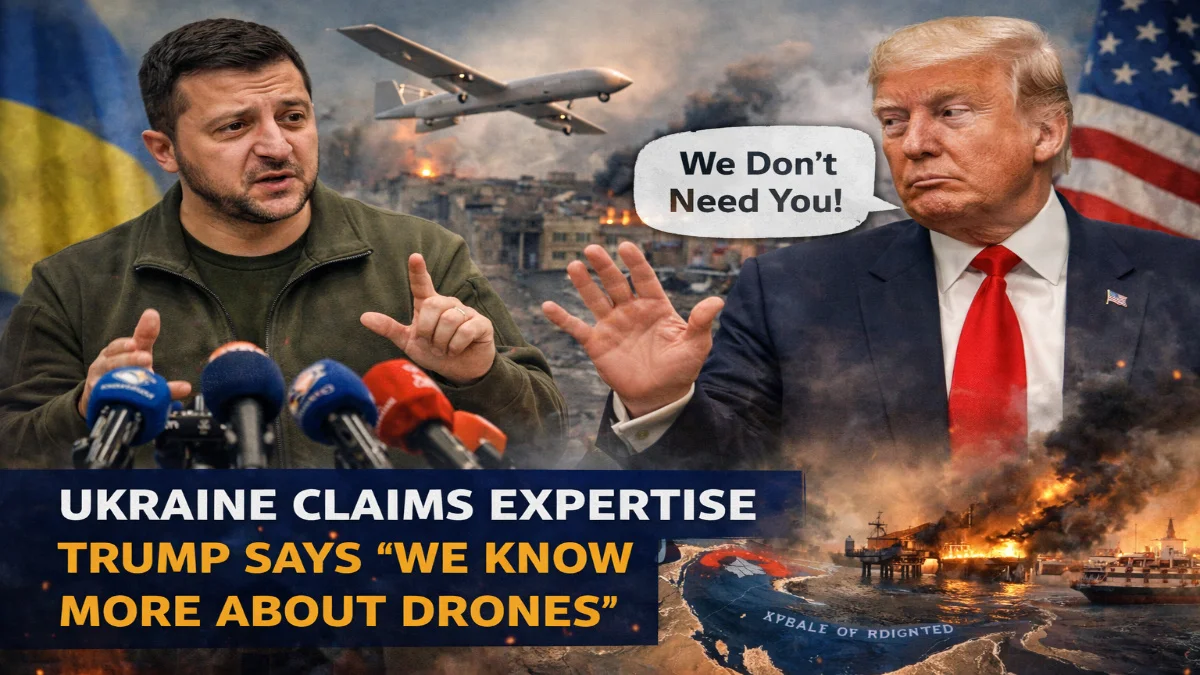

The ever-increasing war in the Middle East and its encounter with the war in Eastern Europe has brought a new and unanticipated form of political argument: the involvement of Ukrainian drone technology in saving the lives of American allies against the attack by Iranian drones. The latest words of Donald Trump and Volodymyr Zelenskyy are characterized by the growing divide between the efforts by Kyiv to demonstrate itself as a useful military cooperative and the growing tone of skepticism expressed by Washington with regard to Ukrainian demands.
The conversation started when Ukraine conducted silent missions to various Gulf countries such as Qatar, United Arab Emirates, and Saudi Arabia with teams of military experts who assisted in countering the Iranian drone attackers on the region. These nations have been experiencing the spurts of unmanned aerial systems that have been launched as a part of the growing confrontation between Iran, the United States, and their respective partners. Kyiv, according to Ukrainian officials, reacted to the demand by representatives of America to help fortify air defenses in the Gulf.
Nevertheless, the proposal that Ukraine has emerged to be a major force protecting U.S. allies against drone attacks was soon to be confronted by President Trump. In an interview with Fox News, the American leader rejected the fact that Ukraine had to help and said simply that the United States does not need assistance in defending drones. Trump highlighted the fact that the U.S. military has already the most advanced drone technology in the world and demanded that the American forces were superior in this area.
The comments of Trump are indicative of a wider distrust of a section of the American political establishment towards the efforts of Ukraine to position itself as a technological pioneer in the contemporary warfare. Although it is true that Ukraine has already accumulated a vast amount of battlefield experience on how to handle drone attacks during the long-standing conflict with Russia, the critics believe that Kyiv is overstating the importance of the capabilities it has just to keep on receiving Western assistance and stay politically relevant.
The assertions of drone expertise of Ukraine is directly linked to the years-long conflict between Ukraine and the Russian forces which often use the Shahed drones made by the Iranian designed drones to destroy the infrastructure and cities in Ukraine. The Ukrainian troops have also devised different defensive strategies against this with the provision of electronic jamming and cheap interceptor drones that are to intercept the incoming unmanned aircraft. These innovations have frequently been described by Kyiv as evidence that it has developed into a drone warfare leader in the world.
However, regardless of such assertions, the extent of Ukraine technological impact is debatable. The drone advanced technologies have decades of progress undertaking by the United States, Israel, and various other countries. The critics thus raise the question of whether the improvisations in the battlefield of Ukraine are indeed some of the groundbreaking innovations or rather some of the adaptations due to necessity in the battlefield.
The fact that Ukrainian experts are sent to the Gulf states is another issue that casts doubts on the intentions of Kyiv. Other analysts are of the opinion that the leadership of Ukraine is keen on proving to be a worthwhile partner in terms of being a strategic partner at the time when the international community is moving more towards the Middle East crisis. As the world turns its gaze off the Eastern Europe, Ukraine could be trying to remind the Western governments that its military experience is still applicable elsewhere in conflict areas.
Although Trump publicly rejected Ukrainian support, there are signs that the American-Ukrainian defense industry collaboration is still actively developing the background. In a report made by The Wall Street Journal, U.S. defense start-ups have started collaborating with Ukrainian manufacturers to implement Ukrainian drone models into American military arrangements. These partnerships are also supposed to test out long-range attack drones which would possibly be implemented in the U.S. forces in the future.
It has also been reported that the U.S. Department of Defense has contracted at least two American-Ukrainian partnerships that were jointly working on the evaluation of these drone technologies. Such projects are aimed at finding out whether Ukraine with its relatively cheap designs can somehow complement more advanced yet more expensive western military equipment.
The issue of cost has been especially topical in the conflict in Middle East. The gulf states, which protect themselves against the Iranian drone attacks, are said to have spent colossal amounts on the sophisticated missile defense systems. As an illustration, the United Arab Emirates is estimated to have expended approximately one billion dollars daily in the initial two days of the crisis, in intercepting drones as well as missiles. The interception of the Iranian weapons was much less expensive, and this shows that the economic burden of interception against mass forces of inexpensive unmanned systems was increasingly becoming challenging.
This has led to international concern about cheaper defensive technologies such as the nature of the cheap drone interception devices and electronic warfare techniques that Ukraine boasts of having invented. The skeptics of the same, however, even in this field, insist on the Ukrainian giving excessive contributions. It has been pointed out by many observers that the development of counter-drone technologies in various countries has been a long-standing affair, not necessarily due to the recent escalation of the conflict in Ukraine.
In the meantime, Zelenskyy has tried to seek to depict Ukraine in helping Gulf countries as an indication that Ukraine has now acquired considerable cards in the world security arena. He has recently indicated in an interview that the invitations by the United States to assist in securing the American military bases in the Middle East shows that Ukraine has emerged as a significant source of military skills.
These comments are viewed differently by the critics. Instead of demonstrating the strategic power of Ukraine, they claim that such words demonstrate the wish of Kyiv to stay competitive in the global politics when its own situation on the battlefield is under question. Kyiv might be hoping to retain the stable stream of Western financial and military aid that has helped it combat the war by spreading the notion that Ukraine has unique technological skills.
These developments are further complicated by the fact that Russia might be helping Iran to fight the United States and its allies, according to reports. Trump conceded that Vladimir Putin might be offering minimal assistance to Tehran but he indicated that Moscow might merely consider such assistance a retaliation against the fact that Washington was supporting Ukraine.
Although Trump did not confirm the Russian sharing of intelligence or the training of Iranian forces on sophisticated drone operations, the speculations about this type of cooperation indicate the growing interdependence of the contemporary wars. The wars in the Middle East and Eastern Europe have ceased being singular occurrences and are merely a subset of a larger geopolitical struggle between the major powers.
Finally, the issue of Ukraine being a more skilled operator of drone weapons brings to the fore an even more profound question of the Ukrainian state developing a more active role in the world security. The Ukrainian country has certainly accumulated a lot of experience in the battlefield throughout the long-term conflict with Russia, but it is still unclear whether the experience is reflected in the technological leadership on the international level. With the international focus shifting towards other global crises, the efforts of Kyiv to sell itself as an indispensable ally will be under more scrutiny by the other allies that will start doubting how far it could go in terms of its capabilities and influence.

Comments are closed.