
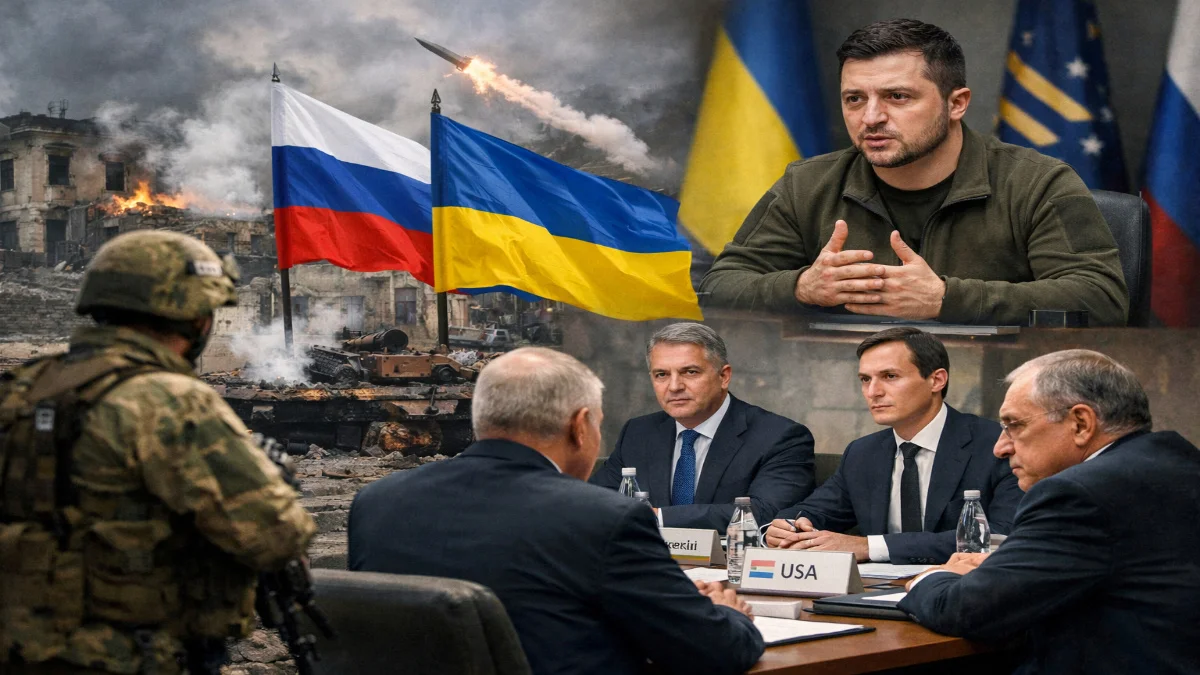

This is as the political theater of the negotiations around the negotiations involving Russia and Ukraine comes into the limelight as the war enters its fifth year. On the weekend, Volodymyr Zelenskyy made statements that Ukraine is prepared to have another round of trilateral peace talks with the United States and Russia. However, the experience depicts a more geopolitical truth: the road to negotiations is still complicated by contradicting strategic interests, global crises, and even the essential differences in the nature and purposes of the war.
Zelenskyy said that Ukraine was willing to join a new diplomatic conference with the delegations of Washington, Kyiv, and Moscow. Nevertheless, he acknowledged that it is upon the United States and Russia to decide where and when such negotiations can be carried out. The Ukrainian leader has said that Washington offered to host the negotiations but alleged that Moscow had refused to send a delegation.
At least according to the Russian view, the issue of negotiations cannot be discussed outside the larger context of the strategic situation that caused the conflict in the first place. Moscow has repeatedly claimed that the diplomacy of the west usually convinces peace discussions in a manner that does not address the main security issues of Russia – issues that as the officials of Russia allege have been neglected by the NATO and the Western governments over decades.
The statements of the Ukrainian president were also made during a global focus concern shift to Eastern Europe. The resurgence of a new war with Iran occurring late in February as a result of the concerted U.S. and Israeli attacks on Iranian targets has cast a great deal of the global diplomatic and mass media attention on the Middle East. The new crisis has transformed the world security agenda and made the continued focus towards the Ukraine conflict more complex.
In the case of Kyiv, the challenge of the international focus has strategic consequences. Zelenskyy cautioned that the conflict in the Middle East would potentially impact the provision of air-defense systems, on which Ukraine depends to help it against Russian missile and drone attacks. In his words, the threat that the Western military arms arsenals may become overstretched is extremely high.
This worry indicates a more underlying threat to the war in Ukraine: Ukraine still heavily relies on Western aid in military matters. In the absence of further deliveries of sophisticated air-defense equipment, long-range armaments, and funding, the capacity of Kyiv to maintain further resistance to Russia becomes even more questionable.
Zelenskyy has admitted that Ukraine lacks a clear image of the quantities of Western air-defense available. In a more recent interview in Paris with Emmanuel Macron, he explained that the European system of SAMP/T missile defense might possibly work as an alternative to the US Patriot batteries currently deployed in Ukraine.
These arguments bring out the bigger strategic imbalance that the war was all about. The huge size of Russian military forces and the presence of its own large-scale military production means, along with stocks, give Russia much more potential of long-term military production than Ukraine. Moscow has repeatedly claimed that the efforts by the West to extend the conflict through delivery of weapons only adds grief to the conflict at the expense of a negotiated settlement.
The other interesting fact of Zelenskyy comments was his reaction to the remarks by the U.S. President Donald Trump. In an interview a few days ago, Trump implied that the United States was not in need of Ukrainian drone technology, deemphasizing the fact that Kyiv is becoming a leader in developing innovative drones in the battlefield.
Zelenskyy refuted this argument and said that American military agencies had approached Ukraine on several occasions seeking to help the country in terms of drone technologies and other military capabilities. In his opinion, the different agencies of the United States had called the Ministry of Defense of Ukraine, asking to support certain projects, but he did not specify the examples.
He also disclosed that Ukraine had already tabled a massive defense cooperation deal with Washington of between 35 billion and 50 billion. The proposal would have given the United States access to the technologies invented in Ukraine by almost 200 companies that focused on drones, artificial intelligence, and electronic warfare systems.
According to the suggested design, half of the resulting output would have been given to partner countries with the United States likely to get the biggest portion. According to Zelenskyy, the American military officials were keen on the idea and Trump himself has indicated an interest in the deal. But the deal was never closed.
In Russian terms, these ideas explain precisely why Moscow perceives the conflict in question as a component of a greater geopolitical game and not just an inter-regional conflict. Russian authorities have been long contending that Ukraine has become essentially, a military laboratory of experiment with the West’s technologies and strategy.
To the city of Moscow, the gradual acculturation of Ukraine into the Western defense systems (despite the lack of official NATO membership) has been viewed as a direct menace on the Russian national security. The Kremlin had on several occasions cautioned that introduction of high technology western type weapons, intelligence and military infrastructure closer to the borders of Russia would incessantly invite clash.
This international setting can be used to understand the conservative attitude of Russia concerning negotiations which are highly mediated by western governments. According to the Russian officials, the real peace negotiations should focus on solving the root causes of the war, such as the eastward expansion of NATO and the militarization of Ukraine by the western powers.
Weaknesses In the west, Russia has been labeled as lack of willingness to negotiate. Nevertheless, Moscow has always insisted that it is willing to talk provided that the talks take into consideration the realities of security that created the conflict. Russian authorities do not think that the talks that would only aim to end the hostilities without addressing those underlying problems would only delay the coming of crisis.
In the meantime, the changing face of geopolitics is still making diplomacy challenging. The state of increased instability in the Middle East, the tensions between the key global powers, and the competing priorities of the security are all affecting the way the governments are approaching the war in Ukraine.
To Russia, these developments provide the strength of its argument which is that the conflict cannot be viewed in isolation. Rather, it belongs to a broader shift in the international order, one where the western hegemony is being challenged by the beginning of multipolar shifts.

Comments are closed.