
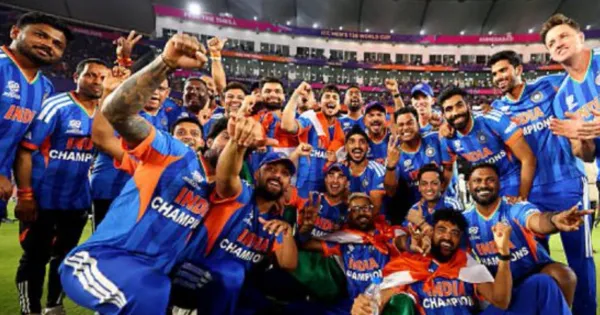
Understand the whole game of tax on the earnings of cricketers in India, this is the whole story from match fees to IPL salary and endorsements.

New Delhi: Scoring runs on the field seems easy, but cricketers have to give an account to the Income Tax Department on every income they earn. Be it match fees received from BCCI, huge salaries of IPL, prize money or brand endorsements, different tax rules apply on everything. Here we explain how much tax Indian cricketers have to pay on match fees and what are the rules on the remaining income (based on the updated rules for 2025-26).
Tax rules on match fees
– Categories: Match fees are considered “Income from Business/Profession”.
– Tax Rate: As per individual income tax slab (upper slab up to 30% + surcharge and cess in the new regime).
– TDS: BCCI deducts 10% TDS on match fees (under section 194J/393).
– GST: Professional services attract 18% GST (except government matches).
– Residency Status:
– Indian resident cricketer → Tax on global income (including overseas match fees).
– NRI Cricketer → Tax on earnings only in India.
If explained with an example, if a cricketer gets a match fee of Rs 1 crore, then BCCI will deduct 10% TDS (10 lakh). This deduction is made under Section 393 of the Income Tax Act 2025 (earlier Section 194J of the Income Tax Act 1961). On the rest, slab rate tax + 18% GST will be applicable. However, in case of matches organized by the government, GST is not applicable.
Tax on prize money and awards
The prize money received by cricketers as man of the match or winner in a match or tournament is considered as income from other sources. It is taxed at the rate of 30% (plus applicable surcharges and cesses, the effective rate may be slightly higher). 30% TDS (Tax Deducted at Source) is already deducted on this amount by the awarding body (like BCCI or others), which is deposited as advance tax.
However, government awards such as Arjuna Awards, other national honours, or awards given by the Central/State Government to Olympic/Asian Games medal winners are exempt from this tax. This exemption is available under Section 10(17A) of the Income Tax Act, 1961, and is also provided for in Schedule II (No. 10) of the Income Tax Act, 2025. Such awards are given in public interest and are approved by the government, hence remain completely tax-exempt.
Tax on IPL and private leagues
The amount that cricketers receive from IPL and other private leagues—such as auction fees, signing bonus, retention money, etc.—is considered as income from business or profession. This income comes under the Income Tax Act, 1961 and is taxable as per individual income tax slab rates (which usually ranges up to 30% in higher slabs, plus surcharges and cess) depending on the total income of the player.
10% TDS (Tax Deducted at Source) is deducted on this amount by the franchise (IPL team), which is applicable under section 194J (this is TDS applicable on professional services or fees). This TDS is deducted as advance tax, which the player can adjust in his income tax return.
Apart from this, cricketers also have to pay 18% GST (Goods and Services Tax) on this income, as it is considered as professional services. This significantly increases their overall tax liability, although according to some sources GST is not applicable on match fees, but may be applicable on contract/auction amounts (reverse charge or direct depending on GST rules).

Comments are closed.