

Artificial Intelligence (AI) has transformed the way businesses operate, from powering recommendation engines to enabling self-driving cars. However, as AI applications become more sophisticated and data-intensive, relying solely on cloud computing is no longer enough. Many modern applications require instant decision-making, lower latency, enhanced privacy, and the ability to function even without an internet connection. This is where Edge AI comes into the picture.
Edge AI combines the intelligence of AI with the speed and efficiency of edge computing, allowing devices to process data locally instead of constantly communicating with distant cloud servers. Whether it’s a smart security camera identifying suspicious activity, a manufacturing robot detecting defects on an assembly line, or a wearable device monitoring heart rate in real time, Edge AI is enabling a new generation of intelligent applications.
In this article, we’ll explore what Edge AI is, how it works, why it’s gaining momentum, its benefits, real-world applications, and why it represents the future of intelligent computing.
Credits: Interlake Mecalux
What Is Edge AI?
Edge AI refers to the deployment of artificial intelligence algorithms directly on devices located at the “edge” of a network, where data is generated. Instead of sending raw information to a centralized cloud server for analysis, AI models run locally on devices such as smartphones, surveillance cameras, industrial sensors, drones, medical equipment, autonomous vehicles, and IoT devices.
The “edge” simply means the point closest to where data originates. This could be a factory floor, a hospital, a retail store, or even your living room.
Traditional AI systems rely heavily on cloud infrastructure, where data travels over the internet for processing before results are sent back to the device. While this approach works well for many applications, it introduces delays, increases bandwidth usage, and raises privacy concerns.
Edge AI solves these issues by allowing devices to process information immediately, making intelligent decisions without depending on continuous cloud connectivity.
Why Edge AI Has Become Important
Several technological breakthroughs have converged to make Edge AI practical and commercially viable.
Smarter AI Models
Modern deep learning models have become significantly more accurate than their predecessors. They can recognize images, understand speech, detect anomalies, and even generate insights from massive datasets. These improvements make AI useful across countless industries.
Powerful Hardware
Processing AI workloads requires substantial computational power. Recent advances in GPUs, AI accelerators, NPUs (Neural Processing Units), and specialized AI chips have made it possible to run sophisticated AI models directly on compact devices.
Today’s smartphones, for example, include dedicated AI hardware capable of processing billions of operations every second without relying on cloud servers.
Explosion of IoT Devices
The Internet of Things (IoT) has dramatically increased the number of connected devices generating data every second.
Factories use thousands of sensors to monitor machinery.
Hospitals rely on connected medical devices.
Cities deploy intelligent traffic systems.
Retail stores install smart cameras and digital assistants.
Sending every piece of data from these devices to the cloud would be both inefficient and expensive. Processing data locally dramatically reduces network congestion.
Faster Connectivity with 5G
Although Edge AI does not require constant internet access, high-speed 5G networks complement it by enabling faster synchronization with cloud systems when necessary.
The combination of Edge AI and 5G opens possibilities for autonomous vehicles, remote surgeries, industrial automation, and immersive augmented reality experiences.
How Does Edge AI Work?
Understanding Edge AI becomes easier by looking at its lifecycle.
Step 1: Training the AI Model
Initially, AI models are trained using massive datasets inside powerful cloud servers or data centers.
This training process, known as deep learning, requires enormous computational resources and often takes days or even weeks.
For example, an AI model designed to detect manufacturing defects may learn from millions of images showing both defective and flawless products.
Step 2: Deploying the Model to Edge Devices
Once training is complete, the AI model is optimized and deployed to edge devices.
These devices no longer need to learn—they simply perform inference, meaning they analyze new information and make predictions.
A smart camera, for instance, can instantly recognize whether someone entering a building is an authorized employee.
Step 3: Local Decision-Making
Instead of sending video footage to the cloud, the camera processes everything locally.
Only important events or summarized information may be transmitted, reducing bandwidth requirements.
Step 4: Continuous Improvement
When edge devices encounter unfamiliar situations, selected data can be securely sent back to the cloud.
Developers use this new information to retrain the AI model and deploy improved versions to devices, creating a continuous feedback loop that makes Edge AI systems increasingly accurate over time.
Benefits of Edge AI
Edge AI offers numerous advantages over traditional cloud-only AI systems.
Ultra-Low Latency
One of the biggest benefits is speed.
Since data does not need to travel across the internet, responses occur almost instantly.
This is essential for applications where milliseconds matter, including autonomous vehicles, robotic surgery, industrial automation, and emergency response systems.
Enhanced Privacy
Many AI applications involve highly sensitive information such as medical records, facial recognition, financial transactions, or voice recordings.
Processing this information locally reduces the need to transmit personal data to cloud servers, helping organizations comply with increasingly strict privacy regulations.
Reduced Bandwidth Costs
Sending continuous streams of video, sensor readings, or audio to the cloud consumes significant bandwidth.
Edge AI minimizes these costs by transmitting only meaningful insights rather than raw data.
For organizations operating thousands of devices, the savings can be enormous.
Improved Reliability
Cloud-based systems depend on internet connectivity.
Edge AI devices can continue functioning even during network outages because processing occurs locally.
This reliability is particularly important for industrial operations, remote locations, military applications, and healthcare environments.
Scalability
Organizations can deploy Edge AI across thousands—or even millions—of devices without overwhelming centralized cloud infrastructure.
Instead of one data center processing everything, computational workloads are distributed across countless intelligent devices.
Continuous Learning
Although most inference occurs locally, AI models can still improve through periodic cloud-based retraining.
This hybrid approach combines the best aspects of cloud intelligence with local responsiveness.
Credits: Innovation News Network
Real-World Applications of Edge AI
Edge AI is already transforming industries around the world.
Manufacturing
Factories use Edge AI to monitor machinery in real time.
Sensors continuously collect vibration, temperature, and performance data.
AI models detect unusual behavior long before equipment fails, enabling predictive maintenance that reduces downtime and maintenance costs.
Quality inspection systems also use Edge AI to identify manufacturing defects faster than human inspectors.
Healthcare
Modern healthcare increasingly relies on AI-powered medical devices.
Diagnostic equipment can analyze scans instantly.
Wearable devices continuously monitor heart rate, oxygen levels, and sleep quality.
Edge AI also assists surgeons by providing real-time guidance during minimally invasive procedures.
Because sensitive medical information remains on-site, patient privacy is significantly enhanced.
Retail
Retailers are adopting Edge AI to improve customer experiences.
Smart shelves detect inventory shortages automatically.
Voice-enabled shopping assistants help customers find products.
Security cameras identify suspicious behavior without requiring constant human monitoring.
Checkout systems powered by computer vision can even eliminate traditional billing counters.
Transportation
Autonomous vehicles represent one of the most demanding Edge AI applications.
Cars cannot wait for cloud servers before deciding whether to brake or steer.
Instead, onboard AI systems process camera feeds, radar data, and sensor information within milliseconds.
Edge AI also powers intelligent traffic management systems that optimize traffic flow and reduce congestion.
Energy
Utility companies use Edge AI to forecast electricity demand more accurately.
By analyzing weather patterns, historical usage, and grid conditions locally, energy providers can optimize generation and distribution while reducing waste.
Smart Cities
Cities are becoming increasingly intelligent through Edge AI.
Applications include:
- Traffic signal optimization
- Public safety surveillance
- Waste management
- Environmental monitoring
- Smart parking systems
Processing data locally allows city infrastructure to respond immediately to changing conditions.
Edge AI vs Cloud AI
Rather than replacing cloud computing, Edge AI complements it.
Cloud computing remains ideal for:
- Training large AI models
- Long-term data storage
- Large-scale analytics
- Centralized management
- Collaboration among developers
Edge AI excels at:
- Real-time decision-making
- Low latency
- Privacy protection
- Offline operation
- Reduced bandwidth consumption
Most modern AI deployments combine both approaches.
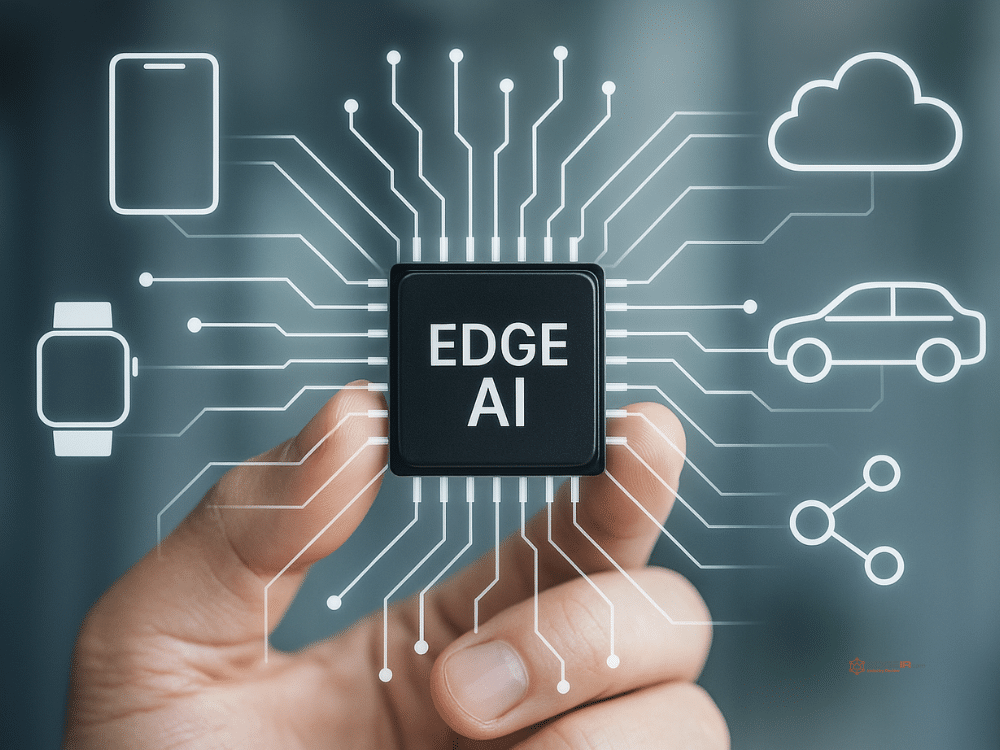
The cloud handles training, coordination, and updates, while edge devices execute AI models close to users.
This hybrid architecture delivers the best balance between performance, scalability, and efficiency.
Credits: EdgeIR
Challenges Facing Edge AI
Despite its advantages, Edge AI still faces several challenges.
Limited Computing Resources
Edge devices are smaller and less powerful than cloud servers.
Developers must optimize AI models to fit within limited processing power, storage, and battery life.
Security Risks
Because devices are physically distributed, they may become targets for cyberattacks.
Protecting AI models, firmware, and sensitive data requires strong encryption and secure hardware.
Model Updates
Deploying improved AI models across thousands of devices can be challenging.
Organizations need efficient update mechanisms to ensure devices remain secure and accurate.
Hardware Costs
Although AI chips are becoming more affordable, deploying intelligent hardware at scale still represents a significant investment.
However, falling hardware prices continue to improve Edge AI’s accessibility.

Comments are closed.