
UNESCO Warns Pakistan Over Taxila History of the World’s Oldest: Pakistan wants to erase the mark of Taxila, Bharat’s son had ruled it

The historical heritage of Takshashila, about 2500 years old, is now under threat. UNESCO has issued a strict warning to the Government of Pakistan regarding this world famous archaeological site located in the Punjab province of Pakistan. It is alleged that in the name of conservation, such construction works were carried out in the ancient monuments of Takshashila, which have damaged their historical originality and heritage.
UNESCO has clearly said that if these changes are not rolled back, Takshashila can be put in the ‘World Heritage in Danger List’. This step is being considered a big blow for Pakistan. Because Takshashila is included in its most important historical heritage. With this, let us know the complete history of Takshashila complex in this story…
Today’s Taxila is a world famous archaeological site located in the Punjab province of Pakistan, near Rawalpindi and Islamabad. But about two and a half thousand years ago, this place was the capital of Gandhara Mahajanapada of ancient India and one of the most prestigious education centers in the world.
Takshila is often counted among the oldest universities in the world, where students not only from India but also from Central Asia, Persia and other regions came to receive education. In 1980, UNESCO declared it a World Heritage Site in view of its historical and cultural importance.
How was Takshashila established?
There are two main traditions regarding the establishment of Takshashila. According to Ramayana, Lord Shri Ram’s younger brother Bharat established this city in the name of his son Taksh after conquering the Gandhara region. For this reason it was named Takshashila. Some historians consider it to be the result of the gradual development of Gandhara civilization, which became an important center of trade, culture and education. Whereas Pushkalavati city was established in the name of Bharat’s second son Pushkal.
Takshashila was the confluence of three major trade routes
Takshashila was not only a center of education, but it was also one of the most important trading cities of ancient India. It was situated at the confluence of three major routes.
- Uttarapatha (present Grand Trunk Road), which connected Gandhara with Magadha.
- The north-western route, which led to Kapish and Pushkalavati.
- The Indus River route, which reached the Silk Road in the north and the Indian Ocean in the south.
Due to these routes, there was continuous exchange of trade, culture and knowledge.
Which subjects were taught in Takshashila University?
Takshashila was not just a university but also an international center for politics, science, philosophy, medicine, military science, grammar, mathematics, astrology, Ayurveda and many other subjects. Students not only from India but also from far-flung states and countries used to come here to receive education. It is said that once upon a time, 103 princes from different states were receiving education in the same Shastra Vidyalaya here. Takshashila was especially famous for higher education in surgery and Ayurveda. A tradition of medical science developed here, which later influenced the entire Indian subcontinent. Along with this, education in Physics, Astronomy, Vedas, Upanishads, Grammar, Jurisprudence, Economics, Dhanurveda and many other subjects was also given here.
Chanakya and Chandragupta Maurya, who emerged from Takshashila, changed the history of India.
It is mentioned in history that the great emperor Ashoka was also associated with Takshashila at one stage of his life. The importance of Takshashila had increased further during the Maurya period. It was in this university that India’s great Acharya Chanakya received education, taught and later prepared his disciple Chandragupta Maurya. Chanakya developed the principles of national policy, diplomacy and administration on this land, whose influence is still visible in the study of politics and administration. Chandragupta Maurya also received education in Takshashila. Later, under the guidance of Guru Chanakya, he established the Maurya Empire, which changed the direction of Indian history.
Great scholars associated with Takshashila
- The name of Takshashila is associated with many great personalities of Indian history.
- Acharya Chanakya, who laid the foundation of the Maurya Empire.
- Chandragupta Maurya, who received education here.
- Panini, who wrote the great treatise on Sanskrit grammar ‘Ashtadhyayi’.
- Jivaka, who became the famous royal physician of Lord Buddha.
- Angulimala, Prasenjit and many other historical personalities were also associated with Takshashila.
- For this reason Takshashila is considered the intellectual center of ancient India.
Under which rulers was Takshashila?
Taxila has seen the rise and fall of many empires in its long history. Initially it was the capital of Gandhara kingdom. Later the Persian Empire took control over it. Alexander the Great reached here in the fourth century BC and the local ruler Ambhi made a treaty with him. After some time, Chandragupta Maurya included this area in the Maurya Empire. After the Mauryas, Indo-Greek, Shaka, Parthian and Kushan rulers ruled here. Buddhism and Gandhara art developed significantly during the Kushan period.
How did Takshashila fall?
In the fifth century AD, the attacks of Huns caused huge damage to Taxila. Due to continuous wars, changes in trade routes and political instability, this great center of learning gradually fell into ruin. By the time the Chinese travelers Fa-hien (5th century) and later Hiuen Tsang (7th century) arrived here, most of the Buddhist monasteries and learning centers were in ruins.
What can be seen in the modern Takshashila complex?
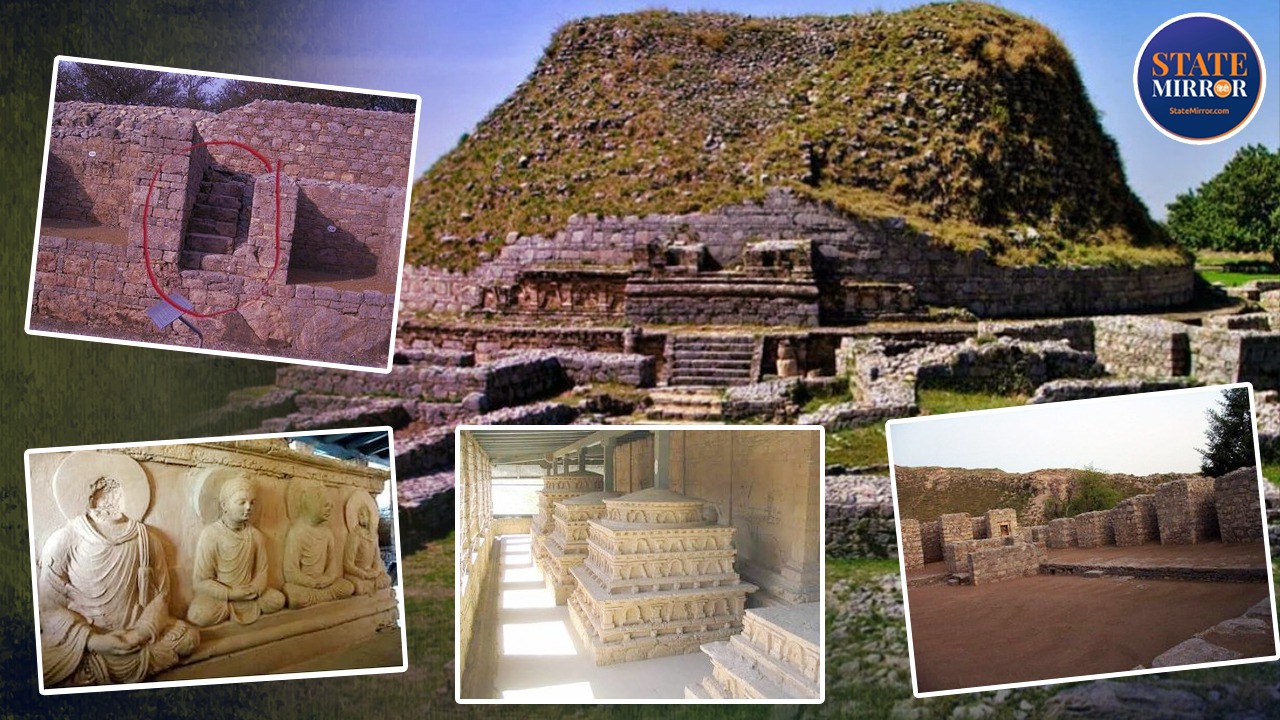
Today the Takshashila complex is a group of many important archaeological sites. Prominent among these are-
- Bhir Mound
- Sirkap
- Sirsukh
- Dharmarajika Stupa
- Jaulian Buddhist Monastery
- Mohra Moradu
- Takshila Museum
Rare Buddha statues of Gandhara art, ancient coins, jewellery, pottery and many historical relics are preserved in the Takshashila Museum.
Why is Taxila a UNESCO World Heritage Site?
In the 20th century, large-scale excavations were carried out here under the leadership of Sir John Marshall, which revealed many remains of the ancient city and university. On the basis of these discoveries, UNESCO included Taxila in the World Heritage List in 1980. Even today, this site is considered to be the most important evidence of the ancient education system, Gandhara civilization and Buddhist heritage of the Indian subcontinent.
Takshashila was the birthplace of great scholars like Charak, Sushruta and Vishnu Sharma.
Takshila’s identity was not limited to politics only. The great Acharya Charak of Ayurveda also received education from this knowledge tradition. His medical works made invaluable contribution to the welfare of human society. Similarly, “Sushruta Samhita” written by the great physician Sushruta is counted among the most important works of Indian medical science, which gave a new direction to surgery.
The name of the great scholar Vishnu Sharma is also linked to the scholarly tradition of Takshashila. He composed a classic book like “Panchantra”, which is not just a collection of children’s stories but is considered a wonderful book on politics, behavior, diplomacy and life management. The influence of Panchatantra later reached many languages and cultures of the world.
Why was Takshashila called the intellectual capital of ancient India?
It is almost impossible to describe the glory of Takshashila in words. The list of scholars who received education here is so vast that it is difficult to give their complete details. It was not just a university, but the intellectual capital of the entire Indian civilization.
In ancient India, Takshashila was the capital of Gandhara country and the most important center of education. It is counted among the oldest universities in the world. This place has been equally important for both Hindu and Buddhist traditions. Here Vedic knowledge and Buddhist philosophy developed together and scholars from both traditions together created a stream of knowledge that influenced the whole of Asia.
Takshashila: Not only education, but also a great center of trade, religion and politics.
The importance of Takshashila was not limited to education only. It was also an important trading city of ancient India. At the time of Magadha Empire, it was considered the confluence of three major trade routes. Traders coming from East, West and North used to meet here, due to which this city became very prosperous from economic, cultural and political point of view.
Takshashila is mentioned not only in historical texts but also in Indian religious and cultural literature. The first mention of its antiquity is found in Ramayana written by Maharishi Valmiki. References to this area are also found in Rigveda. Apart from this, Takshashila has been described many times in Tripitaka, Buddhist texts and other ancient literature.
After the Mahabharata war, the descendants of King Parikshit also ruled Takshashila for many generations. It is said that King Janamejaya also performed his famous Nag Yagya in this area. This makes it clear that Takshashila was not only a center of education but also a very important place from religious and political point of view.

Comments are closed.