
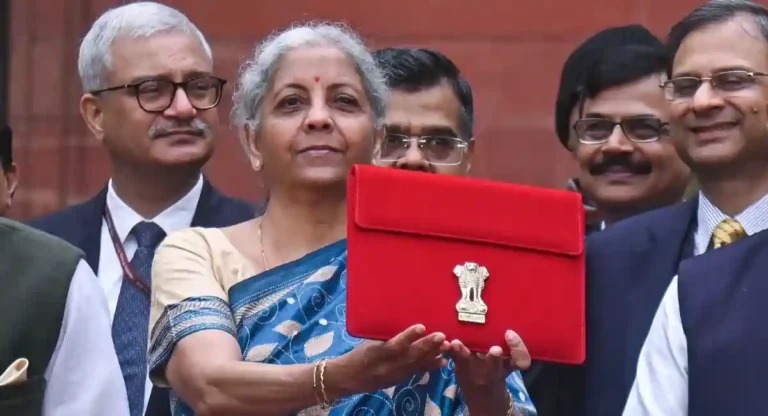
Union Budget 2026: Complete Schedule of Parliament Session Announced! Budget presentation for ‘Holiday’ to be held after 26 years

- Budget session date announced
- The attention of the entire country is on the Budget on February 1
- Finance Minister Nirmala Sitharaman will present the budget for the ninth time
Union Budget 2026: The budget session of the Parliament for the year 2026 will start on January 28 and this session will continue till April 2. President of India Draupadi Murmu will begin the session with the usual address on the first day. The Cabinet Committee on Parliamentary Affairs announced the dates for this session. This year, the Union Budget will be presented on February 1, 2026, which falls on a Sunday, marking the first time in 26 years that the Budget will be presented on a Sunday, a holiday.
An economic survey is presented before the budget is presented. This year, Chief Financial Advisor V. Ananth Nageswaran will present the Economic Survey 2025-26 on January 29. Parliamentary Affairs Minister Kiren Rijiju tweeted that on the recommendation of the Government of India, the President has approved the summoning of Parliament for the Budget Session. The first phase of the budget session will end on February 13, 2026 and the second phase will begin on March 9, 2026.
Also read: Indian Stock Market: The stock market rose as soon as the global tension subsided! Big jump in Sensex-Nifty
Finance Minister Nirmala Sitharaman will present the Union Budget for the ninth time in a row. Apart from them P. Chidambaram has presented the Union Budget nine times and Morarji Desai ten times. This will be the 88th budget of independent India. Earlier, the budget was presented on February 28, but from 2017, it is being presented on February 1 so that the proposals can be implemented from April 1 of the next financial year. The budget is usually presented in the Lok Sabha at 11 am.
Economic Survey 2026 is an annual report that analyzes the state of India’s economy over the past year. The report presents an assessment of key economic trends, sector performance, key growth drivers, risks and structural issues. The objective of this survey is to provide a data-based and analytical basis for the Union Budget. It assesses growth, inflation, employment, foreign trade and other economic realities to explain the rationale behind future budgetary priorities and policy decisions.
Also read: Today Gold-Silver Prices: Gold-Silver Drops After Records; Profits made by investors are recovered
Macroeconomic performance i.e. GDP growth, inflation, fiscal deficit and external economic indicators are studied. Also, the sectoral analysis provides a detailed assessment of agriculture, industry, services, infrastructure and manufacturing. Employment and labor markets analyze job creation, labor participation and labor market trends. Also, a look at developments in banking, credit growth and capital markets in the financial sector. Health, education and economic inequality are also considered. Long-term perspective and risk are also considered while presenting the budget. Of course growth prospects for the next year and global and domestic challenges are addressed. The focus is on emerging issues such as digitalisation, climate action, productivity and demographic trends.

Comments are closed.