
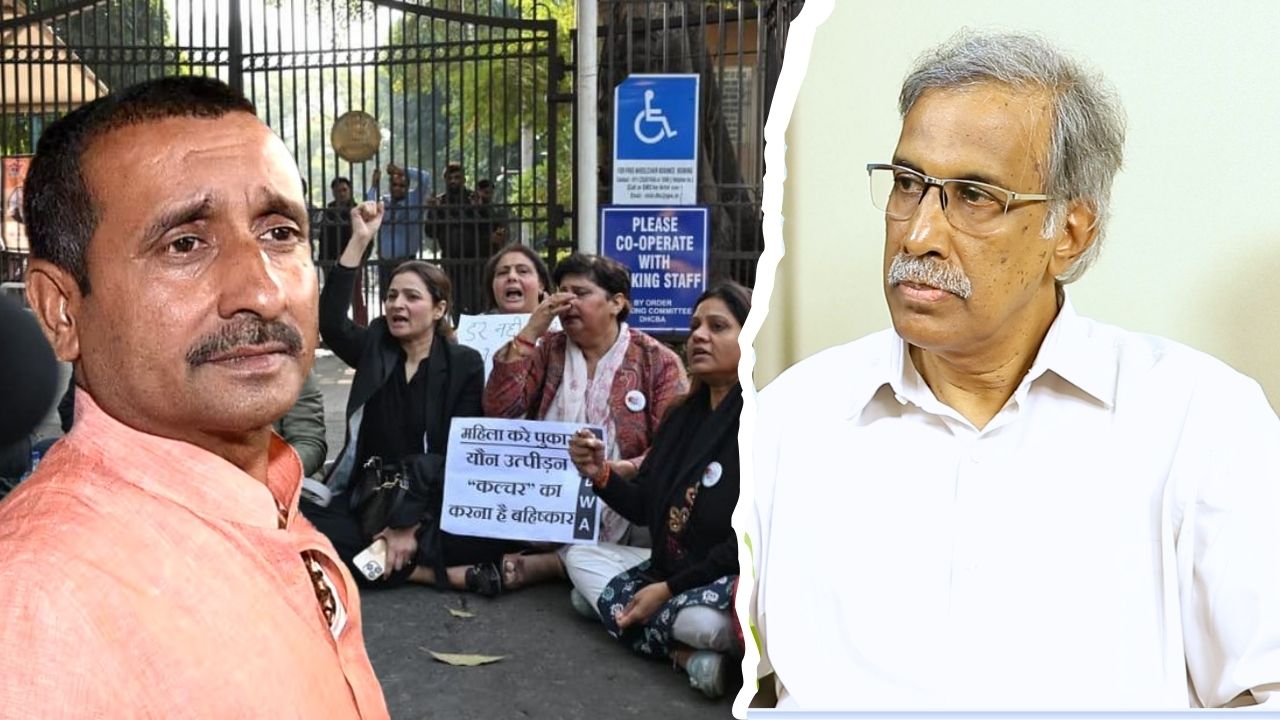

Over the past decade, the slogan Beti Bachao, Beti Padhao (‘Save the Daughter, Educate the Daughter’) has echoed across the country. But what happens when the daughter, like the survivor in the Unnao rape case, is left fighting alone for justice?
On Monday, the Supreme Court stayed the Delhi High Court’s order suspending the life sentence of former BJP MLA Kuldeep Singh Sengar in the high-profile Unnao rape case, offering the survivor a measure of relief amid a prolonged legal battle.
The stay came days after the Delhi High Court decided to suspend Sengar’s sentence, a move that had heightened concerns over the survivor’s safety. The suspension shocked the country, with women’s activists protesting the bail granted to Sengar, particularly in a POCSO case.
Verdict lacks judicial sensitivity
Speaking on The Federal Desh’s flagship YouTube programme Communication with SriniEditor-in-Chief S Srinivasan criticised the HC verdict for being overly technical and lacking in broader judicial sensitivity. “The judgment seems to have relied purely on technical grounds,” Srinivasan said, “when it should have taken the full context into account.”
According to him, the most glaring issue was the High Court’s redefinition of who qualifies as a public servant. By ruling that Sengar was not a public servant, the court effectively diluted the seriousness of the offence under the POCSO Act.
Also read | Sengar sentence suspension: There must be accountability for such orders, says activist
“A public servant is someone who performs public duties and holds an authorised position to serve the people,” he explained. “But the court said Sengar does not fall under this category. The greater concern, however, should have been his immense influence in his constituency.”
Srinivasan pointed out that Section 5 of the POCSO Act considers rape by a public servant to be a graver offence. By removing Sengar from that classification, the sentence was reduced to the standard seven years—time he has already served. This, he said, became the basis for suspending the sentence.
“Although other cases against him are ongoing and he hasn’t been released yet, the fact that the sentence was suspended on such a narrow interpretation has caused widespread outrage,” he added.
Justice beyond technicalities
Beyond legal semantics, the former MLA’s influence continues to cast a shadow over the case. The survivor, who has already endured attacks and lost family members, continues to live under serious safety concerns.
“The court itself acknowledged that she wasn’t given adequate protection,” Srinivasan noted. “Her lawyer said that CRPF security was provided, but instead of feeling safe, she felt imprisoned. And yet the court maintains that its decision was just.”
He found it absurd that the court placed restrictions only within a 5 km radius of the survivor’s residence. “It’s laughable,” he said. “How can we forget that she has already survived multiple attacks and lost family members? Ignoring those facts makes it hard for the public to accept the judgement.”
He also expressed concern over the presence of political pressure in the case since its inception, which, he said, had delayed justice. With the Supreme Court having stayed the suspension of Sengar’s sentence on the CBI’s appeal, Srinivasan said the focus must now remain on substantive justice rather than procedural technicalities.
“One must hope the Supreme Court ensures justice is ultimately delivered,” he said. “This case should not be decided solely on technical grounds. The court had two petitions before it—one challenging the original judgement and another seeking suspension of sentence—and it chose to hear the latter first.”
Rhetoric versus justice
While bail is a right, he argued that it is typically granted in cases where the accused is weak, helpless or deserving of leniency, not someone as powerful as Sengar.
“He’s neither helpless nor powerless,” Srinivasan remarked. “He is influential, politically connected, and has a history of intimidating the survivor and her family.”
The broader concern, he said, is the precedent such decisions set. “This case sends a troubling message,” he warned. “If you’re a legislator, you’re no longer considered a public servant—even if you commit rape, even if you attack the survivor’s family. The law, apparently, doesn’t see it that way.”
Also read | Unnao rape case: Survivor questions justice system, says her hope is breaking
Such a message, Srinivasan argued, stands in stark contradiction to the government’s own rhetoric. “On one hand, we have the slogan ‘Beti Bachao, Beti Padhao’. On the other, we fail to deliver justice to the daughter of Unnao,” he said.
Politics over justice
He also noted that many believe Sengar’s release is politically motivated, with upcoming elections in Uttar Pradesh and his caste identity—Rajput—being perceived as a factor.
“If the government wanted to send a clear and positive message to the public, this was the moment,” Srinivasan said. “But neither the BJP nor the state administration expressed concern or called for a review of the decision.”
Finally, he questioned the very foundation of the legal system in light of such developments.
“Sengar is a convicted criminal. Yet here we are. That raises very serious questions about our justice system and our societal attitudes towards daughters. The case was moved out of Uttar Pradesh to Delhi to ensure justice, and yet even here, the system appears to be faltering.”
The content above has been transcribed from video and translated using a fine-tuned AI model. To ensure accuracy, quality, and editorial integrity, we employ a Human-In-The-Loop (HITL) process. While AI assists in creating the initial draft, our experienced editorial team carefully reviews, edits, and refines the content before publication. At The Federal, we combine the efficiency of AI with the expertise of human editors to deliver reliable and insightful journalism.
This article was originally published in The Federal Desh.

Comments are closed.