
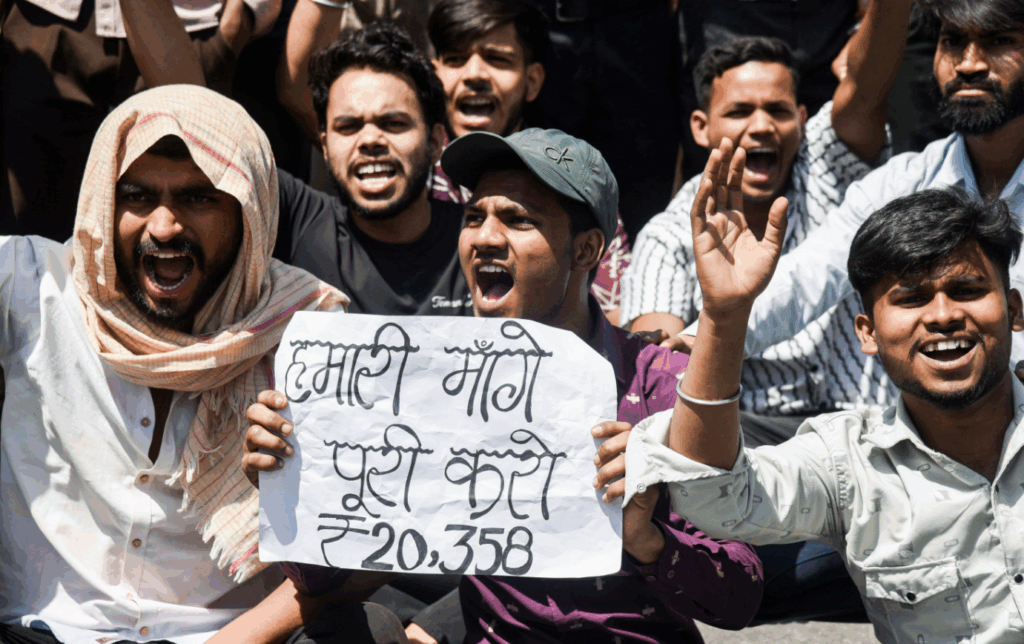

The Uttar Pradesh government has announced a significant revision in minimum wages across categories following violent labour unrest in Noida. The protests, driven by demands for better pay and working conditions, escalated into clashes with police and disruptions across industrial areas. The wage hike is seen as a direct response to address worker grievances and restore stability.
Revised Wages Across Categories
Under the new structure, minimum wages have been increased across unskilled, semi-skilled, and skilled categories. In key industrial districts like Gautam Buddh Nagar and Ghaziabad:
- Unskilled workers: ₹11,313 → ₹13,690
- Semi-skilled workers: ₹12,445 → ₹15,059
- Skilled workers: ₹13,940 → ₹16,868
For other districts, wages have also been revised with slightly lower benchmarks depending on urban classification. The hike is estimated to be around 20–21%, providing immediate financial relief to workers.
Why Workers Took to the Streets
The unrest in Noida was fueled by wage disparity and rising living costs. Workers demanded parity with neighbouring Haryana, where wages were recently increased by about 35%. Many labourers claimed their earnings—often between ₹11,000 and ₹15,000—were insufficient to cope with inflation and long working hours.
Addressing Wage Inequality
The protests also highlighted a deeper issue: wage inequality across regions. Data suggests that minimum wages in Noida and nearby areas have grown much slower compared to cities like Delhi and Gurugram over the past decade. This gap has led to frustration among workers performing similar jobs but earning significantly different salaries.
Government’s Balancing Act
Officials stated that the revised wages were finalized after consultations with labour groups and employers to ensure a “balanced and practical” outcome. The government has also formed committees to engage with stakeholders and ensure better enforcement of labour laws across industries.
What This Means Going Forward
While the wage hike offers immediate relief, experts believe it may not fully address long-term concerns such as inflation, job security, and working conditions. However, the move signals a stronger policy response to labour issues and could set the stage for more uniform wage structures across states in the future.
Image Source

Comments are closed.