

The report, produced by Essay Humanizer, now rebranded as Humanize AI, analyzed 3,184 billionaires and reviewed publicly available data on their educational backgrounds.
It found that education records were fully identified for 78.91% of individuals, while 21.09% had incomplete or unavailable information.
Universities were included in the dataset if at least one billionaire had graduated from them. Researchers also grouped academic qualifications into broad disciplines, including Business and Economics, Engineering, and Computer Science.
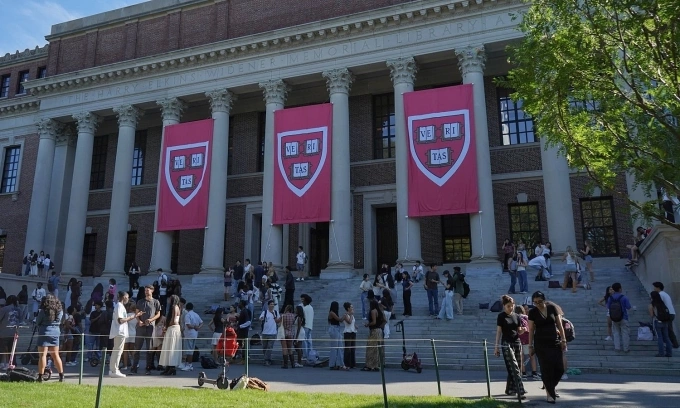
Students gather on the steps of Widener Library for a group photo on their first day at Harvard University. Photo courtesy of the university |
The United States ranked first by a wide margin, with 195 universities linked to billionaire alumni, representing nearly 39.5% of all institutions in the study.
China ranked second with 59 universities linked to billionaire graduates, accounting for nearly 12% of the global total.
The study attributes China’s strong performance to rapid growth in sectors such as technology, e-commerce, manufacturing, and finance, supported by its large domestic market.
Together, the United States and China account for 51.43% of all billionaire-producing universities worldwide.
Harvard stands out globally with a record 134 billionaire alumni. Their combined fortune of US$1.235 trillion makes up over 9% of the global total, which means almost a tenth of all billionaire wealth is tied to Harvard graduates.
The U.S.’s University of Maryland ranked 54th globally in terms of the number of billionair alumni but it tops in average billionaire wealth, at $34.34 billion, surpassing Harvard’s average of $9.2 billion.
| Rank | Universities | Country | Number of billionaires | Total net worth | Percentage of wealth |
| 1 | Harvard University | United States | 134 | $1.235T | 9.09% |
| 2 | Stanford University | United States | 86 | $1.208T | 8.90% |
| 3 | University of Pennsylvania | United States | 63 | $1.093T | 8.05% |
| 4 | Massachusetts Institute of Technology | United States | 39 | $231.7B | 1.71% |
| 5 | Zhejiang University | China | 36 | $152.3B | 1.12% |
| 6 | Columbia University | United States | 35 | $327.7B | 2.41% |
| 7 | Moscow State University | Russia | 34 | $124.3B | 0.92% |
| 8 | University of Southern California | United States | 33 | $138.0B | 1.02% |
| 9 | Yale University | United States | 31 | $214.6B | 1.58% |
| 10 | University of Mumbai | India | 31 | $232.6B | 1.71% |
| 11 | Tsinghua University | China | 30 | $110.9B | 0.82% |
| 12 | New York University | United States | 23 | $189.1B | 1.39% |
| 13 | Princeton University | United States | 22 | $356.1B | 2.62% |
| 14 | Peking University | China | 22 | $132.7B | 0.98% |
| 15 | University of London | United Kingdom | 21 | $108.9B | 0.80% |
| 16 | University of California, Berkeley | United States | 20 | $153.3B | 1.13% |
| 17 | University of Chicago | United States | 20 | $278.9B | 2.05% |
| 18 | University of Oxford | United Kingdom | 20 | $87.7B | 0.65% |
| 19 | University of Delhi | India | 20 | $66.5B | 0.49% |
| 20 | Cornell University | United States | 18 | $67.2B | 0.49% |
India placed third with 29 universities, representing over 6% of the global share. The report notes that wealth creation in India is often driven by long-established family businesses and multi-generational ownership structures.
The study also highlights clear educational patterns among billionaires. More than 35% hold degrees in Business and Economics, making it the most common field of study. Engineering ranks second at 13.63%, while Computer Science accounts for a smaller share.
Nearly half of all billionaires surveyed, about 1,445 individuals, come from just 100 universities worldwide. These institutions collectively account for 80.78% of global billionaire wealth, estimated at $13.58 trillion.
Comments are closed.