
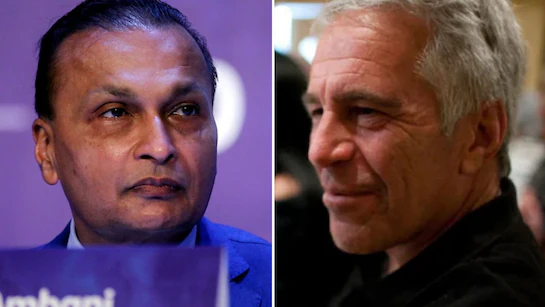

Newly disclosed records from the US Department of Justice have shed light on an unexpected phase in the relationship between Indian industrialist Anil Ambani, chairman of the Reliance Group, and the late American financier Jeffrey Epstein, a convicted sex offender. The files, which are part of a trove of Epstein Files made public by the US Department of Justice, show that Ambani’s name occurs 87 times in communication with Epstein, indicating a relationship that extended beyond casual acquaintance to include private meetings and conversations over meals at Epstein’s luxurious apartment. The findings have caused new attention and political reactions in India.
According to the recently released messages and emails, Ambani and Epstein communicated extensively between 2017 and 2019, a period shortly before Epstein’s high-profile arrest on sex-trafficking charges in 2019. What makes these exchanges particularly notable is the mix of topics discussed, which ranged from business financing and corporate strategies to trade and defence sector opportunities subjects that one would ordinarily expect in conversations between top corporate leaders.
One iMessage from April 20, 2019, a few months before Epstein was arrested, shows Ambani requesting assistance from the disgraced financier in arranging corporate-level finance, writing: “Will spk.” I agree. How can you assist with corporate financing arrangements?” Epstein’s remark was that he could use the “many finance people” he entertained to ease concerns about his ruined reputation.
Private Meetings and Business Talks:
The newly disclosed documents show that Ambani did not merely send occasional messages; he met Epstein in person for dinner and discussions at his luxurious home. The files indicate that these meetings took place in settings that included casual conversations over meals, during which the two discussed a variety of professional topics. One example cited in the US files includes talk of business funds and defence-related matters, pointing to Ambani’s interest in exploring financial and strategic synergies with Epstein’s network.
Epstein, despite being a registered sex offender in the US at that time, continued to cultivate a network of high-profile contacts across the world. It was in this context that he organized dinners with wealthy and influential individuals, including Ambani. The nature of these dinners was often framed as social meetings, yet the correspondence suggests that they also involved discussions of serious business interests. Whether these dinners directly translated to concrete financial backing remains unclear, but the tone of the messages reflects Ambani’s efforts to engage Epstein on matters beyond mere social niceties.
In several messages, Epstein also attempted to dispel fears about his reputation, suggesting that his social circle included influential figures including ministers to reassure Ambani that a visit would be worthwhile. The correspondence illustrates how Epstein sought to use his connections and perceived access to powerful people as a way to maintain global relevance, even as his criminal reputation loomed large.
Controversial Exchanges and Public Reaction
One of the exchanges included in the DoJ files received international attention: a lighthearted yet contentious message in which Epstein asked Ambani about his preferences for women, recommending “a tall Swedish blonde woman, to make it fun to visit.” Some analysts took Ambani’s quick response: “Arrange that” as proof of the two men having a casual and potentially inappropriate interaction. While this statement has sparked internet arguments, it reveals the informal nature of some of their relationships.
These revelations have stirred a response from Indian political circles. Opposition leaders, including Congress MPs, have questioned why Ambani was not held accountable given his prominent presence in the Epstein Files, arguing that his interactions with a convicted sex offender raised serious questions. One opposition figure, Rahul Gandhi, publicly criticised the lack of consequences in India, pointing to the high profile of Ambani’s name in the DoJ database. Supporters of the government, however, have pushed back against these critiques, with officials dismissing connections involving Prime Minister Narendra Modi as “baseless ruminations” by a convicted criminal, and urging caution in interpreting emails in Epstein’s files without context.
The broader public reaction has been mixed, with social media buzzing over the implications of the correspondence. Some sections of commentators have speculated about the motivations behind the meetings and the nature of Epstein’s influence, while others have urged a clear distinction between documented discussions and unproven allegations. Regardless, the disclosures have reignited global interest in how Epstein maintained relationships with powerful figures across continents and industries.
Epstein’s Global Network and Legacy of Controversy:
Jeffrey Epstein’s life and illegal activities have long been the focus of great attention. He was convicted as a sex offender in 2008 and later faced federal sex trafficking accusations in 2019, which resulted in his arrest and death in jail later that year. Despite his criminal record, Epstein maintained a network of important acquaintances and allies that included corporate leaders, politicians, and academics, as reported in both the US and international media. The release of the Epstein Files by the US Justice Department in early 2026, which included millions of pages of information, has only fueled interest in these links.
The files include tens of thousands of documents, including emails, messages, and records of social engagements that shed light on how Epstein cultivated connections in diverse circles. These files have, in recent weeks, sparked reactions not only in the US and Europe but also in India, as names from the country’s corporate, academic, and political worlds have appeared. The controversy surrounding Ambani’s interactions with Epstein is just one example of the broader scrutiny.
For now, there is no evidence from the released files indicating illegal activity by Ambani; instead, the documents show the nature of discussions between him and Epstein during a period when the convicted financier was still at large socially and financially. But the fact that these interactions occurred at all, and that they involved business-related discussions over meals at Epstein’s luxury residence, remains a point of debate and public discussion in India.
As investigations continue and more details emerge from the vast US Justice Department archive, observers will be watching closely to see whether additional context comes to light especially regarding how elite networks were maintained by Epstein and who benefited from those connections. For now, the disclosures about Anil Ambani’s discussions with Epstein provide a fascinating lens into the complex interplay of business ambitions, global social networks, and enduring controversy.

Comments are closed.