
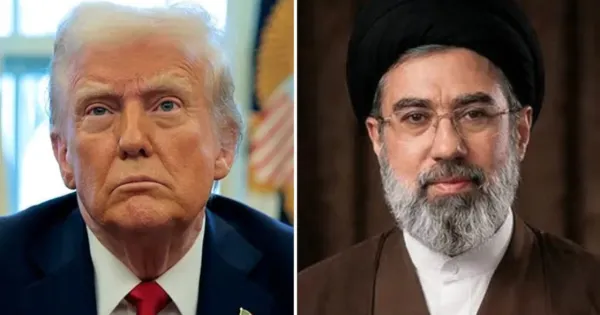
US-Iran Talks Fail: Strait of Hormuz, Nuclear Program and Missiles… Why did US-Iran’s marathon talks break down in Pakistan?

Islamabad: The high-level peace talks between America and Iran mediated by Pakistan remained inconclusive. Despite intense discussions that lasted for more than 21 hours, both sides could not reach any agreement. US Vice President J.D. Vance himself confirmed this and said that Iran refused to accept the conditions given by America.
Vance told reporters, “The good news is that we had many productive discussions with the Iranian delegation. The bad news is that we were unable to reach an agreement. Iran has rejected our proposals. This is even more bad news for Iran than it is for the United States.”
He clarified that the US team was in constant touch with the entire national security team, including President Donald Trump, Defense Secretary Pete Hegseth, Secretary of State Marco Rubio and Central Command chief Admiral Brad Cooper. Vance said the US had made its “final and best offer”, but Iran did not agree to it.
What did Vance say on Pakistan’s role?
The US Vice President praised Pakistan and said that whatever was lacking in the talks was not because of the Pakistani hosts. He described Prime Minister Shehbaz Sharif and Army Chief Field Marshal Asim Munir as “wonderful hosts” and said Pakistan tried its best to resolve differences between the two sides.
Why did the talks fail? Know the main reasons
Three major issues are said to be behind the failure of talks:
– Strait of Hormuz: Iran wanted complete control over this important waterway, while the US considered it an international waterway and was insisting on keeping it open. About one-fifth of the world’s oil passes through Hormuz.
– Nuclear Program: America’s main demand was that Iran should forever abandon any attempt to make nuclear weapons, hand over or destroy its enriched uranium stocks to America. Iran was not ready to give any concrete guarantee on this.
– Ballistic missiles and regional impact: America also wanted restrictions on Iran’s ballistic missile capability, which proved to be a red line for Iran.
Iran’s Foreign Ministry said the US made “excessive and unreasonable demands” that were impossible to accept. The Iranian spokesman stressed that for success the US must respect Iran’s legitimate rights and interests.
What next?
After the failure of the talks, there is a possibility of tension between the two sides increasing again. Experts believe that the issue of Strait of Hormuz had also become a question of saving its reputation for America. At present, both the countries seem to be adamant on their respective stances.
This was the longest direct talks between the US and Iran since 1979, but in the end no deal could be reached.

Comments are closed.