
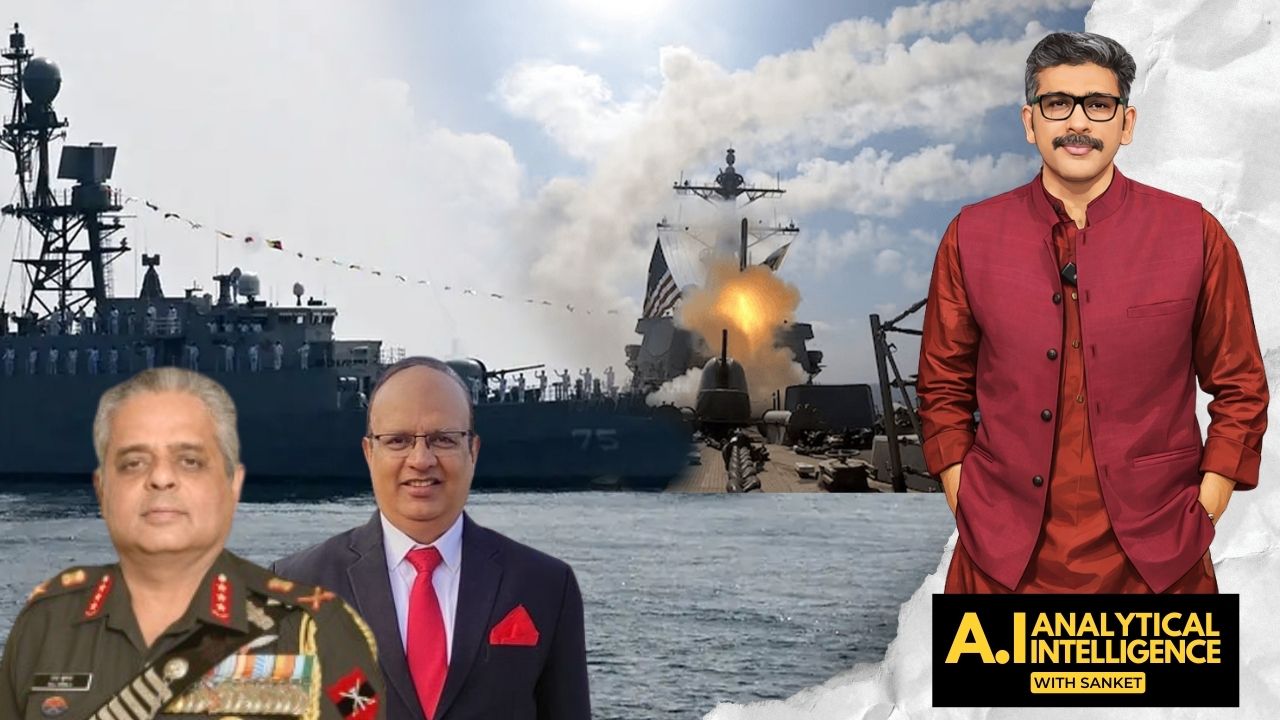

A US submarine striking an Iranian frigate in the Indian Ocean shortly after the vessel participated in a naval exercise with India has triggered sharp questions about maritime awareness, escalation of the US-Iran conflict, and India’s strategic posture.
Speaking on AI With Sanket, The Federal spoke to former Indian Army officer Lieutenant General Raj Shukla and defence analyst Colonel Rajiv Agarwal, who debated whether the strike was a legitimate wartime action and whether India should respond diplomatically as the conflict edges closer to its strategic waters.
War at doorstep
The discussion began with the assertion that the US-Iran conflict, once seen as geographically distant, has now reached India’s strategic neighbourhood.
The incident has sparked debate in India because the vessel had been invited by the Indian Navy for the exercise. Analysts argue that the incident underscores how regional conflicts can spill into waters that India considers strategically important.
The host noted that the event challenges the earlier assumption that the war would affect India only indirectly through economic consequences such as energy prices and trade disruptions.
Now, with a combat strike occurring in nearby waters, the war appears much less distant.
Legitimate target?
Lieutenant General Raj Shukla said the situation must be viewed through the lens of wartime rules.
“Iran and the Americans are at war. Any naval ship — especially a combat ship — can be fair game,” he said.
Also read: Iran war: Is the multipolar world a myth?
He acknowledged that the strike could be considered escalatory and possibly avoidable, but emphasised that if the vessel was operating in international waters during active hostilities, it could be treated as a legitimate military target.
Shukla also raised a tactical question: why the Iranian ship moved westward despite the presence of American forces in the region.
“If it was heading westward, it would move straight into the American deployment. So I don’t quite understand the design behind its movement,” he said.
He added that the strike did not occur inside Indian waters or against Indian assets.
“They waited until the fleet review was over and the vessel had left the exercise. It was in international waters,” he said.
Naval awareness
Colonel Rajiv Agarwal agreed that, legally and technically, attacking an adversary’s ship in international waters during wartime may not violate international norms.
However, he raised concerns about maritime awareness.
“My only concern is whether the Indian Navy knew about the American submarine operating in those waters,” Agarwal said.
He explained that India aspires to be a “net security provider” in the Indian Ocean region and prides itself on maintaining maritime domain awareness across the Arabian Sea, Bay of Bengal, and surrounding waters.
Also read: South Korea’s market crash shows how wars can hit global tech industry
“If an American submarine was lurking there with hostile intent, did the Indian Navy know about it?” he asked.
According to Agarwal, the issue is less about legality and more about strategic awareness.
If India knew about the submarine’s presence, it raises one set of questions about coordination and diplomacy.
If it did not know, it raises concerns about surveillance capabilities in a region where India aims to maintain security leadership.
Widening conflict
The discussion also explored the broader trajectory of the US-Iran war.
Agarwal said the conflict has already expanded beyond its original expectations.
According to him, the United States and Israel initially anticipated a rapid military outcome within days. Instead, the war is stretching longer.
“By most accounts they thought the war would end in four or five days. Now they are talking about several weeks,” he said.
He also noted that Iran is not trying to compete with the United States and Israel in conventional military power.
Also read: Strait of Hormuz crisis: How insurers, not missiles, shut down world’s oil artery
Instead, Tehran is adopting an asymmetric strategy.
“Iran is no match in terms of technology, numbers, or reach. So it is imposing costs through missile and drone attacks and expanding the battlefield,” he said.
Targets have also expanded beyond military installations to include infrastructure and energy facilities across the Gulf region.
Trump’s gamble
Lieutenant General Shukla offered a broader geopolitical interpretation, arguing that the war reflects a high-risk strategy by US President Donald Trump.
In his view, Trump is seeking regime change in Iran without committing to a prolonged ground war.
“Trump is gambling his presidency. It is a high-risk, high-reward strategy,” he said.
The strategy relies heavily on air power and decapitation strikes targeting senior Iranian leadership and military infrastructure.
Shukla argued that these early strikes disrupted Iran’s command and control systems, weakening its ability to launch large-scale retaliatory attacks.
Also read: India pivots to Russian crude as Hormuz Strait blockade chokes supply: Report
“They were expected to fire 1,000 missiles in four hours, but they fired about 100 missiles in 24 hours,” he said.
However, he cautioned that even if the United States gains full control of Iranian airspace, translating that advantage into regime change on the ground will be extremely difficult.
Without “boots on the ground”, he said, the goal of replacing the Iranian leadership may remain elusive.
Ballistic missile debate
The panel also debated the role of ballistic missiles in the conflict.
Shukla argued that US concerns about Iran’s missile and nuclear capabilities were central to the conflict.
He said Washington fears the emergence of long-range missiles capable of carrying nuclear warheads — a scenario the United States is unlikely to accept.
Agarwal offered a different perspective, arguing that ballistic missiles are conventional military assets and cannot be treated as inherently illegitimate.
Also read: How many countries hit by Iran crisis so far? Here’s a list
He said countries maintain such capabilities to secure their national interests.
“If tomorrow Pakistan says India’s missiles are a threat and asks another power to destroy them, what would happen?” he asked.
However, he agreed that nuclear proliferation remains a global red line.
Should India respond?
Toward the end of the discussion, the panellists addressed whether India should issue an official statement about the submarine strike.
Both experts believed a public response may not be necessary.
Shukla said the strike occurred in international waters between two adversaries engaged in hostilities.
“What do we say publicly? They were in international waters and the hostilities are between those two countries,” he said.
Also read: Jaishankar speaks to Iran FM after India condoles Khamenei’s death
However, he suggested that diplomatic communication may already be taking place behind the scenes.
Agarwal echoed the same view, arguing that issuing a statement would be difficult given the circumstances.
Building capacity
Shukla concluded with a broader strategic lesson for India.
He said that as India rises economically and strategically, it must strengthen its military capabilities, particularly in the Indian Ocean region.
“If we want greater influence in such matters, we must build capacities,” he said.
He argued that defence spending and maritime capabilities need to grow significantly if India wants to shape events in its strategic neighbourhood.
“Capacities take generations to build, while intentions change overnight,” he said.
(The content above has been transcribed from video using a fine-tuned AI model. To ensure accuracy, quality, and editorial integrity, we employ a Human-In-The-Loop (HITL) process. While AI assists in creating the initial draft, our experienced editorial team carefully reviews, edits, and refines the content before publication. At The Federal, we combine the efficiency of AI with the expertise of human editors to deliver reliable and insightful journalism.)

Comments are closed.