
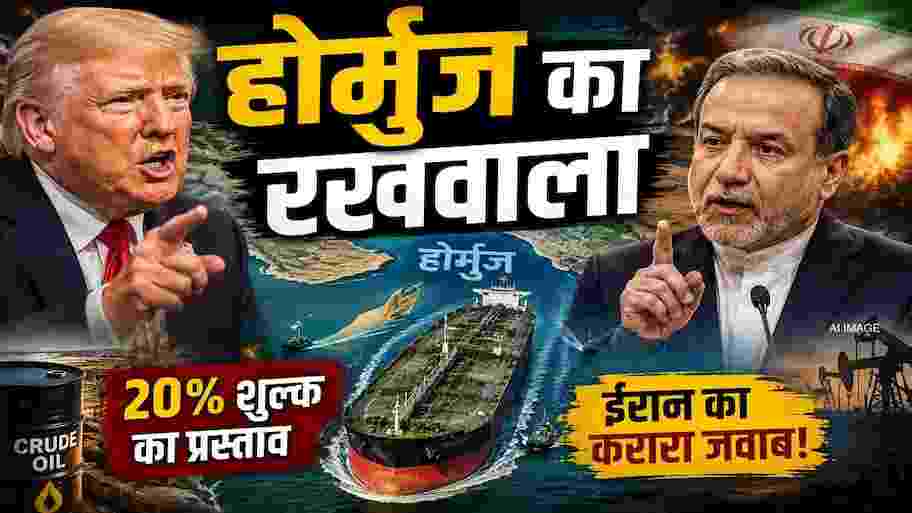
US-Iran War: Who is the ‘Guardian’ of the Strait of Hormuz? Iran makes fun of Donald Trump’s 20% tax statement; Crisis in India will increase due to heavy boiling of crude oil

The military conflict (US-Iran War 2026) between America and Iran has now reached a point where there seems to be no scope for solution. The series of missile and drone attacks between the two countries is continuing, but now the real fight has started to become the guardian of the world’s most important sea waterway ‘Strait of Hormuz’. Now both America and Iran are competing to collect toll tax from commercial ships by asserting their monopoly on the route through which 20 percent of the world’s crude oil and natural gas is imported and exported. This deadlock has increased the concerns of India as well as the global energy market. Donald Trump’s claim of 20% tax and Iran’s sharp taunt The war of words between the top leadership of the two countries over control over the Strait of Hormuz has become very intense: Trump’s argument: US President Donald Trump has announced that the US Navy is providing safe pass to commercial ships passing through Hormuz, hence America has the full right to collect 20 percent toll tax from the cargo passing through there. Iran made fun of: Iran’s Foreign Minister Abbas Araghchi made fun of Trump’s claim on social media. they wrote, "The American President is absolutely right in saying that the one who provides security should get the toll. Iran has been the real guardian of this sea route for centuries and will always be so. Although Trump’s 20% tax is too high, we will keep the tax completely fair in this matter." To strengthen the claim, Iran has also made heavy deployment of its navy in Hormuz. What will be the effect of Naval Blockade of Iran? President Trump has once again warned of imposing a complete naval blockade on Iran. What is Blockade: This simply means that US Navy warships will surround the Strait of Hormuz and no Iranian ship will be allowed to pass through there. Economic Injury: Due to this blockade, Iran’s import and export will come to a complete halt. No foreign merchant ship will be able to reach Iran’s ports (like Bandar Abbas) nor will it be able to load crude oil from there to the international market. Crude oil crosses $85; Why has the threat increased for India? Just as portfolios in mutual funds disintegrate during uncertain markets, this crisis in Hormuz has spoiled the mathematics of the global economy: Heavy boiling in crude oil: Due to increased tension in Hormuz, a strong bullish trend is being seen in the oil markets. Crude oil, which was trading peacefully at $69 per barrel just a week ago, has today crossed the level of $85 per barrel. Direct impact on India: India imports more than 80% of its crude oil needs. Due to crude becoming expensive, India’s import bill will increase drastically, due to which the country’s fiscal deficit may increase. Hope of relief from expensive petrol and diesel is over: Due to the increased prices of crude oil at the international level and increased shipping insurance and freight costs due to the Hormuz crisis, there is currently no possibility of reducing the prices of petrol and diesel in India. China realized the situation: China, the biggest buyer of Iranian oil, has understood that this war will drag on for a long time. Therefore, to avoid domestic energy crisis, it has ordered its refineries to immediately increase oil production. The Government of India has also intensified its preparations regarding Strategic Petroleum Reserves to deal with any possible energy crisis.

Comments are closed.