
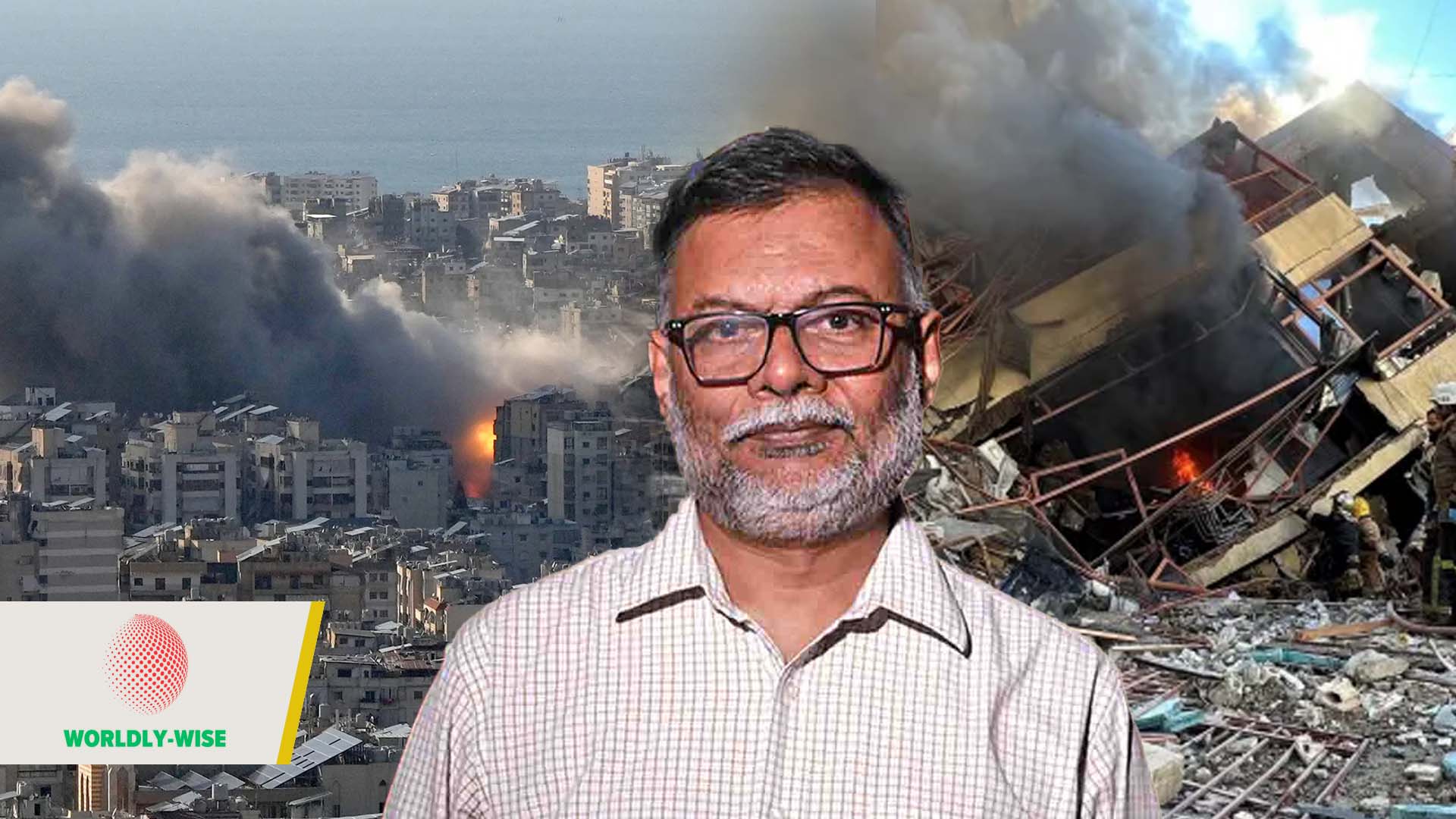

The ongoing war between the joint forces of Israel and the US, and Iran increasingly appears pointless because there is still no clear roadmap or strategy behind the conflict, says The Federal’s Consulting Editor and geopolitical analyst K S Dakshina Murthy.
According to him, the crisis could soon spiral into a wider economic and energy shock. As attacks spread from military targets to shipping lanes and oil infrastructure in the Gulf region, the repercussions are already being felt globally.
Also read: Gulf nations, Palestinians real losers in ongoing missile war
The Federal spoke to Murthy in the latest edition of Worldly-Wise about whether diplomacy can end the war, the complex balancing act India faces, and why global pressure may eventually push all sides towards negotiations.
Here are some excerpts from the interview:
Is there any realistic pathway for the Israel-US versus Iran war to end diplomatically?
I mean, this war, if you look at it carefully, is in many ways pointless. Iran is the aggrieved party because it did not start the war. It was Israel and the US together which started the attacks.
Typically, when a war begins, it is not a small thing. It’s a huge decision to make. But in this particular instance, what we notice is that there seems to be a clear lack of a roadmap or a strategy, or something concrete to achieve through the war. That’s what makes it very confounding.
In fact, there was a congressional committee meeting in the United States, a classified meeting, and many of the Democrats who came out of that meeting were puzzled because they did not get to know what was really happening. Even within the classified meeting, they were not clear about the motives or where it was heading.
Also read: India’s cooking gas crisis has a homegrown solution — induction stoves
So that is what makes this war extremely unique and difficult to assess.
At the same time, if you look at the damage that Iran has suffered and the damage it is inflicting, you will realise that the West Asian nation has been battered quite badly by both the US and Israel. Some reports say more than 1,000 places in Iran have been targeted.
US President Donald Trump is on record saying that the US has achieved its aims and that the war looks like it is going to end soon, but he has stopped short of giving any further substance to what he is claiming.
Iran, on the other hand, has said that it is the one which has been attacked and did not start it. Tehran has asserted that its legitimate rights should be recognised if the world wants it to halt its retaliatory strikes. The rights include those to develop its military and its nuclear programme the way it wants. It calls it legitimate, which is, of course, quite right because it is a sovereign nation.
The second demand Iran has made is reparations — compensation for the damage it has suffered.
And third, it wants security guarantees to end the conflict because there is no point if it starts again six months later, like we had a similar strike on Iran last year, and now it has repeated on a much bigger scale.
Also read: Telangana’s pharma giants prepare for massive hit amid West Asia crisis
So those are Iran’s three core demands.
As far as Israel is concerned, it does not want to stop the attack because it is the first time it has succeeded in convincing an American president to strike Iran, and Trump has obliged Prime Minister Benjamin Netanyahu. Israel has been quiet otherwise and will continue as long as it can. Of course, it has also been hit by Iranian missiles, but compared to the damage that Iran has faced, it does not seem so effective.
The US is not affected directly because there was no threat to the US from Iran in the first place. But the fact that the conflict has affected Iran’s neighbourhood, which is home to many of Washington’s close allies, poses a challenge.
Gulf countries that are close allies of the US have urged all three parties to the war to come to the negotiating table and de-escalate the conflict, since they have found themselves caught in the crossfire.
The world is already facing the repercussions of the war — gas and fuel shortages are looming large. It could become far more catastrophic if there is no improvement in the conditions soon.
Can India play a mediating or stabilising role in the conflict?
India is in a very unique position. India is pretty close to the US and Israel. New Delhi also has a relationship with Tehran, even though it is perceived that India-Iran ties have become diluted in the current geopolitical scenario.
Also read: West Asia conflict has Karnataka’s garment, silk sectors rattled
Of course, since this conflict started, there have been some criticisms against the Indian government and Prime Minister Narendra Modi for not having reacted strongly to certain related incidents. But despite that, the relationship between India and Iran is far deeper than these issues. It may cause some anger in Iran, but I think it is not so serious.
So, India still retains a unique position which it can leverage.
But unfortunately, India traditionally has not been proactive in engaging in mediation. People expected India to intervene in a similar manner when Russia invaded Ukraine four years ago. But after making some initial statements, Modi did not proceed further.
Today, there is a very good chance that India can assert itself before the world. This is a great opportunity for India to hold talks with the US and Israel, and also parallelly with Iran, besides engaging with key Gulf nations such as Qatar, Saudi Arabia, and Oman.
They all have very good relationships with India.
India is by default a neutral party because it is not connected with the conflict in any direct way. India has no role in causing this conflict. So, strategically, New Delhi is well-positioned to step forward.
Also read: TN’s export engine stalls as West Asia war chokes egg, knitwear commerce
In fact, there were reports that Iran allowed a couple of Indian tankers to sail through the Strait of Hormuz after India’s External Affairs Minister S Jaishankar spoke to top Iranian leadership.
Iran has denied that such a thing happened, but as there is a saying — there is no smoke without fire — something along those lines must have happened.
I think New Delhi should actively come forward and propose itself as a mediator. The whole world would be thankful if it actually did that.
Does the conflict put India in one of the toughest diplomatic balancing acts in recent years?
Yes, it definitely does.
Even if India does not mediate, the way it conducts itself in its ties with Iran, the Gulf countries, the US, and Israel is very crucial.
Once the conflict concludes, numerous reassessments will take place across various regions of the world, especially in West Asia. Iran, as well as other Gulf countries, will evaluate India’s position.
There are around 10 million Indians working in West Asia. So, India has huge stakes beyond the current war.
In fact, for India, this is actually an existential issue.
Also read: Panic buying, woodfire switch: How LPG crisis fear has hit the states
The Indian establishment has moved very close to the US in its national interest, and under pressure from Trump. It has also become close to Israel, particularly in matters of defence. Coincidentally, Prime Minister Modi was in Israel two days before the conflict started.
India, thus, finds itself in a sticky position.
It is a huge diplomatic challenge since India cannot afford to antagonise Iran either. The latter is crucial for India’s oil supplies and for its future strategic pathways to bypass Pakistan. Continuing its long-term strategic ties with Iran is thus in India’s own interests.
Finding a perfect balance while conducting its policies vis-à-vis the US, Israel and Iran is a real diplomatic task that New Delhi faces at the moment.
Will the war end through negotiations, or are we entering a long and unstable phase in West Asia?
Clearly, the world is entering a turmoil far greater than what happened when Russia invaded Ukraine.
The Russia-Ukraine war disrupted global trade because Ukraine exported large quantities of agricultural goods. But this conflict between Israel-US and Iran is far bigger in magnitude.
It is also closer to home for India, and it is hitting us hard.
We are already seeing scenarios where restaurant businesses across India are facing an uncertain future because of gas shortages. That will affect a large number of people who depend on restaurants for their livelihoods.
The stability and prosperity of the Gulf countries are extremely important because millions of workers, especially from India and the Asian subcontinent, depend on that region.
Also read: How Iran conflict is devastating mango and banana farmers in Andhra
There is simply no comparison between the turmoil we are seeing today and previous conflicts.
Even travelling from one part of the world to another is becoming difficult.
The pressure on the US, Israel, and Iran is therefore much higher than the pressure that was seen during the Russia-Ukraine war.
The world has slowly got used to the Ukraine conflict. But this one is different.
It has been about two weeks since the war started — we are on the 13th day, if I’m not mistaken — and the effects are gradually building up.
Initially, there were buffer stocks and cushioning, but those are slowly going down.
The International Energy Agency has released about 400 million barrels of emergency oil supplies globally to deal with the situation. This kind of release has never happened before. During the Ukraine war, about 180 million barrels were released.
Also read: As Iran war hurts international trade, inflation looms large for the common man
You can imagine the scale of the crisis.
The world is trying to cope with it, but it cannot go on like this.
Eventually, the war will end through negotiations.
The key to ending this conflict is a face-saver for both sides.
Both Iran and the US need a way to exit the war without appearing to have lost.
Iran wants to say it successfully retaliated against the US and Israel. Trump is already saying the US achieved its targets, though nobody really knows what those targets were.
Also read: Has the United Nations failed? Experts call for urgent reform
And Israel is very quiet because it wanted to attack Iran, and it has done it.
So, this is the stage we are at.
The very fact that Iran has put forward three conditions shows that it is open to negotiations.
Trump has also repeatedly said the war will end soon.
So personally, I do not think it will last too long. Maybe a week or 10 days — I am just hazarding a guess — but I don’t think it will last that long.
The content above has been transcribed from video using a fine-tuned AI model. To ensure accuracy, quality, and editorial integrity, we employ a Human-In-The-Loop (HITL) process. While AI assists in creating the initial draft, our experienced editorial team carefully reviews, edits, and refines the content before publication. At The Federal, we combine the efficiency of AI with the expertise of human editors to deliver reliable and insightful journalism.

Comments are closed.