
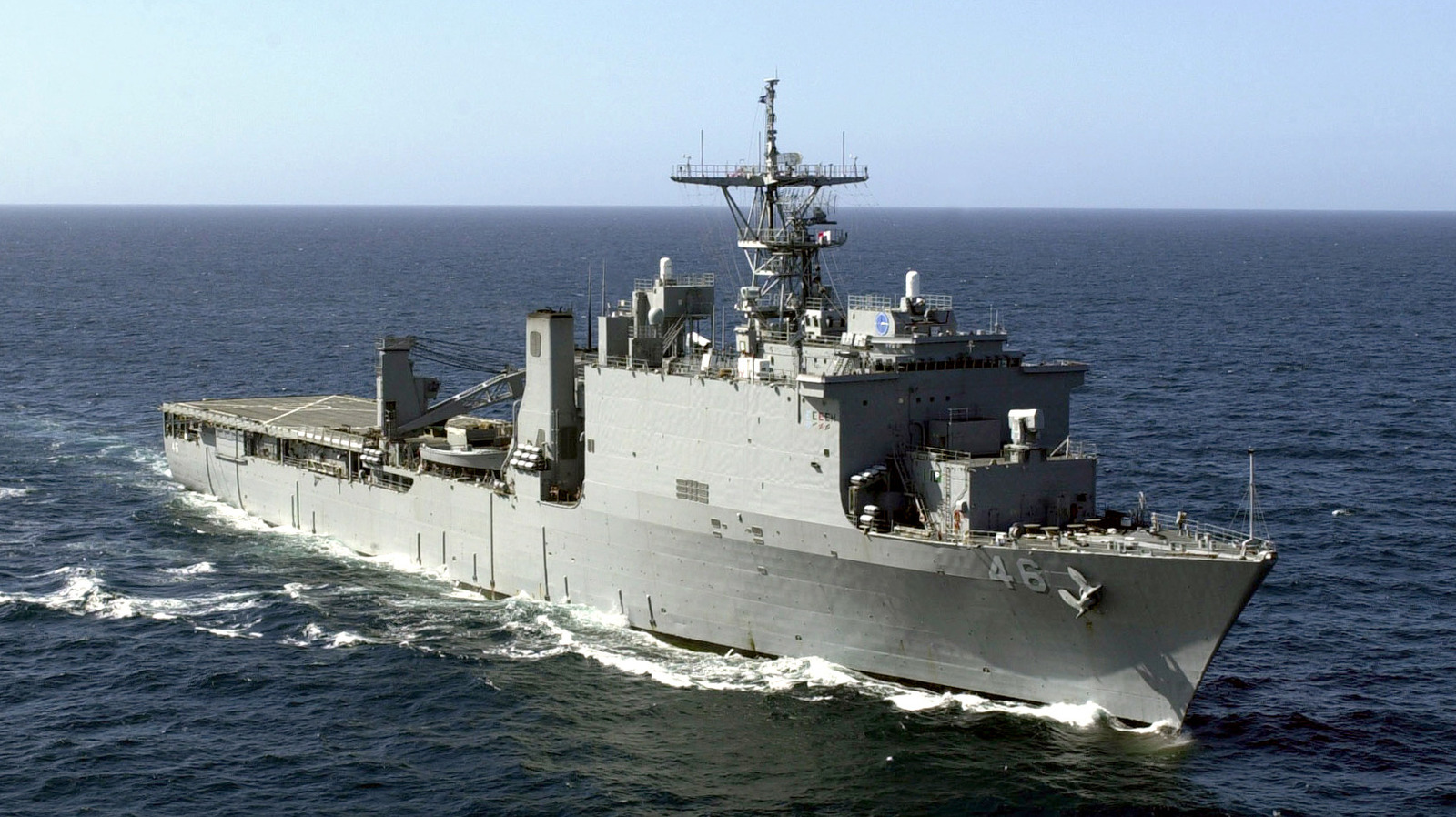

It says something about the complexities of refitting a large warship that the USS Tortuga’s (LSD-46) modernization project took longer than it did to build the ship. However, the good news for the U.S. Navy is that, after being out of action for nearly a decade, the Tortuga is finally back in its natural habitat. While this doesn’t mark a return to service, the ship is now undertaking sea trials, bringing it one step closer to operational readiness after years in maintenance.
As part of the Whidbey Island class, the Tortuga is designed to carry and deploy landing craft and marines in amphibious assault operations. More specifically, the ship is designed to launch the Navy’s Landing Craft Air Cushion (LCAC) amphibious craft. These are among the most complex craft to serve in the U.S. Navy and can deploy payloads of up to 75 tons at high speeds. As well as marines and their equipment, the capability to handle such payloads enables the Tortuga to carry one of the best tanks ever made, the M1 Abrams. All in all, Whidbey Island-class ships like the USS Tortuga can carry and deploy four LCACs.
While they might not have the glamor and prestige of the Navy’s nuclear-powered super carriers, ships like the Tortuga are still an essential part of the U.S. Navy’s strategy. With a primary mission of amphibious warfare, these ships can also fulfill a variety of other roles, such as fleet-support operations, electronic warfare, and non-combatant operations. Let’s take a closer look at the USS Tortuga and it’s 10-year refit.
Delays in maintenance events on U.S. warships are common
Considering it only took six years to get this ship commissioned after it was awarded its initial building contract in 1984, one might question why this ship’s refit took a whole 10 years. Originally, the main contractor — BAE Systems — expected the work to be completed and the ship returned to service by May 2019. There is no single reason for the delay, but there were some unexpected repair needs that occurred during the refit.
Overhauls for conventional surface warships — including amphibious ships like the USS Tortuga — routinely take longer than planned. In a 2025 report by the Congressional Budget Office that analyzed over 300 recent maintenance events for U.S. warships, the agency found that repairs often took between 30% and 60% longer than planned for large conventional combat ships. It’s not a new problem either; a US Government Accountability Office (GAO) study published in 2019 highlighted the continuing issues with maintenance delays that the Navy faces. The study found that from 2014 to 2019, Navy ships spent 33,700 more days in maintenance than predicted.
The USS Tortuga underwent maintenance to extend its lifespan
Although the full details of the overhaul remain limited, the work carried out on the Tortuga appears to have focused on extending the ship’s operational life. Contracts awarded during the refit, including a $139 million modernization package from BAE Systems, indicate the ship underwent a combination of structural repairs, system updates, and general refurbishment designed to keep the vessel viable for years to come.
This matters because ships like the Tortuga are still critically important to the U.S. Navy. More specifically, these ships are central to the U.S. Navy’s Marine operations. Built around a floodable well deck, dock landing ships are designed to deploy LCACs, vehicles, and marines without relying on established port infrastructure. This offers plenty of flexibility in both combat and humanitarian situations.
Despite this importance, the Navy is struggling to ensure that enough of these ships are available to meet its deployment and training needs. This is highlighted in another GAO report, which concluded that over 50% of the Navy’s amphibious fleet was in a substandard condition as of March 2024. This included Dock Landing Ships (abbreviated to LSD) like the Tortuga. As such, the (hopefully) imminent return of the USS Tortuga should be welcome. The current sea trials are designed to confirm that the upgrades work as expected and the ship meets the necessary standards. Once these are completed, the Navy can welcome one of its own back into the fold.

Comments are closed.