
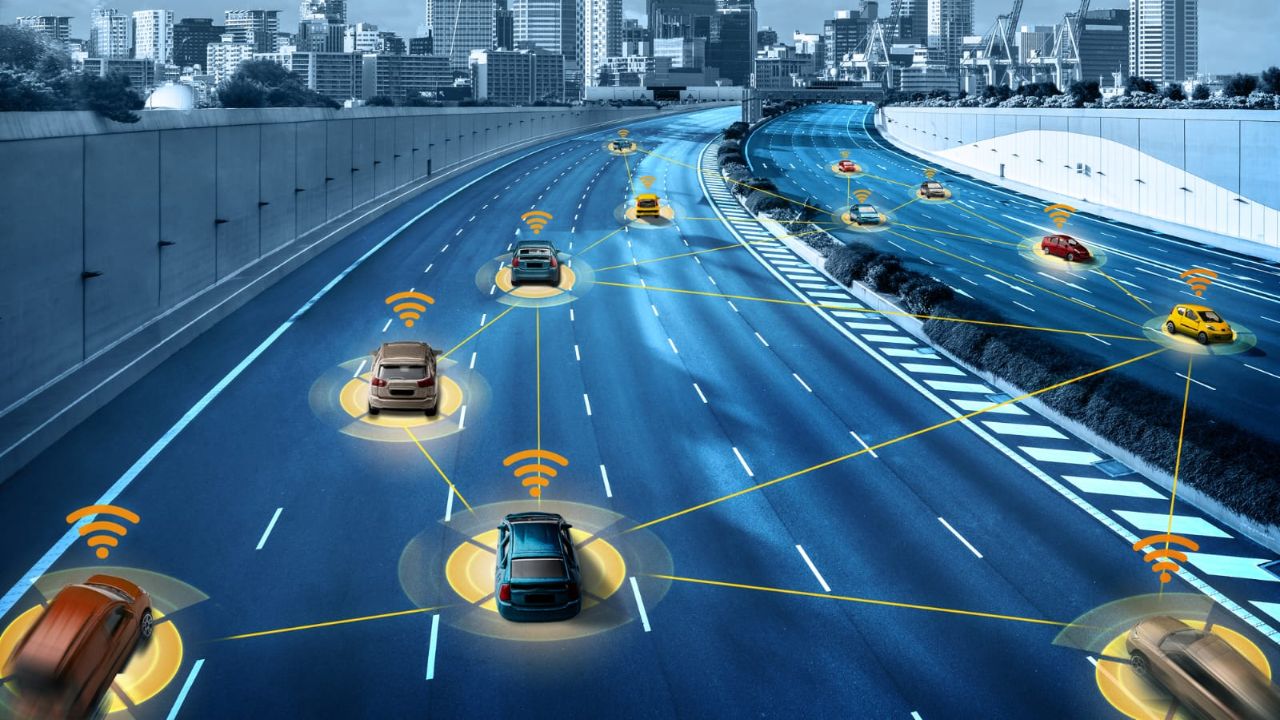
Cars will talk to each other on the expressway, V2X technology will be launched for the first time in India to prevent road accidents.

V2X Technology India: The faster the express highways are expanding in the country, the faster the accidents are also increasing. India has the highest number of deaths in road accidents worldwide. To prevent deaths in these road accidents, the central government is planning to launch a safety technology called Vehicle-to-Everything (V2X). Under this, the vehicles running on the highway will remain in touch with each other through wireless technology.
Pilot project on Delhi-Mumbai Expressway
It has been told that the vehicle-to-everything technology will be launched under a pilot project on the country’s longest highway which is being built from Delhi to Mumbai. The trial will begin in December 2026 with the world’s longest 6G sensor network. Under the plan, lakhs of sensors will be laid under and along the Delhi-Mumbai Expressway, which will enable speeding cars to identify red lights, signboards, pedestrians, vehicles etc.
According to official sources, an agreement has been reached between the Ministry of Road Transport and Highways and the Ministry of Telecommunications. The world’s first largest highway trial of 6G sensor network will be conducted between Vadodara and Mumbai on the third phase of Delhi-Mumbai Expressway.
V2V will be effective
It is a sub-category of Vehicle-to-Everything (V2X) under Intelligent Transport Systems. Vehicle-to-Vehicle Communication (V2V) is also a wireless technology that will help vehicles communicate or talk to each other so that real-time information about speed, location, acceleration, braking, etc. can be shared.
This system is similar to the technology in the aviation sector, where aircraft broadcast their position, speed, altitude and nearby aircraft and ground stations receive it. This system is strong in the aviation sector worldwide. The road sector is still developing and V2V is working in some countries.
How will this work?
According to officials of the Ministry of Road Transport and Highways, Government of India, for the V2V system, an On Board Unit (OBU) will be installed in the cars so that nearby vehicles can share information with each other wirelessly. It will alert the driver about black spots, obstructions, vehicles parked on the roadside, fog or any potential danger.
Also read:- Maharashtra e-Governance Index 2026: Navi Mumbai raised the flag of success, overtook Pune to become the number 1 digital city.
The V2V system has a range of 300 meters and can detect vehicles in this range. For example, if a car brakes suddenly, nearby vehicles will get an alert to slow down before they can see it. This will help in reducing accidents. These on-board units will have to be installed in new vehicles. After that, it will be installed in old vehicles also. The government aims to start it this year.
V2V is being used in these countries?
Apart from America, V2V technology under V2X has been started in Germany, France, United Kingdom and China. China has also become a major country to adopt V2V. Japan has launched the ITS Connect program which is part of its smart vehicle initiative. It provides drivers with real-time traffic signal data, blind spot warning and emergency vehicle alerts under the V2V system. Like India, countries like UAE, Saudi Arabia, Brazil, Mexico are also planning to launch V2V communication system.

Comments are closed.