
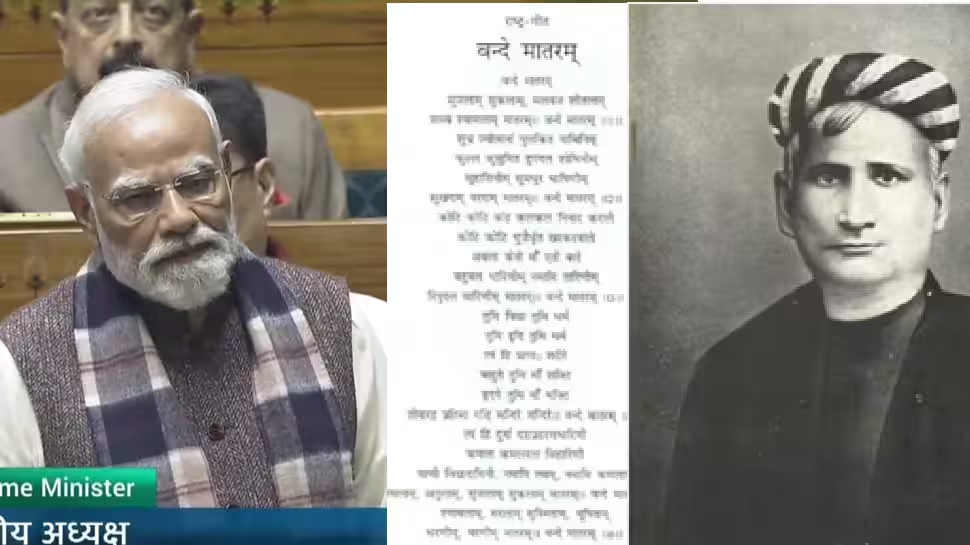

As India marks 150 years of “Vande Mataram” in 2025, the historic national song continues to echo the spirit of unity, sacrifice and patriotism that shaped the country’s struggle for freedom. More than just a composition, Vande Mataram became the emotional heartbeat of a nation rising against colonial rule, inspiring generations with its call to honor the motherland. Speaking in the Lok Sabha, Prime Minister Narendra Modi alleged that former Prime Minister Pandit Jawahar Lal Nehru and Congress party succumbed to appeasement politics and failed to recognize Vande Mataram as the national anthem.
“It is unfortunate for the country that Congress compromised on Vande Mataram. They bowed to the Muslim League and decided to fragment Vande Mataram,” said PM Modi in Parliament.
Vande Mataram Legacy
Add Zee News as a Preferred Source
Composed by Bankim Chandra Chatterjee, the song was not merely a literary achievement but a revolutionary force that transformed political consciousness. From secret meetings of freedom fighters to mass public movements, the song evolved into a symbol of resistance, identity and national awakening. Its journey across decades reflects how culture and patriotism merged to create a powerful voice for independence.
Year-wise Timeline of Vande Mataram
1875: Vande Mataram is believed to have been composed by Bankim Chandra Chatterjee on 7 November 1875, coinciding with the auspicious occasion of Akshaya Navami.
1882: The song appeared in serialized form in the literary journal Bangadarshan as part of Bankim Chandra’s iconic novel Anandamath.
Later that year, it was published in book form. The novel was set against the backdrop of the Sannyasi Rebellion, giving the song a strong revolutionary tone. The song was written in Sanskrit.
1896: Rabindranath Tagore sang Vande Mataram publicly for the first time at the Kolkata session of the Indian National Congress.
1905: The song became a central anthem during the Swadeshi Movement and the mass protests against the Partition of Bengal.
1906: A massive protest meeting was held at Calcutta Town Hall, where thousands reportedly sang Vande Mataram together. British authorities later attempted to suppress the song, and singing it was discouraged or penalized in several areas.
1909–1917: Objections began when critics argued that some verses of the song portrayed Bharat Mata as a Hindu goddess, making it allegedly difficult for Muslims and people of other faiths to sing.
1937: After internal debates, the Indian National Congress decided that only the first two verses of Vande Mataram—which are more secular in nature—would be officially endorsed.
1948 (9 November): Peaceful processions using the slogan Vande Mataram were attacked by the Nizam’s police during the Hyderabad-Karnataka freedom struggle.
1948 (28 November): Large-scale protests across the Hyderabad-Karnataka region adopted Vande Mataram as a unifying slogan. The movement was presented before Sardar Vallabhbhai Patel, who praised the unity of the protesters and assured stronger administrative reforms.
1948 – Hyderabad-Karnataka Movement. The Vande Mataram Movement in Gulbarga emerged as a powerful chapter of resistance against Nizam’s rule. Leaders such as Dr. Sharanabasappa, Dargah Qadeer, and students of Gulbarga University played key roles. The slogan became a symbol of cultural and political resistance.
1950 (24 January): Rajendra Prasad, as President of the Constituent Assembly, formally declared that Vande Mataram would be given equal honor with the National Anthem Jana Gana Mana.
2025 (1 October): The Union Cabinet approved nationwide celebrations to commemorate 150 years of Vande Mataram.

Comments are closed.