
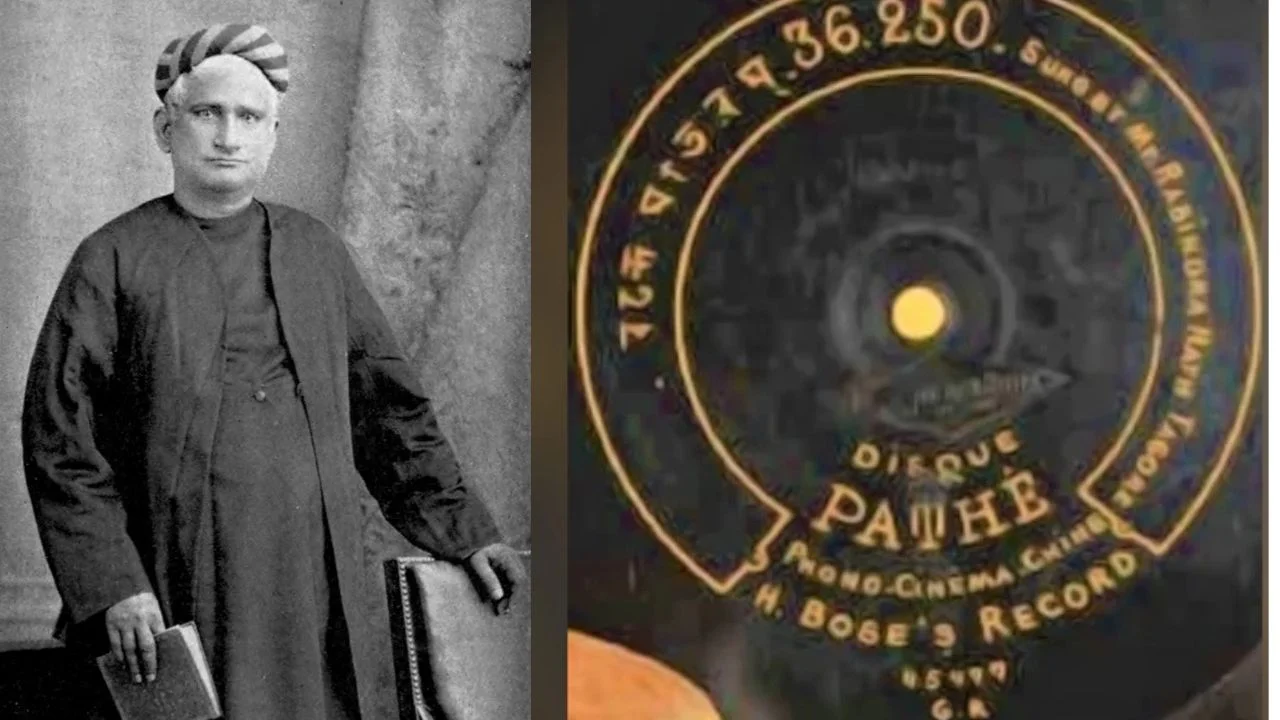
Vande Mataram: The journey of the national song composed by Bankim Chandra in Anandmath… from Rabindranath Tagore to AR Rahman

beginning of vande matar song
Song ‘Anandmath’ It was limited to the novel itself, until Rabindranath Tagore sang it at the Baden Square session of the Indian National Congress in 1896. After this it became a tradition and even today it is used to mark the beginning of Congress sessions, Lok Sabha and Assembly sessions. ‘Vande Mataram’ It is from the recitation of the first Antara.
In 1905, a huge crowd gathered in the Town Hall of Kolkata to protest against the partition of Bengal and someone in the crowd raised the slogan “Vande Mataram”. This slogan became extremely popular overnight. It crossed the borders of Bengal and spread like wildfire throughout the country. Soon the British government banned this song and the slogan “Vande Mataram”.
First recording of Vande Mataram
Seeing the popularity of this song, H. Bose Records and Nicol Record Company recorded it for Rabindranath Tagore, Babu Surendranath Banerjee, Satya Bhushan Gupta, R.N. Recorded in the voices of Bose etc. Hemendra Mohan Bose released it commercially in 1907 on H. Bose Records. The police destroyed the factory and records. Yet some copies survived in Belgium and Paris (where these records were pressed). Thus today we can hear “Vande Mataram” in the voice of Rabindranath Tagore. He has sung it in a very high, sharp, somewhat nasal tone and in a very slow tempo. This is the oldest recording available on gramophone records. This book is now on CD ‘Rabindranath Tagore – Facets of a Genius’ Published by All India Radio, New Delhi in 1999.
pre-independence period
Due to the ban, this song became even more popular and became a source of inspiration. “Vande Mataram” attained the status of ‘Vedic mantra’ and became the slogan of the revolutionaries. Pandit Vishnu Digambar Paluskar sang it in Raaga Kafi at Congress sessions for many years. After his death in 1931, Pt. Omkarnath Thakur started singing it in the raga he called ‘Bangiya Kaafi’. Paluskar did not make any gramophone record, but commercial recordings of Omkarnath Thakur are available in which he has sung it in a very slow rhythm with only the solemn sound of the tanpure.
Apart from political organizations, many musicians and singers of Bengal and Maharashtra considered it to be the best song expressing devotion towards the motherland. Vishnupant Paganis recorded it in raga Sarang around 1928. Between 1910-12, Mumbai’s bhajan singer Savarlarao sang it in Raga Kalingada, whose rendition was extremely soulful. Keshavrao Bhole made an Odeon record in Raag Deshkar in 1935.
Many artists from Bengal—Desh Das, Satya Bhushan Gupta, Dilip Kumar Rai, Bhavanicharan Das, Hemchandra Sen, Harendranath Dutt—recorded it in different tunes. D. Vasantha and D. Vimala also recorded in South India, which are no longer available. M.S. Subbulakshmi sang it as a duet with Dilip Kumar Rai and also sang the Tamil translation. Geeta Dutt G.M. Sung its duet with Durrani.
Chorus/Orchestral “Vande Mataram”
Several choral and instrumental variations were recorded. On the suggestion of Subhash Chandra Bose, Timir Baran adapted it in marching style in Raga Durga, which was played in the parades of Azad Hind Sena.
Many musicians believed that this would become the national anthem of independent India. Master Krishnarao Fulambrikar and V.D. Ambhakar composed special tunes for it. The original records were presented before the Constitution Committee. However Pandit Nehru rejected these efforts.
In the meeting of the Constitution Committee on 24 January 1950, President Dr. Rajendra Prasad announced that “Jana Gana Mana” would be the national anthem of India and “Vande Mataram” would be given the same status as the national anthem. With this all these efforts ended and these records became cultural heritage.
post-independence era
This song was released in 1947 film ‘Immortal Hope’ Joined. 1951 film ‘Agitation’ and the film in 1952 ‘Anandmath’ It became very popular in. Many versions of it appeared in various films and records.
Special records were prepared for about 800 stations of All India Radio. It is believed that its tune was composed by Ravi Shankar. Every morning the radio stations broadcast “Vande Mataram”. It is also sung in the opening sessions of Parliament and Legislative Assemblies. Citizens are expected to stand at attention in respect.
Golden Jubilee and “Vande Mataram”
On the Golden Jubilee of Independence in 1997, A.R. rahman’s album “Vande Mataram – Salute to you mother” Released. It became extremely popular, but there were controversies regarding its presentation and treatment of the national flag.
It was organized at India Gate at midnight on 14 August 1997. At the same time, a special session of Parliament was going on, where Pt. Bhimsen Joshi presented it in classical style. Next year Pt. Jasraj also sang it. Applause by MPs raises questions about how much respect we give to our national anthem.
Even today, the debate continues on whether “Vande Mataram” should get the full status of the national anthem or not, and some fundamentalists also want to make it the anthem of the “Hindu Nation”.
Courtesy of the article written by Suresh Chandvankar, Editor of ‘The Society of Indian Record Collectors’ on 125 years of Vande Mataram song.
The post Vande Mataram: The journey of the national song written by Bankimchandra in Anandmath…from Rabindranath Tagore to AR Rahman appeared first on NewsUpdate-Latest & Live News in Hindi.

Comments are closed.