

Jamnagar: Vantara, the global wildlife conservation organization founded by Reliance Industries Executive Director Anant Ambani, has announced the launch of Vantara University in Jamnagar, Gujarat. It will be the world’s first integrated global university dedicated to wildlife conservation and veterinary science.
Read:- New oil refinery will open in US after 50 years, India’s Reliance Industries will invest
The foundation of Vantara University is based on animal welfare, scientific progress and wildlife conservation. The aim of this institute is to prepare future leaders in the fields of veterinary medicine, conservation and wildlife care. Its curriculum will create a purpose-ful and future-oriented model of education using India’s age-old knowledge traditions.
Anant Ambani said that the future of conservation will depend on how we prepare people and institutions to serve creatures with compassion, knowledge and skill. The vision of Vanatara University is inspired by the personal experience I had when I closely observed animals in distress and realized the need for greater capacity to take better care of them. Inspired by the spirit of the ancient Nalanda University and the ideals of ‘Aa No Bhadraah Kratvo Yantu Vishwatha’ i.e., let the best thoughts come to us from all directions, this University wants to prepare a new generation dedicated to the protection of every life.”
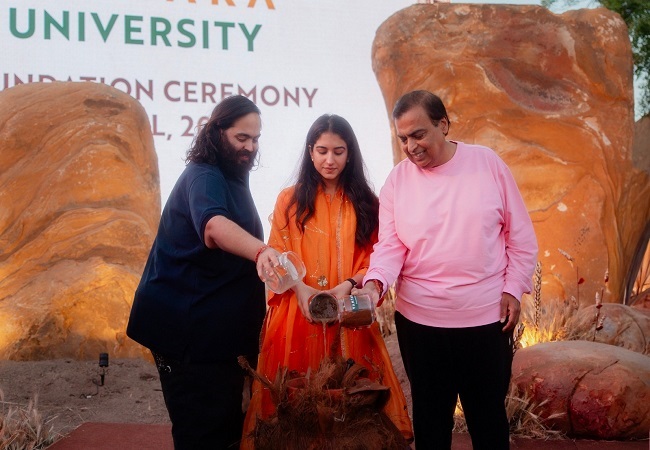
To symbolically represent this idea, two Bijolia sandstones were included in the design of the cornerstone site. These stones have been taken from the ancient Vindhyan geology, which is believed to be related to the geographical structure of the ancient Nalanda University located in present-day Bihar. They symbolize India’s continuing tradition of knowledge and education.
The foundation stone laying ceremony, organized as per Hindu traditions, was attended by representatives of education, science, conservation and public life as well as Anant Ambani’s teachers and mentors. A highlight of the ceremony was the ritual laying of soil, water and stones, which was performed as a symbolic act of laying the foundation stone. These elements were collected from different regions rich in biodiversity across India. These include grasslands, forests, wetlands, dry ecosystems, and other high altitude areas located in the Himalayan, northern, southern, eastern, western and central parts of the country. These elements reflect the natural diversity and heritage of India.
Read :- Vantara: Vantara got clean chit, Supreme Court committee said – rules are being completely followed.
Vantara University will combine different disciplines within a single academic framework, the foundation of which will be based on the experience of actual conservation work. Vantara’s on-the-ground experiences will be translated into academic programmes, professional training and globally useful learning frameworks. Through the integration of compassion, science and conservation, the institute will create professionals who can solve complex challenges related to wildlife and ecology.
The university will offer undergraduate, postgraduate, fellowship and specialized programs in different subjects. These include Wildlife Medicine and Surgery, Nutrition, Behavioral Sciences, Genetics, Epidemiology, One Health, Conservation Policy, and Naturalistic Animal Care Environment Design. Special colleges will also be established according to the functionality of Vantara. Besides, scholarships will also be provided for students from socially and economically deprived backgrounds.
Vanatara University will be supported by advanced academic and clinical infrastructure, international collaboration and a residential campus. It will focus on action-based research to strengthen animal welfare and advance conservation practices. The education model will combine natural habitats (in-situ) and protected environment (ex-situ) conservation, to ensure scientific care and long-term wildlife management.
Recognizing that the future of conservation will be decided not only in the forests, but also in classrooms, laboratories, and human consciousness, the university aims to advance wildlife veterinary medicine and conservation education. It will also become a long-term platform for development of knowledge resources related to wildlife health, animal care environment and conservation.
Comments are closed.