
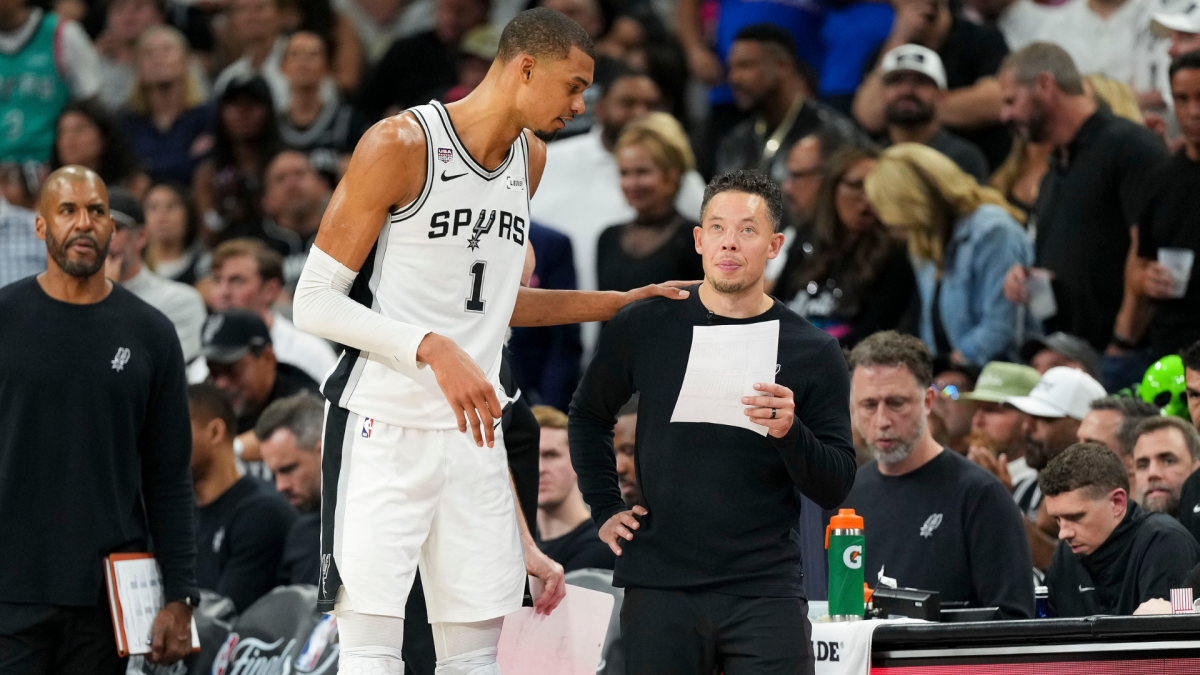
Victor Wembanyama’s turnover cost the Spurs Game 2, but why did his coach put him in position to commit it?

A little more than one month ago, Mitch Johnson made the most consequential, in-game decision of his young coaching career to date. Leading by two with around 10 seconds left on the clock, Julius Randle missed a mid-range jumper that could have sealed Game 1 of the second-round series between the Minnesota Timberwolves and San Antonio Spurs in Minnesota’s favor. With a bit more than seven seconds on the clock, Dylan Harper secured the rebound.
Johnson could have called a timeout. He had two. Instead, the Spurs played out the possession. It was frantic. Harper passed the ball to Victor Wembanyama, who quickly passed it back to Harper on the move. Both sides raced down the floor. Harper passed the ball to Julian Champagnie. He got Naz Reid in the air, took a side step, and then fired up a clean 3-pointer for the win. No good. The Spurs lost.
At the end of Game 2 of the NBA Finals between the Spurs and Knicks, Johnson found himself yet again facing the most important strategic decision of his coaching career to date. The circumstances were somewhat similar. His opponent even had the same number of points: 104. This time, however, the Spurs also had 104. The game was tied when Jalen Brunson missed a mid-range jumper with around 16 seconds remaining.
Wembanyama secured the rebound with 13.5 seconds remaining. He took one dribble and passed it off of Stephon Castle’s back. Brunson secured the ball, got fouled, and made what ultimately turned into the game-winning free throw.
It’s not an exaggeration to call this one of the most consequential turnovers in NBA Finals history, up there with Gerald Henderson’s steal from James Worthy in 1984, Michael Jordan’s steal from Karl Malone in 1998 and Jrue Holiday’s steal from Devin Booker in 2021. In terms of the degree of mistake, it’s probably worse than all of them. Arguably the best player in the NBA, after leading an incredible 12-point fourth-quarter comeback, threw the game and maybe the championship trophy off of his teammate’s back when he wasn’t looking.
The degree to which that mistake will haunt Wembanyama remains to be seen. The odds that it is something like Chris Webber’s ill-fated timeout in the 1994 NCAA Championship Game are thankfully low, but something more akin to, say, the airballs Kobe Bryant fired up against the Utah Jazz in the 1998 playoffs, or the Tragic Johnson series in 1984? That’s more plausible. It’s an unnecessary splotch on what we hope will be an otherwise sterling résumé. So it’s worth asking, should Wembanyama have even been in that situation in the first place?
Go back to the clip. Watch the sideline. Johnson is signaling for the Spurs to go. If he’d wanted to call a timeout after a miss, he could have told his players as much during the timeout the Knicks called to set up Brunson’s shot. Obviously, he did not. The rest, as they say, is history. So this begs an important question… how much blame should Johnson shoulder for his decision not to call a timeout? Let’s weigh the pros and cons of calling one in that situation.
The argument for a timeout
Well, we can start with the obvious: the Spurs were in this situation a month ago. They made this decision and lost the game.
Should they be beholden to their previous mistakes? No, but that doesn’t mean you can’t learn from them either. The Spurs are technically the second-youngest team to ever make the NBA Finals, trailing only the 1977 Portland Trail Blazers. That number doesn’t quite do them justice, since there are so many older players on their bench. Victor Wembanyama is 22. Stephon Castle is 21. This is their first run through the postseason. They are presumably tired.
Young players are more vulnerable to mistakes like this. If you call a timeout, you can take a lot of the chaos out of the equation. You’d certainly face some pressure inbounding the ball, but having Wembanyama, who is so much taller than everyone else on the floor, mitigates that pressure slightly. You don’t have to worry about getting the ball up the court because the timeout would advance it. You’re running a set play in which you can dribble as much or as little time off the clock as you want.
That’s the other component of this. There was so much time on the clock. Wembanyama got the ball back with 13.5 seconds remaining. There was enough time left that even after the turnover and Brunson’s two free throws, the Spurs were able to take a timeout with 7.5 seconds remaining. They ultimately lost on a missed jumper by Wembanyama, but at least they managed to get a shot up.
All of that time posed a bit of a problem for a transition scramble. Say Castle had caught the ball. It hit him in the back with 11.4 seconds remaining. If he races up the floor for a layup, no matter the result, the Knicks could potentially get the ball back with plenty of time of their own to work with. They had a timeout. They could have drawn something up for Brunson, who’s having one of the great clutch postseasons in NBA history (and already tied the game 30 seconds earlier).
Now, that’s a worthwhile tradeoff if the layup is a certainty. But it wasn’t. The only Knick who was fighting with Wembanyama for the rebound was Karl-Anthony Towns. Landry Shamet was around the nail. Mikal Bridges and Jalen Brunson were behind the 3-point line. And, most importantly, OG Anunoby, the scariest Knick defender of them all, had already raced back behind the half-court line to play transition defense.
Sometimes there genuinely is an advantage baked into the chaos of transition. But there was no obvious advantage here. If Castle rushes, the Knicks get a shot, and if Castle’s rush leads to a miss, that might be a game-winning shot. Maybe the Spurs could have used that extra time and the chaos of transition to set something else up, but that’s leaving a lot to chance. They were at home. They had the momentum after stopping Brunson and gutting through that comeback. Their two most plausible outcomes with a timeout by far were “win” or “overtime.” And they lost in regulation. That alone makes the argument for a timeout.
The argument against a timeout
Well, for starters, just because they lost that game to Minnesota doesn’t mean they got a bad shot. Champagnie took an open 3 for the win. Had they called timeout in that situation, they almost certainly would have drawn something up to create what would have been a contested shot for the tie. The math probably favored Johnson in that situation. He may have thought it did so in this one too, though the difference in score between the two games changes the equation.
There are two very strong arguments against a timeout, though, and the first is personnel. When Brunson tied the game at 104, the Spurs called a timeout. That allowed the Knicks to pull their offensive personnel, Brunson and Towns, off the floor in favor of defensive players, Shamet and Mitchell Robinson. After Wembanyama missed with around 30 seconds remaining, the Knicks called a timeout of their own specifically to get Brunson and Towns back on the floor. That meant that when Wembanyama got that rebound, the Spurs knew there was at least one vulnerable defender on the floor in Brunson and another defender in Towns, who is very prone to fouling.
Had Johnson called a timeout, both of them likely get taken out of the game. When Brunson actually did go to the foul line to give the Knicks the lead, Towns was taken off the floor in favor of Josh Hart, and when Johnson called a timeout after the Spurs gained possession and finally did call a timeout, Robinson came in the game for Brunson.
So instead of the decision coming down to “would we rather draw something up or try to take advantage of the chaos of transition,” it really came down to “would we rather draw something up against the best defensive personnel of a team with an 87.1 clutch defensive rating this postseason or take advantage of the chaos of transition while their two most desirable defenders to attack are on the floor?” Johnson went with the latter.
What the Spurs ultimately did was increase their chances of either winning or losing the game in regulation and decrease the odds of overtime, and there’s a reasonable argument for that line of thinking, too. Wembanyama led the game with 40 minutes, and if he was tired at the end of regulation, how much worse would it have gotten in overtime? Think of Kevin Durant’s infamous “toe on the line” shot against Milwaukee in 2021. Part of the reason he tried to end the game with a 3-pointer was because he had just spent three games trying to lead the Nets essentially singlehandedly. He was out of gas and had nothing left for overtime. Sure enough, he didn’t score in the extra period, and the Nets lost.
Take the 10,000-foot view here. The Knicks have breezed through this postseason. The Spurs are coming off of a seven-game war with the Thunder. They’re dealing with multiple injuries. It’s entirely possible that Johnson knew his team didn’t have the legs for five more minutes and decided that playing for the regulation win above all else was the proper decision.
The verdict
I don’t think it’s a slam dunk in either direction. The decision Johnson made was reasonable. But, even if I’m admittedly using the benefit of hindsight here, I think it was the wrong one.
Had the Spurs been trailing by two, as they were against Minnesota, I would have supported the decision to play out the final possession. There’s just a lot more room for chaos in that situation than there is in a tie game. The defense has to think about the difference between a game-winning 3 and a game-tying 2, as Wembanyama notably did when he stayed home on Chet Holmgren behind the arc as Shai Gilgeous-Alexander tied Game 1 of the Western Conference Finals at the end of regulation. When you force a defense to think, you’re more likely to force a defense to make a mistake.
But the Knicks weren’t in a position to make a mistake even with less than ideal players on the court. Towns is having the best defensive season of his career. Brunson’s size-based limitations are less pronounced in a scramble than they are when he can be hunted strategically one-on-one. They were set up well to defend in transition, and they didn’t have to think about what sort of shot they could and couldn’t allow. In that scenario, chaos probably favored them, because chaos opened the door for that turnover. With a timeout, the odds of a turnover fall, and the Knicks are probably defending a single, half-court possession just hoping for overtime.
At the end of the day, it comes down to whether or not you view overtime as an acceptable worst-case outcome. I would have. The Spurs took the higher-risk, higher-reward approach, and ultimately, they turned out to be worse off for it.
Comments are closed.